All species › Passerines › Buntings › Cinnamon-Breasted Bunting
Cinnamon-Breasted Bunting | Emberiza tahapisi
Zevenstrepengors | Escribano Canelo
The Cinnamon-Breasted Bunting is a small, dark bunting of stony slopes and bare ground in woodland. The male has a black head with seven white stripes, which gives the species its Dutch name, and a warm cinnamon body. It breeds late in the rains and is most conspicuous when singing from a boulder.

Voice
The song is a short, fast, rattling phrase, chip-cheerie-cheerie or trrp-tree-tree-tree, repeated dozens of times in succession from a rock or low branch. The call is a soft, nasal pee-wee or a thin tseet.
Recording: bert de bruin — CC BY-NC-SA 4.0 · converted to mono · xeno-canto
Identification
14–15 cm, with a dark upper mandible and a yellowish to pinkish-horn lower mandible. The male has a black head and throat with seven white stripes: a narrow white median crown stripe and, on each side, a white supercilium and a white stripe below the eye. The mantle and back are cinnamon with dark streaks, the wing coverts rufous with dark centres and no white wingbars. Breast, belly and flanks are deep cinnamon, the undertail coverts slightly paler. The female is duller, with a brown rather than black head, pale buffy stripes and a grey-brown streaked throat. Juveniles resemble the female but are duller still.
Confusion species
Cape Bunting (Emberiza capensis) has a white throat, grey underparts and bright chestnut wings. Lark-Like Bunting (Emberiza impetuani) is sandy and lacks a head pattern, and lives in drier, more open country. Golden-Breasted Bunting (Emberiza flaviventris) has yellow underparts and white wingbars. In females, check the cinnamon underparts, the streaked throat and the lack of white wingbars.
Habitat
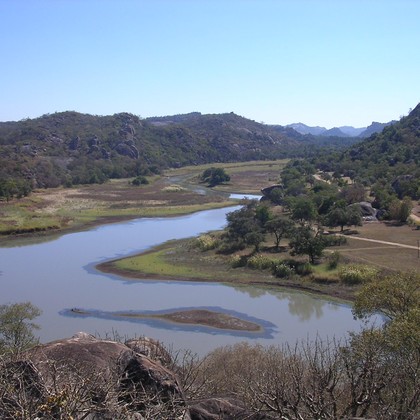
Stony and rocky slopes, koppies and erosion gullies in woodland, as well as bare or burnt ground, road verges and field edges in mopane, mixed broadleaf woodland and miombo. It forages on the ground for grass and herb seeds and drinks regularly. The nest is placed on the ground under a tuft or against a stone.
Where the bird is most at home, classified by the vegetation units of southern Africa.


Range and movements
Widespread in the north and east of the region: northern and eastern South Africa south to the Eastern Cape, Lesotho, Eswatini, Zimbabwe, eastern and northern Botswana, northern and central Namibia, Mozambique, Zambia, Malawi and Angola. Absent from the Western Cape, the western Karoo and the Namib. Beyond the region across much of sub-Saharan Africa and in south-western Arabia.
- Resident
- Summer visitor (c. Oct–Mar)
- Winter visitor (c. Apr–Sep)
- Passage (Mar–Apr, Oct–Nov)
- dark = core range, pale = thinly spread
How and when to look
Best in the late rains, from December to April, when males sing tirelessly from boulders on a hillside. Outside the breeding season they walk inconspicuously over bare ground and along roads; look for them at drinking places too. With a good view of a male, the combination of black throat and cinnamon breast is unmistakable.
Conservation status
Not threatened; common and widespread, with local seasonal shifts that follow the rainfall.
Scientific name
Emberiza tahapisi | Smith, 1836
Smith described the species in 1836 and placed it straight away in the genus where it still stands. The genus Emberiza was introduced in 1758 by Linnaeus. Emberiza comes from Old German Embritz, a name for a bunting. tahapisi derives from the Setswana word 'thagapitse', used for various buntings and finch-like birds. The specimen the first description was based on came from headwaters of the Vaal River, Mpumalanga, South Africa.