All species › Passerines › Waxbills › Red-Headed Finch
Red-Headed Finch | Amadina erythrocephala
Roodkopamadine | Estrilda Cabecirroja
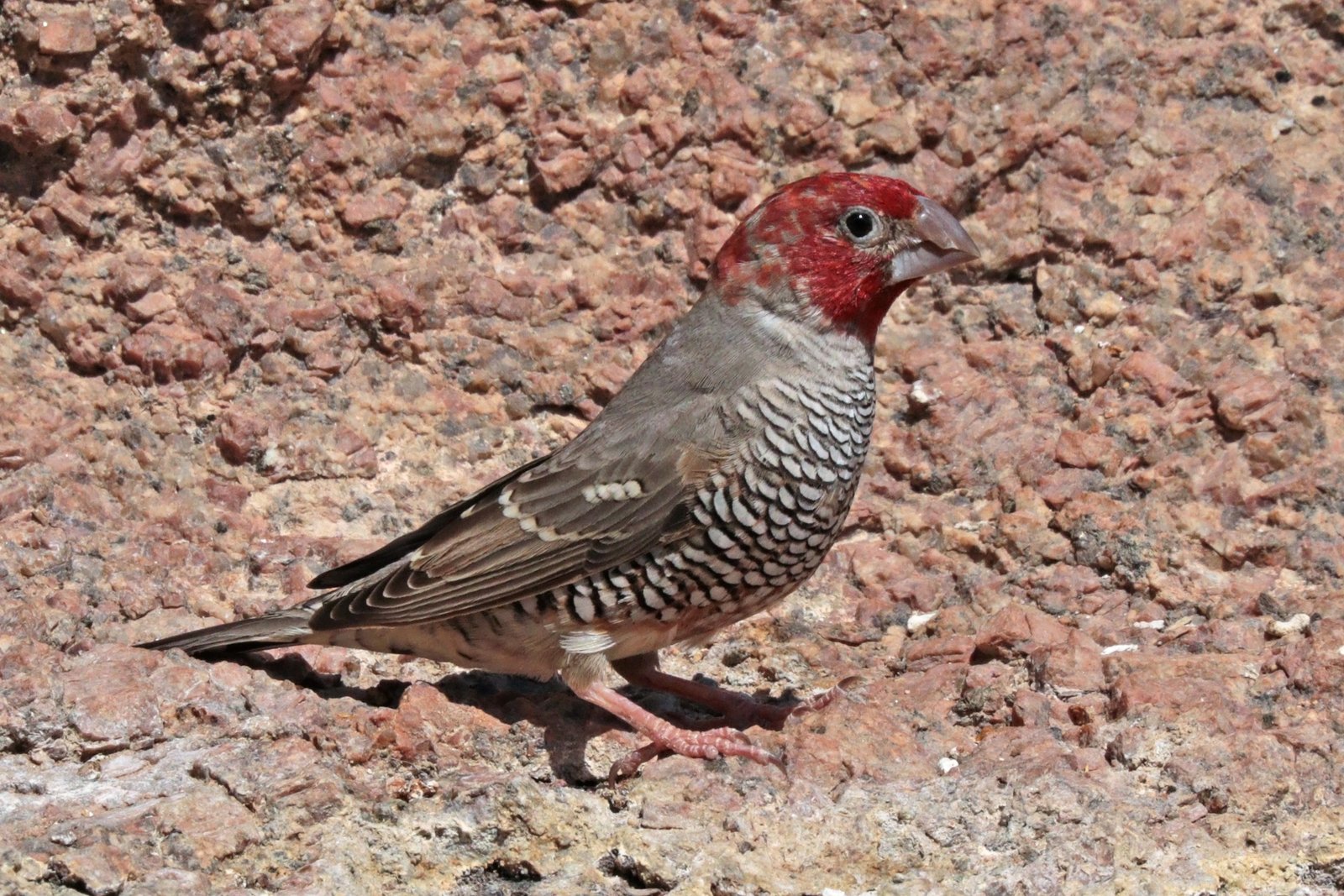
The Red-Headed Finch is a large, stocky estrildid of the arid west, which turns up in flocks at waterholes and breeds in old weaver nests, above all in the chambers of Sociable Weaver colonies. The male stands out with its dull red head above a scaly breast.
Click a thumbnail to switch the photo above.
Voice
A soft, somewhat nasal chuk or chek, especially when flocks take off. The male's song is a quiet buzzing and twittering babble with rasping and clicking notes, delivered with the head feathers raised.
Recording: Campbell Fleming — CC BY-NC-SA 4.0 · converted to mono · xeno-canto
Identification
13–14 cm, large for an estrildid, with a heavy, pale horn to pinkish-grey conical bill. The male has a dull red head down to the throat; mantle and wings are grey-brown, the wing coverts with small pale spots. Breast and flanks are scaled: white spots edged black on a grey-brown to cinnamon ground; the belly is paler. The female lacks the red and has a plain grey-brown head, but shares the scaly underparts, less boldly marked. Juveniles are duller with a dark bill; young males soon show a reddish wash on the head.
Confusion species
The male Cut-Throat Finch (Amadina fasciata) has only a narrow red band across the throat, not a wholly red head, and is smaller, with finely barred plumage and a chestnut belly patch. In females the differences are smaller: the female Red-Headed Finch is larger and greyer, has a plain head and is scaled only on the breast and flanks, not finely barred all over. The female House Sparrow (Passer domesticus) lacks the scaly breast and has a pale supercilium. The Scaly-Feathered Weaver (Sporopipes squamifrons) is smaller, with a pink bill, a black malar stripe and a scaled forehead.
Habitat
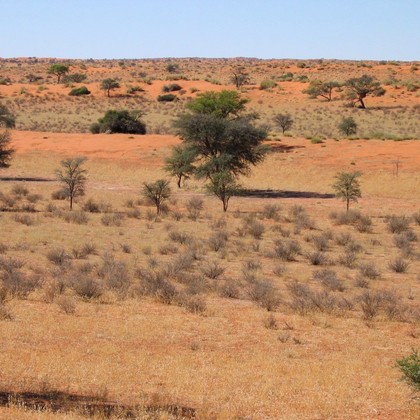
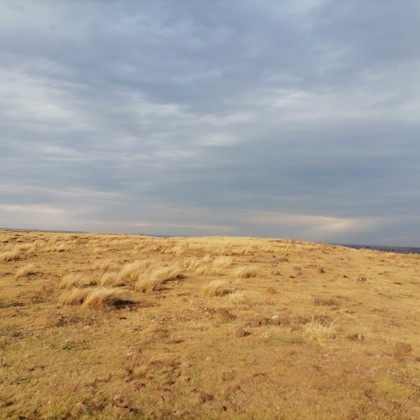
Dry savanna, Kalahari thornveld, Nama Karoo and dry grassland, also at the edges of farmland and around farmsteads. Dependent on drinking water: flocks come to dams and stock troughs in the heat of the day. It feeds mainly on grass seeds on the ground. It breeds in old nests of other birds, above all Sociable Weavers, White-Browed Sparrow-Weavers and other weavers, sometimes in holes; it rarely builds a nest of its own.
Where the bird is most at home, classified by the vegetation units of southern Africa.

Range and movements
Common in Namibia (not in the bare Namib), Botswana (mainly the centre and south) and western and central South Africa, from the Northern Cape and the interior of the Western and Eastern Cape to the Free State, Gauteng, North West and western Limpopo; also in Lesotho. Further in south-western Angola and marginally in south-western Zimbabwe. Nomadic: in dry years flocks wander far beyond the usual range. Not found outside the region.
- Resident
- Summer visitor (c. Oct–Mar)
- Winter visitor (c. Apr–Sep)
- Passage (Mar–Apr, Oct–Nov)
- dark = core range, pale = thinly spread
How and when to look
Wait at a dam or trough in the Kgalagadi Transfrontier Park, in Etosha or on farms in the Karoo and the Free State: around midday flocks of dozens, in winter sometimes hundreds, come to drink together. Also check Sociable Weaver nests, where pairs breed in the chambers. The males' red heads make a flock recognisable even in flight; females are less conspicuous among sparrows.
Conservation status
Not threatened. Common and locally abundant; it has benefited from the construction of dams and stock watering points, which allowed it to spread east and south. Trapped on a small scale for the cage-bird trade.
Scientific name
Amadina erythrocephala | (Linnaeus, 1758)
Linnaeus described the species in 1758 as Loxia eryocephala; because it was later moved to another genus, the author and year stand in brackets. The genus Amadina was introduced in 1827 by Swainson. Amadina is a corrupted diminutive of Ammodramus, a genus of American sparrows; Swainson saw the Cut-throat Finch as a link between that genus and Estrilda. erythrocephala comes from the Greek eruthros, 'red', and kephalē, 'head' — for the male's red head. The specimen the first description was based on came from Angola.