All species › Passerines › Buntings › Lark-Like Bunting
Lark-Like Bunting | Emberiza impetuani
Leeuwerikgors | Escribano Alaudino
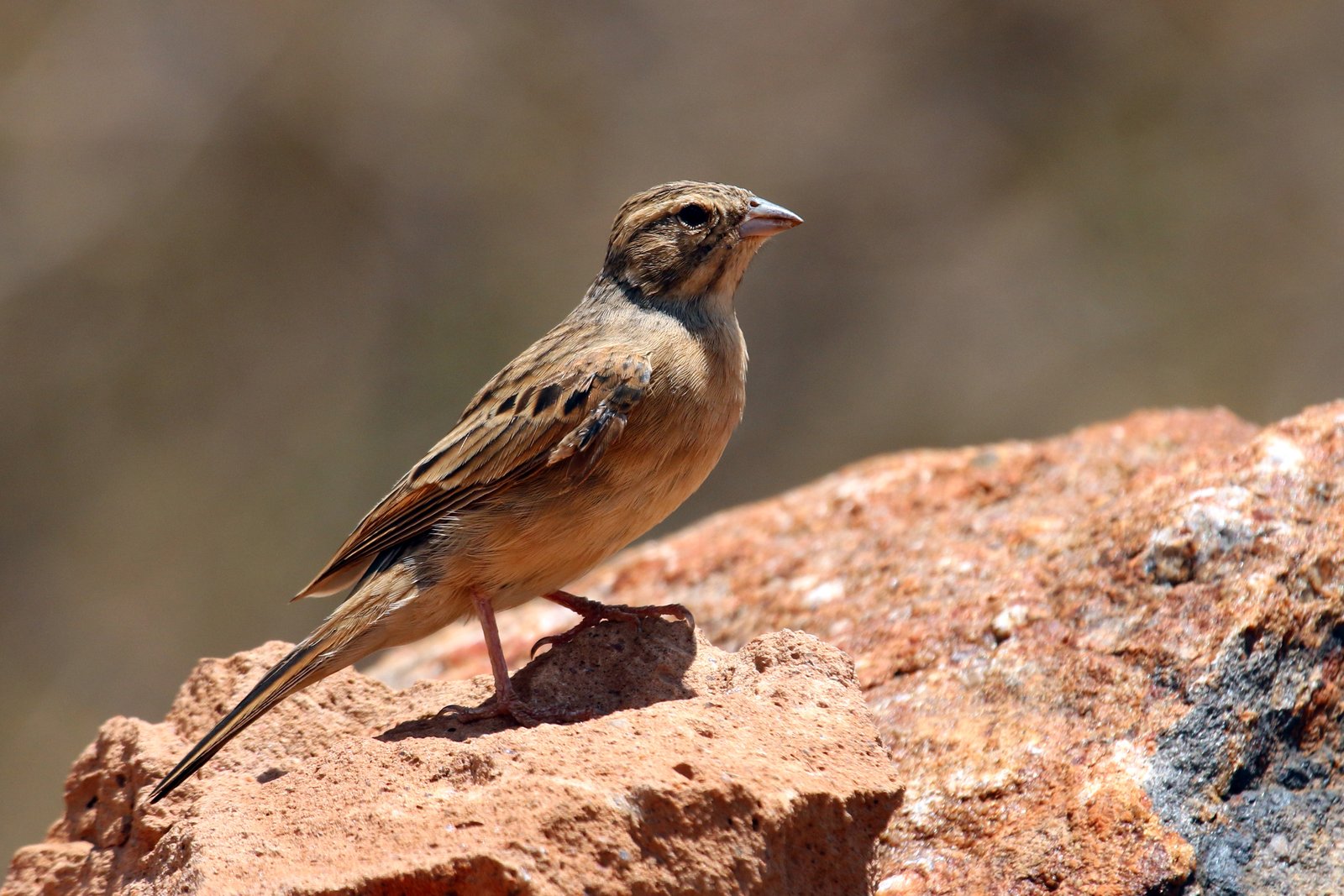
The Lark-Like Bunting is a small, sandy bunting of the dry western half of the region, so plain that it suggests a lark or a female sparrow rather than a bunting. It is nomadic, moves in flocks in the wake of the rains and in dry years appears at drinking places in swarms of hundreds.
Voice
The call is a short, nasal tuk or chut, often repeated within flocks. The song is a fast, mechanical-sounding series of chirping notes, tip-tip-tip-tipitipi-chee, from a stone or small bush.
Recording: Campbell Fleming — CC BY-NC-SA 4.0 · converted to mono · xeno-canto
Identification
13–14 cm, a small, compact bunting with a short, pinkish-horn conical bill. The plumage is plain sandy-brown to greyish-brown with faint dark streaks on crown and mantle and a weakly marked face: a pale supercilium and a pale eye-ring, without black-and-white stripes. The flight feathers and greater coverts have warm cinnamon edges, so that the wing stands out rufous against the body. The underparts are pale brownish-grey, slightly warmer on the breast and off-white towards the belly, without streaks. The sexes are alike; juveniles are slightly paler and more lightly streaked.
Confusion species
Female Cape Sparrow (Passer melanurus) is larger and has a grey head with a pale half-circle behind the eye and chestnut shoulders. Sabota Lark (Calendulauda sabota) has a longer, thinner bill, a clear white supercilium and a streaked breast, and walks like a lark rather than hopping. Females and juveniles of Cinnamon-Breasted Bunting (Emberiza tahapisi) are darker and more cinnamon below, with a streaked head and throat. The combination of bunting bill, plain sandy underparts and rufous wing edges is diagnostic.
Habitat
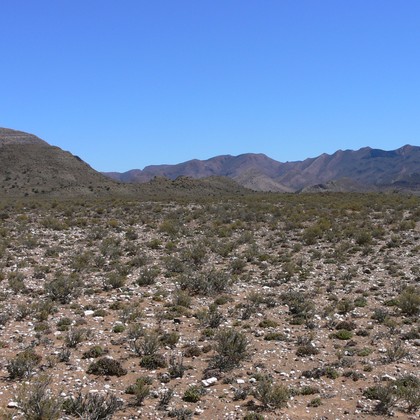
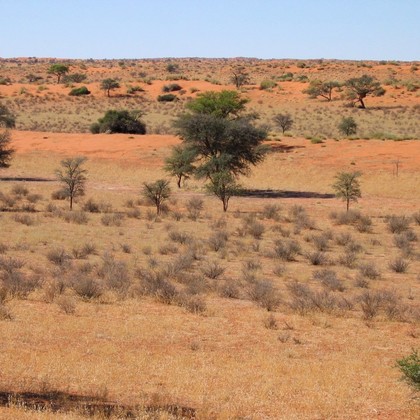
Dry, open landscapes: Nama Karoo and Succulent Karoo, stony plains and slopes with scattered shrubs, the edges of the Namib and dry Kalahari thornveld. It forages on bare ground for small seeds, often in mixed flocks with canaries and sparrows. It depends on water and comes to drink in dense flocks in the morning and afternoon.
Where the bird is most at home, classified by the vegetation units of southern Africa.

Range and movements
Almost endemic to the region: the Karoo and the Northern Cape in South Africa, most of Namibia, south-western and western Botswana and south-western Angola. During irruptions after rain it spreads east to the Free State, Gauteng, North West and south-western Zimbabwe, and exceptionally to Lesotho and Eswatini. It does not occur beyond the region.
- Resident
- Summer visitor (c. Oct–Mar)
- Winter visitor (c. Apr–Sep)
- Passage (Mar–Apr, Oct–Nov)
- dark = core range, pale = thinly spread
How and when to look
Easiest at a waterhole or stock dam in the Karoo or Namibia in the early morning, when flocks of buntings drop in together. Because the species is nomadic, numbers vary greatly between years and districts: after good rains it may suddenly be common where it was absent the year before. With an 'unknown lark', check for the short, thick bill and the rufous wing.
Conservation status
Not threatened; widespread and locally very common, with strongly fluctuating numbers that follow the rainfall.
Scientific name
Emberiza impetuani | Smith, 1836
Smith described the species in 1836 and placed it straight away in the genus where it still stands. The genus Emberiza was introduced in 1758 by Linnaeus. Emberiza comes from Old German Embritz, a name for a bunting. impetuani comes from the Zulu name im'tiyane for various finches and waxbills. Andrew Smith (1836) deliberately adopted native names as specific names. The specimen the first description was based on came from eastern Botswana.