All species › Passerines › Buntings › Cape Bunting
Cape Bunting | Emberiza capensis
Kaapse gors | Escribano del Cabo
The Cape Bunting is the grey bunting of rocky slopes, fynbos and the Karoo: a grey-brown bird with a black-and-white striped head and chestnut wings. In the south-west it is a familiar visitor to campsites, viewpoints and gardens, where it hunts for crumbs among the people.

Voice
The call is a nasal, rising zzoo-zee-zee or cheer-twee, often on take-off. The song is a fast, cheerful series of chirping notes, cheep-chip-chip-cheerio, from a boulder or bush.
Recording: Lynette Rudman — CC BY-NC-SA 4.0 · converted to mono · xeno-canto
Identification
15–16 cm, with a fairly long tail and a dark conical bill with a paler lower mandible. The crown is grey-brown with fine dark streaks. The head has a white supercilium, a black eye-stripe, a white stripe below the eye and a black malar stripe, together forming a striking striped face; the throat is white. The mantle and back are grey-brown with dark streaks. The wing coverts and the edges of the flight feathers are bright chestnut, which is especially obvious in flight. The underparts are plain grey, paler towards the belly and warm grey-brown in some districts, without yellow. The sexes are nearly alike; the female is slightly duller. Juveniles are browner, with a less crisp head pattern and a finely streaked breast.
Confusion species
Cinnamon-Breasted Bunting (Emberiza tahapisi) has a black throat and warm cinnamon underparts, and the male an almost black head with white stripes. Golden-Breasted Bunting (Emberiza flaviventris) and Cabanis's Bunting (Emberiza cabanisi) have yellow underparts. Lark-Like Bunting (Emberiza impetuani) lacks the black-and-white head pattern. A grey bunting with a striped face and chestnut wings is always this species.
Habitat
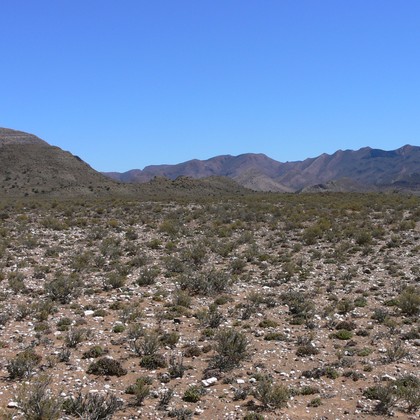
Rocky slopes and koppies, fynbos and renosterveld, Karoo scrub, montane grassland with rocks and coastal dunes with bush; also gardens, farmyards, parks and campsites within these landscapes. It forages on the ground among stones and low shrubs for seeds and insects. The nest is placed low in a bush or among stones.
Where the bird is most at home, classified by the vegetation units of southern Africa.


Range and movements
Common in the west and south of South Africa, from the Western and Northern Cape through the Karoo to the Eastern Cape, the Free State and the highlands of KwaZulu-Natal and Mpumalanga, and throughout Lesotho; also in western and central Namibia and south-western Angola. Local and scarce in rocky hills in south-eastern Botswana, in Eswatini, in Zimbabwe and in the mountains of west-central Mozambique and Malawi. It scarcely occurs beyond the region.
- Resident
- Summer visitor (c. Oct–Mar)
- Winter visitor (c. Apr–Sep)
- Passage (Mar–Apr, Oct–Nov)
- dark = core range, pale = thinly spread
How and when to look
Easiest at viewpoints and picnic sites in the Western Cape and the Karoo, where it is tame and approaches to within a few metres. Elsewhere it perches on boulders on dry slopes and gives itself away with the nasal call. In flight the chestnut wings are the best feature.
Conservation status
Not threatened; common and little at risk within its habitat. It benefits locally from gardens and farmyards.
Scientific name
Emberiza capensis | Linnaeus, 1766
Linnaeus described the species in 1766 and placed it straight away in the genus where it still stands. The genus Emberiza was introduced in 1758 by Linnaeus. Emberiza comes from Old German Embritz, a name for a bunting. capensis means 'of the Cape', after the Cape of Good Hope, where the first specimen came from. The specimen the first description was based on came from Cape of Good Hope.