All species › Passerines › Buntings › Golden-Breasted Bunting
Golden-Breasted Bunting | Emberiza flaviventris
Acaciagors | Escribano Pechidorado
The Golden-Breasted Bunting is the common bunting of southern African woodland: a slim seedeater with a black-and-white striped head, a chestnut back and a golden-yellow breast. It forages unobtrusively on the ground under trees, but in the breeding season the male sings for hours from a branch in the canopy.

Click a thumbnail to switch the photo above.
Voice
The song is a repeated whistled phrase of two or three notes, weechee-weechee-weechee or sweeu-sweeu-sweeu, very variable between individuals and districts. The call is a soft nasal zzhrr or a plaintive tee-too, often given on flushing from the ground.
Recording: Tim Cockcroft — CC BY-NC-SA 4.0 · converted to mono · xeno-canto
Identification
15–16 cm, with a conical bill, the upper mandible dark and the lower pinkish-horn. The head is black with three white stripes on each side: a white median crown stripe, a broad white supercilium and a white stripe below the eye; the throat is yellow. The mantle and back are chestnut with grey fringes, the rump grey. The wing is dark with two clear white wingbars. The underparts are bright yellow, warm orange-yellow on the breast, with white flanks and undertail coverts. The outer tail feathers show white on take-off. The female is duller, with brownish-black rather than black head stripes and a paler orange breast. Juveniles have a brown-striped head with pale yellowish stripes and a finely streaked breast.
Confusion species
Cabanis's Bunting (Emberiza cabanisi) is larger and has wholly black cheeks without a white stripe below the eye, a grey rather than chestnut mantle, weaker wingbars and a less orange breast; it lives mainly in miombo in the north and east of the region. Cape Bunting (Emberiza capensis) has a similarly striped head but grey underparts without yellow and chestnut wing coverts. Cinnamon-Breasted Bunting (Emberiza tahapisi) has cinnamon underparts and a black throat. A yellow-and-chestnut bunting with three white head stripes on each side and an orange breast in woodland is almost always this species.
Habitat
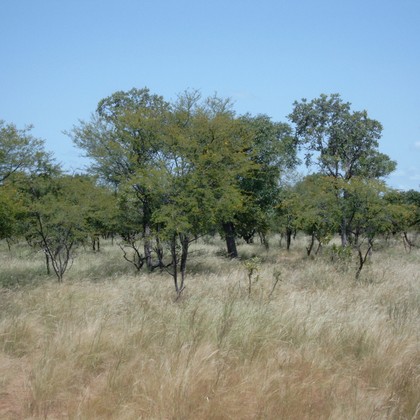
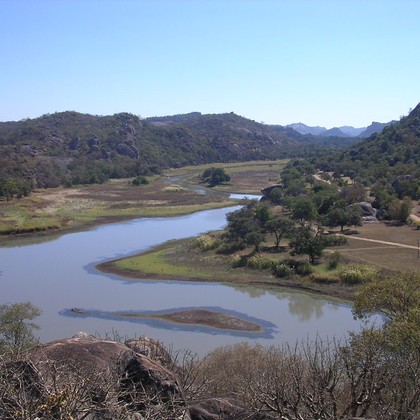
Dry and moist savanna and woodland of many kinds: acacia bushveld, mixed broadleaf woodland, mopane and the edges of miombo, as well as plantations, parks and large wooded gardens. It takes seeds and insects on bare or sparsely vegetated ground under trees and flies to a low branch when disturbed. The cup nest is placed low in a bush or sapling.
Where the bird is most at home, classified by the vegetation units of southern Africa.

Range and movements
Widespread in the north and east of South Africa, in Eswatini, Zimbabwe, Botswana except the driest south-west, central and northern Namibia, Mozambique, Zambia, Malawi and southern Angola; rare in Lesotho and absent from fynbos and the western Karoo. Beyond the region it extends north through East Africa to the Horn of Africa.
- Resident
- Summer visitor (c. Oct–Mar)
- Winter visitor (c. Apr–Sep)
- Passage (Mar–Apr, Oct–Nov)
- dark = core range, pale = thinly spread
How and when to look
All year in woodland, most often recorded in the breeding season from September to March, when males sing from an exposed branch. Outside the breeding season it walks inconspicuously on the ground and is often only noticed when it flushes and shows the white tail sides. When in doubt, count the white head stripes: the white stripe below the eye and the chestnut mantle rule out Cabanis's Bunting.
Conservation status
Not threatened; common and widespread. It benefits locally from gardens and planted trees, but disappears where woodland is wholly converted to cropland.
Scientific name
Emberiza flaviventris | Stephens, 1815
Stephens described the species in 1815 and placed it straight away in the genus where it still stands. The genus Emberiza was introduced in 1758 by Linnaeus. Emberiza comes from Old German Embritz, a name for a bunting. flaviventris comes from the Latin flavus, 'yellow', and venter, 'belly' — for the yellow underparts. The specimen the first description was based on came from Cape of Good Hope.