All species › Passerines › Wagtails and pipits › Citrine Wagtail
Citrine Wagtail | Motacilla citreola
Citroenkwikstaart | Lavandera Cetrina
The Citrine Wagtail breeds from eastern Europe to Central Asia and winters mainly in South Asia. In southern Africa it is an extremely rare vagrant with a handful of documented records, mostly at sewage ponds and freshwater margins.
Voice
A harsh, rasping tsrreep, harder and drier than the thin call of Western Yellow Wagtail; useful for picking out a bird among yellow wagtails or in flight.
Recording: Daan van der Hoeven — CC BY-NC-SA 4.0 · converted to mono · xeno-canto
Identification
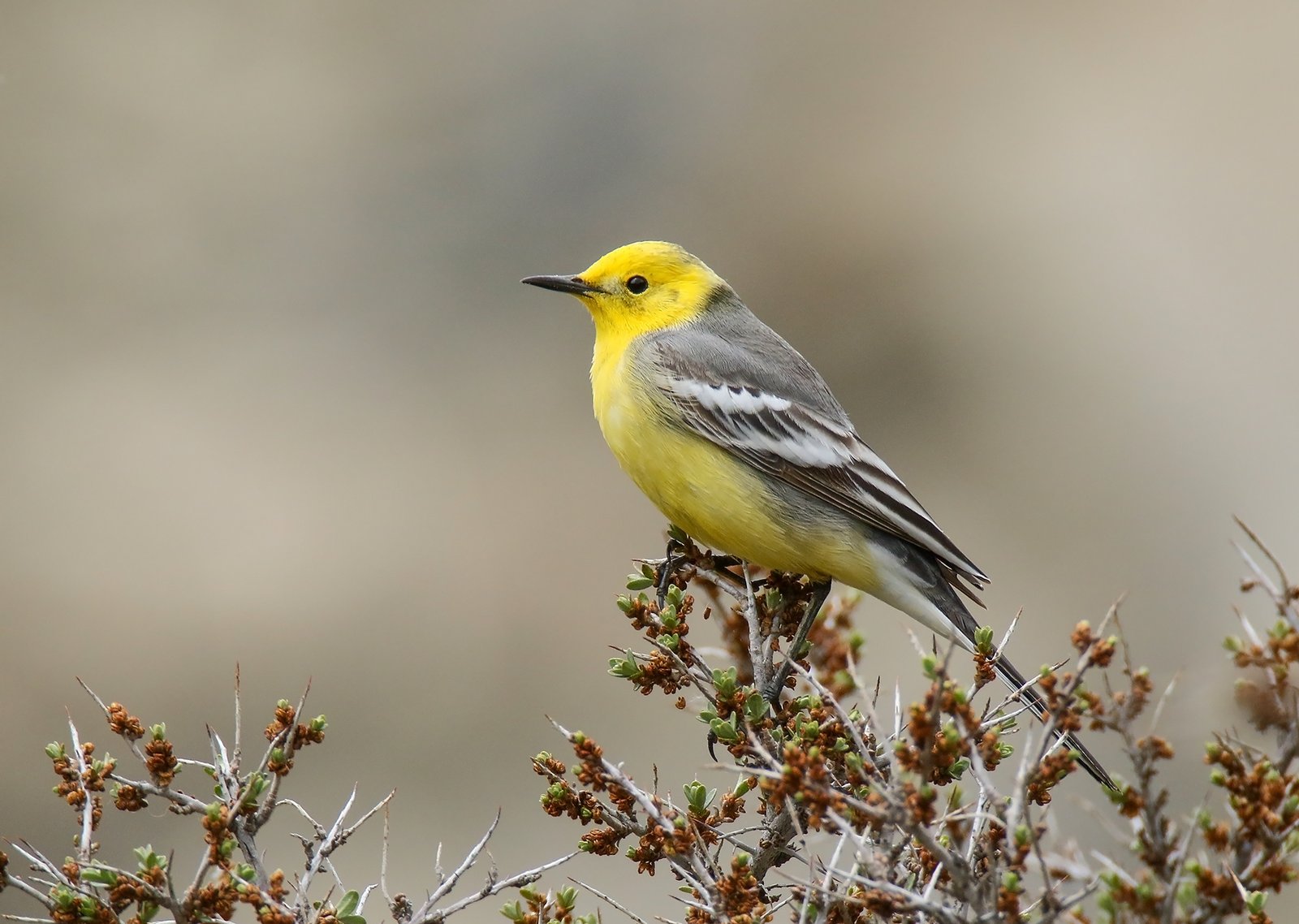
16 to 18 cm. The breeding male has a lemon-yellow head and underparts, a black collar on the nape, a grey back and broad white wing bars. Females and winter birds have a grey back, a yellow supercilium that continues around the dark ear coverts, and a yellow throat. First-years, the plumage most likely here, are grey and white without yellow: a pale supercilium continuing around the ear coverts, pale lores, white undertail coverts and two broad white wing bars. The legs are black.
Confusion species
Grey first-year Western Yellow Wagtails (Motacilla flava) have an olive-grey back, narrower wing bars, dark lores, no encircled ear coverts and a yellowish wash on the undertail. White Wagtail (Motacilla alba) has a white face with a black crown or nape and a black breast band. Cape Wagtail (Motacilla capensis) is brown-grey, with a breast band and no broad wing bars.
Habitat
Freshwater margins, sewage ponds, marsh edges and wet meadows; in the region often in the company of Western Yellow Wagtails.
Where the bird is most at home, classified by the vegetation units of southern Africa.

Range and movements
Within the region a few documented records in South Africa, including the Strandfontein sewage works near Cape Town (2015) and Cape Recife near Gqeberha (2018), and a bird on the border of KwaZulu-Natal and Eswatini (2019); isolated, undocumented reports from Zambia and Malawi. Breeds from eastern Europe to Mongolia and the Himalaya and winters mainly in the Indian subcontinent and South-East Asia; rare in East Africa.
How and when to look
Go through the grey first-years in wagtail flocks at sewage works carefully and listen for the harsh call. Document any record with photographs and, if possible, a sound recording, and submit it to the rarities committee of the country concerned.
Conservation status
Not threatened. Large range, expanding westwards in Europe.
Scientific name
Motacilla citreola | Pallas, 1776
Pallas described the species in 1776 and placed it straight away in the genus where it still stands. The genus Motacilla was introduced in 1758 by Linnaeus. Motacilla was the Roman name for the wagtail; it is really a diminutive of motare 'to move about', but from medieval times -cilla was wrongly taken to mean 'tail'. citreola is Latin for 'lemon-yellow', after the head and underparts of the male. The specimen the first description was based on came from eastern Siberia.