All species › Passerines › Wagtails and pipits › White Wagtail
White Wagtail | Motacilla alba
Witte kwikstaart | Lavandera Blanca
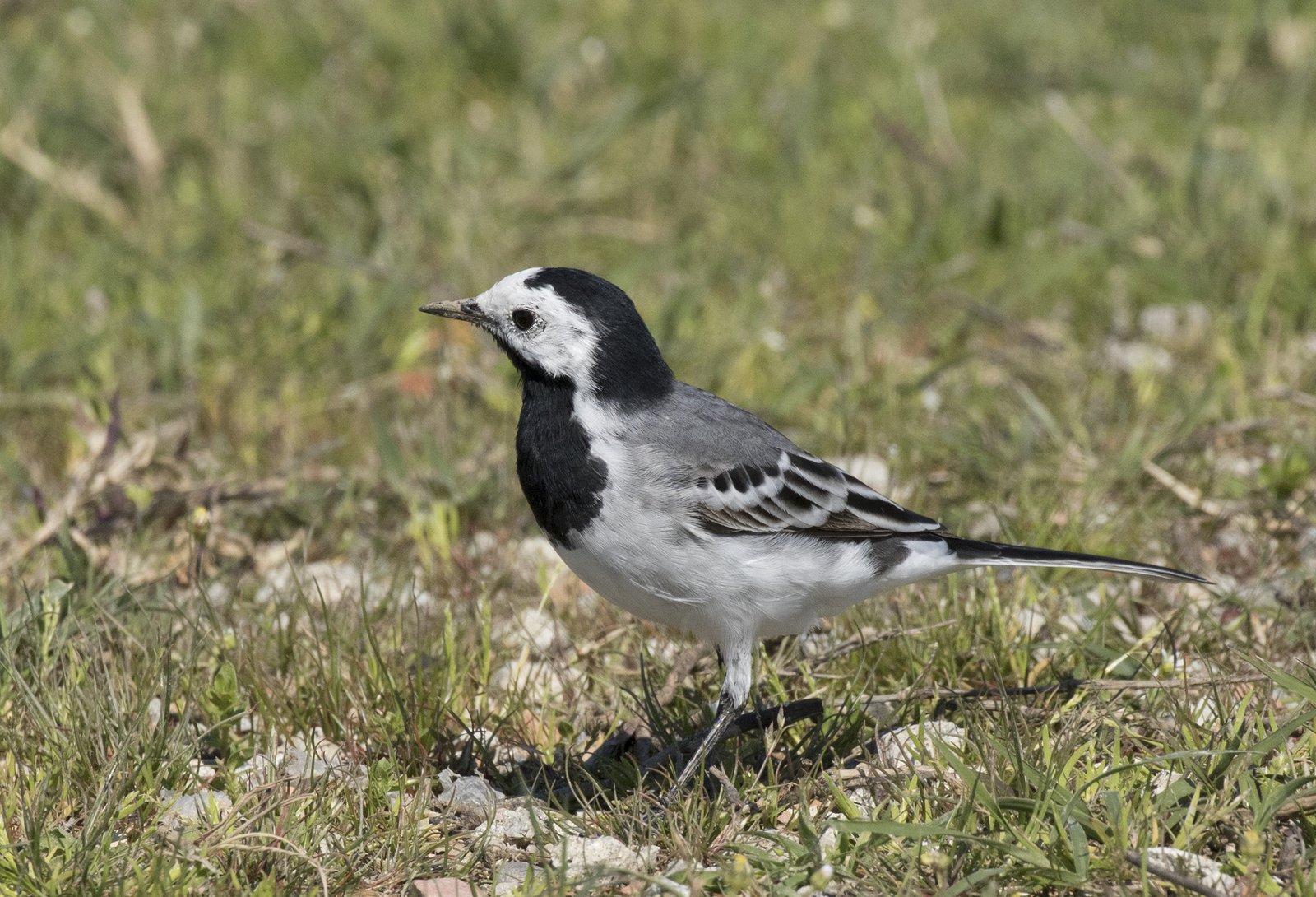
The White Wagtail, the familiar grey, black and white wagtail of Europe and Asia, is a very rare vagrant to southern Africa. A single bird feeding among Cape Wagtails at a lagoon or sewage pond draws birders from across the country.
Voice
A clear disyllabic tsee-wip or chissik, usually in flight; similar to the call of Cape Wagtail but slightly fuller.
Recording: Simon Gillings — CC BY-NC-SA 4.0 · converted to mono · xeno-canto
Identification
18 to 19 cm. Grey back, white forehead and face, black crown and nape. In breeding plumage the throat and breast are black; in winter the throat is white, with a black crescent-shaped breast band. The wings are grey-black with broad white edges and two white wing bars. The tail is black with white outer feathers. First-years have a greyer head without a black crown, a narrow breast band and sometimes a yellowish wash on the face.
Confusion species
African Pied Wagtail (Motacilla aguimp) has a black back and head with a white supercilium and a large white wing patch. Cape Wagtail (Motacilla capensis) is brown-grey, without a white face. Grey first-year Citrine Wagtails (Motacilla citreola) have a supercilium continuing around the ear coverts and lack black on crown and breast. Mountain Wagtail (Motacilla clara) has a narrow breast band, no white forehead and a much longer tail.
Habitat
Margins of lagoons, lakes and dams, sewage works, lawns and harbours; in the region usually among other wagtails at open water.
Where the bird is most at home, classified by the vegetation units of southern Africa.


Range and movements
Within the region a few documented records in South Africa, including Rooisand near Kleinmond in the Western Cape (January 2018) and near Stanger in KwaZulu-Natal (November 2022); also old specimens from southern Malawi and isolated reports from Zimbabwe, Zambia and Namibia. Breeds in Europe, North Africa and almost all of Asia and winters south to northern tropical Africa, rarely to East Africa.
How and when to look
In summer, check wagtail groups at lagoons and sewage works for a bird with a grey back and white face. A record requires photographs and a submission to the rarities committee of the country concerned.
Conservation status
Not threatened; a very large range and a numerous, stable population.
Scientific name
Motacilla alba | Linnaeus, 1758
Linnaeus described the species in 1758 and placed it straight away in the genus where it still stands. He introduced the genus Motacilla in that same work. Motacilla was the Roman name for the wagtail; it is really a diminutive of motare 'to move about', but from medieval times -cilla was wrongly taken to mean 'tail'. alba is Latin for 'white', after the black-and-white plumage. The specimen the first description was based on came from Sweden.