All species › Passerines › Chats and flycatchers › Collared Palm Thrush
Collared Palm Thrush | Cichladusa arquata
Zambesipalmlijster | Zorzal Palmero Acollarado
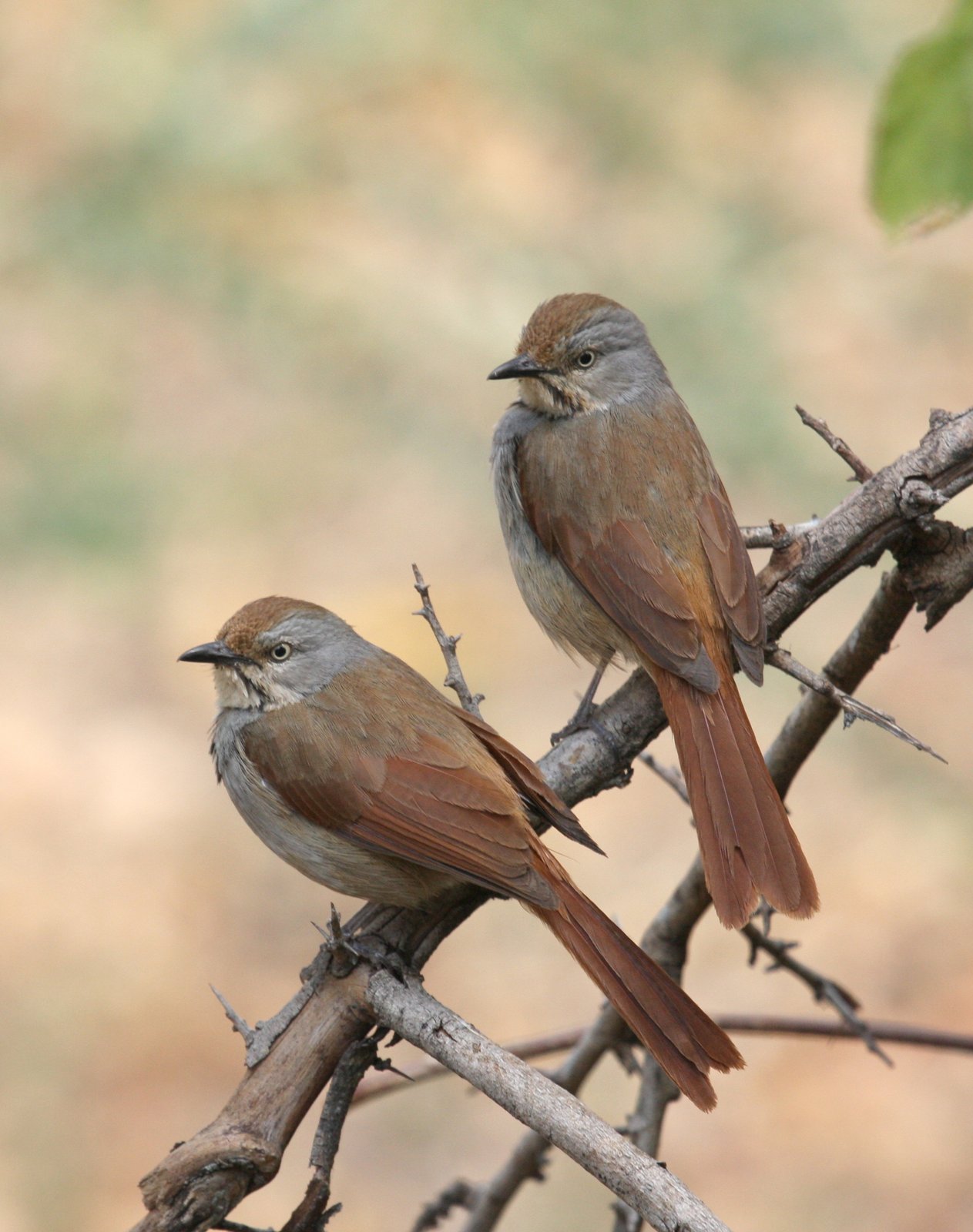
The Collared Palm Thrush is a grey-brown, long-tailed thrush-like bird with a thin black necklace, closely tied to fan palms in the warm river floodplains of the north and east of the region. Its cheerful, whistled duets are a familiar sound around the Victoria Falls and along the middle Zambezi.
Voice
A clear, cheerful series of whistles and chirping notes, tchee-tcherry-wee-tchoop, often sung as a duet between male and female and endlessly varied, with imitations of other birds. The call is a soft tchuk and a rasping alarm. Sings mainly in early morning and at sunset, sometimes also at night by moonlight.
Recording: Oliver Fowler — CC BY-NC-SA 4.0 · converted to mono · xeno-canto
Identification
A slender bird of 18 to 19 cm with a long, often cocked tail. Crown and back are grey-brown, wings and tail warm rufous. Throat and breast are cream to pale ochre-yellow, framed by a thin black necklace running from the gape along the cheek to the breast. The belly is dull white with grey flanks. The eye is strikingly pale yellow to cream; bill black, legs grey. The sexes are alike; juveniles lack the necklace and are somewhat mottled. Spends much time on the ground and raises its tail while drooping its wings.
Confusion species
Rufous-Tailed Palm Thrush (Cichladusa ruficauda) of Angola and the Kunene is more rufous above overall, lacks the black necklace and has an orange eye; the ranges do not meet. White-Browed Scrub Robin (Cercotrichas leucophrys) is smaller, with a white supercilium, white wing stripes and a streaked breast. Kurrichane Thrush (Turdus libonyana) has an orange bill and black malar stripes, but no necklace and no rufous tail.
Habitat
Savanna and river floodplains with fan palms (Hyphaene and Borassus), riverine forest with palms, islands in large rivers, and homesteads, villages and lodge gardens with palms, mostly below 1200 m. Forages on the ground for insects. The nest is a cup of mud and plant fibre on the base of a palm frond.
Where the bird is most at home, classified by the vegetation units of southern Africa.


Range and movements
In the region in the Zambezi Valley and its tributaries: Zambia (Zambezi, Luangwa, Kafue), northern Zimbabwe (Victoria Falls, Kariba, Mana Pools), the extreme north of Botswana (Kasane and the Chobe) and the Zambezi Region of Namibia, as well as Malawi (Shire Valley and the shores of Lake Malawi) and Mozambique to the coast. Outside the region in southern DR Congo, Tanzania and the extreme south-east of Kenya.
- Resident
- Summer visitor (c. Oct–Mar)
- Winter visitor (c. Apr–Sep)
- Passage (Mar–Apr, Oct–Nov)
- dark = core range, pale = thinly spread
How and when to look
Around lodges at the Victoria Falls, in Kasane or at Mana Pools, look for fan palms and listen in early morning for the whistled duet. The bird often sits on palm fronds or runs across lawns beneath the palms; note the pale eye and the necklace.
Conservation status
Not threatened. Locally common wherever palms grow and numbers are stable; it benefits from palms around villages and lodges. Felling of palms for palm wine or building material can drive it out locally.
Scientific name
Cichladusa arquata | Peters, 1863
Peters described the species in 1863 and placed it straight away in the genus where it still stands. He introduced the genus Cichladusa in that same work. Cichladusa comes from the Greek kikhlē, 'thrush', and adousa, 'singer' — for the rich, varied song of the palm thrushes. arquata comes from the Latin arcuatus, 'bowed' — for the curved black band framing the pale throat. The specimen the first description was based on came from Sena on the Zambezi, Mozambique.