All species › Passerines › Chats and flycatchers › Rufous-Tailed Palm Thrush
Rufous-Tailed Palm Thrush | Cichladusa ruficauda
Gabonpalmlijster | Zorzal Palmero Colirrufo
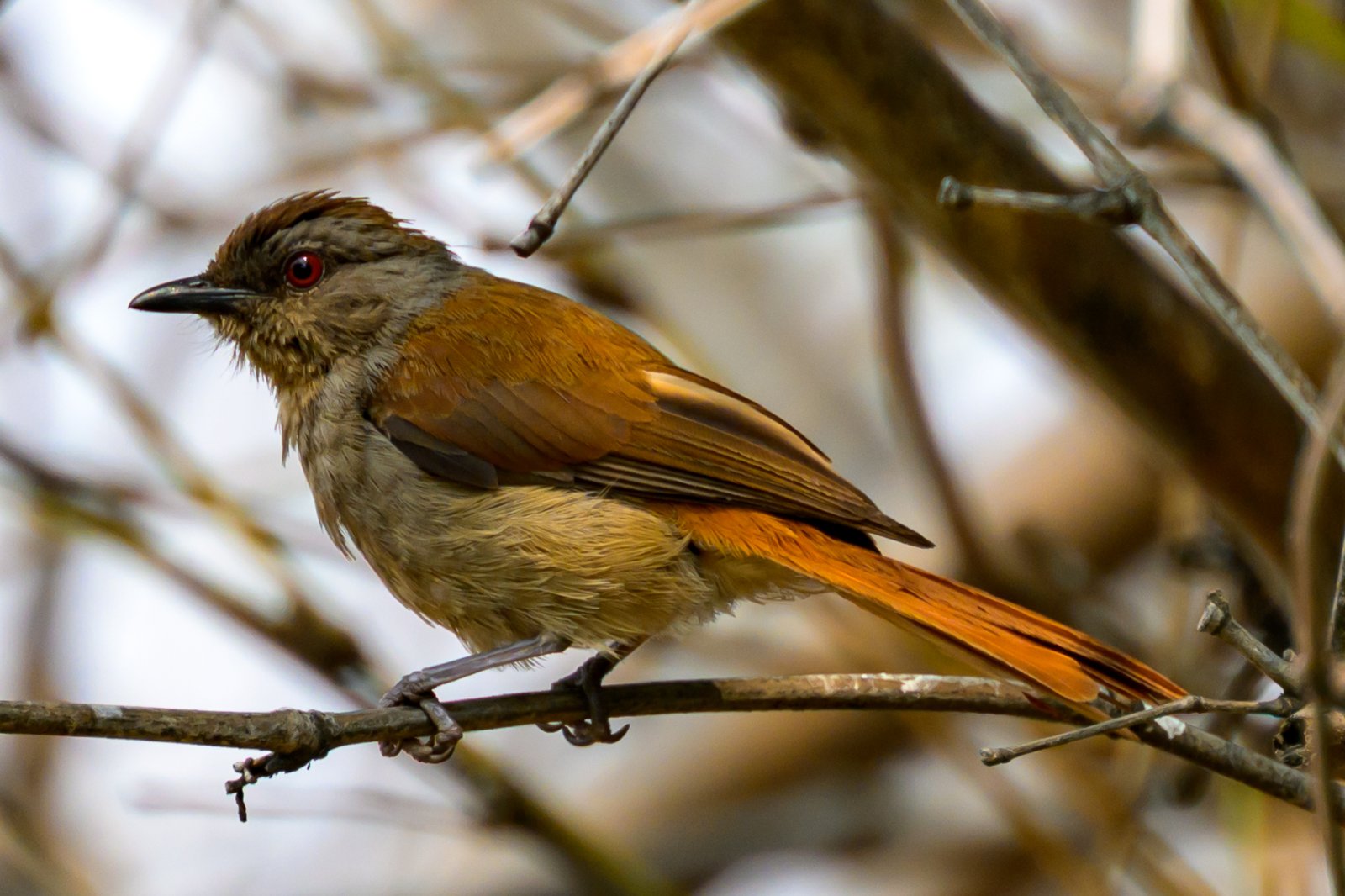
The Rufous-Tailed Palm Thrush is the rufous palm thrush of west-central Africa, which in the region inhabits the western half of Angola and just reaches Namibia along the Kunene. It lives around palms and dense vegetation near rivers and villages, and is most noticeable for its melodious duets.
Voice
A sweet, melodious series of whistles and chattering notes, wee-too-tooo-tchee-weedoo, often as a duet and with mimicry, mainly at dawn and dusk. The call is a sharp tchik, and a rasping tchrrr in alarm.
Recording: Bram Piot — CC BY-NC-SA 4.0 · converted to mono · xeno-canto
Identification
A slender bird of 17 to 18 cm with a long tail. The upperparts are warm rufous-brown, the crown slightly greyer, rump and tail bright cinnamon-rufous. The throat is pale cream to whitish without a black border, breast and flanks pale grey-brown, belly dull white. The eye is orange to reddish-brown; bill black, legs grey. The sexes are alike. Walks and runs on the ground with cocked tail and drooped wings, like the other palm thrushes.
Confusion species
Collared Palm Thrush (Cichladusa arquata) has a black necklace around a cream throat, a greyer back and a pale eye; it lives farther east and the ranges do not meet. Brown-Backed Scrub Robin (Cercotrichas hartlaubi) is smaller, with a white supercilium, white wing patches and a black-and-white tail tip. Mocking Cliff Chat (Thamnolaea cinnamomeiventris) is black with a rufous belly and lives on rocks.
Habitat
Dense riverside vegetation with palms, gallery forest, thickets at the foot of cliffs, mangrove edges, and gardens, homesteads and villages with oil or fan palms, from the coast to about 1500 m. Forages on the ground for insects. The nest is a mud cup, often on the base of a palm frond or on a ledge of a building.
Where the bird is most at home, classified by the vegetation units of southern Africa.


Range and movements
In the region in western Angola, from Cabinda and the coastal plain near Luanda south through Cuanza Sul, Benguela and Huíla provinces to Namibe, inland to the foot of the escarpment; also in north-western Namibia along the Kunene at Ruacana and Epupa. Outside the region from Gabon and Cameroon to both Congos and the Central African Republic.
- Resident
- Winter visitor (c. Apr–Sep)
- Passage (Mar–Apr, Oct–Nov)
- dark = core range, pale = thinly spread
How and when to look
In Namibia the riverine vegetation around the Epupa and Ruacana falls is the place to search, especially where makalani palms line the Kunene. In Angola it is regularly seen in the forest at the foot of the cliffs at the Leba Pass. Listen in early morning for the whistled duet and then search low down in the shade.
Conservation status
Not threatened. The species is locally common and adapts well to gardens and villages with palms; numbers are stable. The Namibian population is small and tied to the riverine forest along the Kunene, which is vulnerable to dams and clearing.
Scientific name
Cichladusa ruficauda | (Hartlaub, 1857)
Hartlaub described the species in 1857 as Bradyornis ruficauda; because it was later moved to another genus, the author and year stand in brackets. The genus Cichladusa was introduced in 1863 by Peters. Cichladusa comes from the Greek kikhlē, 'thrush', and adousa, 'singer' — for the rich, varied song of the palm thrushes. ruficauda comes from the Latin rufus, 'rufous', and cauda, 'tail' — for the rufous tail. The specimen the first description was based on came from Gabon.