All species › Passerines › Chats and flycatchers › Angola Cave Chat
Angola Cave Chat | Xenocopsychus ansorgei
Holenlawaaimaker | Cosifa Angoleña
The Angola Cave Chat is a black-and-white, long-tailed robin-chat of rocky slopes and cliffs in the western highlands of Angola, with a small outpost just south of the Kunene in Namibia. The only member of its genus, it is one of the most sought-after Angolan endemics.

Voice
The call consists of three clear whistles, wee-tee-tee, the first higher, sometimes in reverse order. The song is a fluting doolooloo, dooloo, doolooloo, interspersed with harsh chip notes. In alarm a rough birr-djarr. The voice carries far along the cliffs and is often the first sign of the species.
No recording with a suitable Creative Commons licence is available for this species yet.
Identification
A slender, long-tailed bird of 18 to 19 cm. Head and upperparts are black to blackish-grey, with a long, broad white supercilium. The uppertail coverts and underparts are white, and the outer tail feathers are largely white, conspicuous on take-off. Eye, bill and legs are black. The female is slightly smaller; juveniles have a yellowish wash on breast and flanks. Lives singly or in pairs, hops over lichen-covered boulders and perches in the open on a rock or branch to sing.
Confusion species
Mocking Cliff Chat (Thamnolaea cinnamomeiventris) lives in the same rocky terrain but has a rufous belly and rump and no white supercilium. White-Browed Robin-Chat (Cossypha heuglini) also has a black head with a white supercilium, but orange-rufous underparts and tail, and lives in dense riverine forest. White-Browed Scrub Robin (Cercotrichas leucophrys) is smaller and brown with a streaked breast.
Habitat
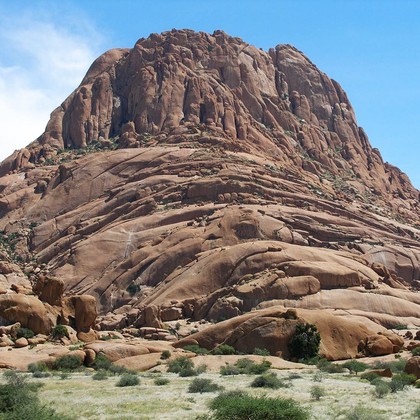
Steep rocky slopes and cliffs of sandstone and granite with crevices and caves, interspersed with dense scrub, thornbush and forest edges, from about 700 to 2200 m. Forages on the ground and on boulders for insects. The nest is a cup in a rock crevice or cave; breeds mainly from September to November.
Where the bird is most at home, classified by the vegetation units of southern Africa.

Range and movements
Near-endemic to Angola, known from a handful of sites along the western escarpment and central highlands: N'dalatando, Kumbira, Mount Soque, Mount Moco, the Namba Mountains and the Tundavala Gap near Lubango. In addition, a small population in the Zebra Mountains just south of the Kunene in north-western Namibia. The species occurs nowhere outside this region.
- Resident
- dark = core range, pale = thinly spread
How and when to look
Tundavala near Lubango is the classic site: walk the edges of the gap early in the morning and listen for the three clear whistles. The bird is shy in the scrub but perches in the open on a boulder to sing; the white tail sides give it away as it flies off.
Conservation status
Not threatened; previously considered Near Threatened, but since downgraded because its rocky habitats are little disturbed. Fire, wood-cutting and grazing in the forest edges below the cliffs are local threats.
Scientific name
Xenocopsychus ansorgei | Hartert, 1907
Hartert described the species in 1907 and placed it straight away in the genus where it still stands. He introduced the genus Xenocopsychus in that same work. Xenocopsychus comes from the Greek xenos, 'strange', and Copsychus, the magpie-robin genus — a 'strange magpie-robin'. ansorgei honours the British-German physician and collector William John Ansorge (1850–1913), who collected extensively in Angola. The specimen the first description was based on came from Lubango, Angola.