All species › Passerines › Sylvia warblers › Common Whitethroat
Common Whitethroat | Curruca communis
Grasmus | Curruca Zarcera
The Common Whitethroat is a Palearctic migrant that reaches southern Africa at the far edge of its African wintering range. Between November and April it lives hidden in thorn scrub in the dry interior, where it draws attention more by its grating call than by its appearance.

Voice
The call is a hard chek or tak and a grating, nasal cherr, often from within a dense bush. In February–April some birds sing before departure: a short, scratchy, hurried phrase, cheewee-chee-chewee-cheri.
Recording: David Darrell-Lambert — CC BY-NC 4.0 · converted to mono · xeno-canto
Identification
13–15 cm, slender and long-tailed. The male has a grey head, a pure white throat that is puffed out when excited, a pale eye-ring and a brown back; the breast is off-white with a pink or buff wash. The female and juvenile have a browner head and a less contrasting throat. Characteristic are the rufous edges to the greater coverts and tertials, which form a warm wing panel. The tail is dark brown with white outer feathers. The bill is grey with a pale base, the legs pale brown. In Africa many birds are in fresh or, conversely, worn plumage during moult, and the colours are then duller. It moves restlessly through dense bushes, raising its head and tail.
Confusion species
Garden Warbler Sylvia borin is plain greyish brown, without a white throat, rufous wing edges or white in the tail, and has a shorter, stubbier bill. The female Eurasian Blackcap Sylvia atricapilla has a rufous-brown cap. Barred Warbler Curruca nisoria is larger and greyer, with pale wingbars and, in adults, a yellow iris and barred underparts. Chestnut-Vented Warbler Curruca subcoerulea is grey, with a pale iris, a streaked throat and a chestnut vent.
Habitat
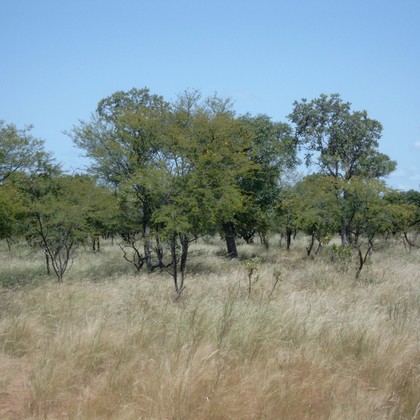
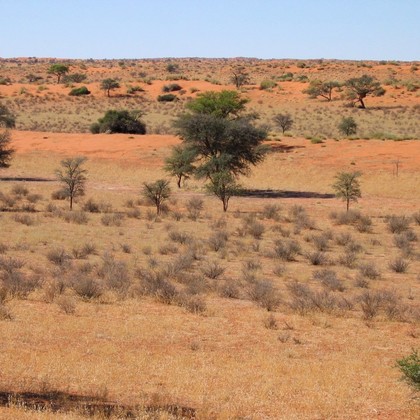
Dry acacia savanna and thornveld, Kalahari thornveld and scrubby margins of fields and riverbeds, especially where dense, low thorn bushes grow. It feeds on insects and in late summer also on berries.
Where the bird is most at home, classified by the vegetation units of southern Africa.
Range and movements
Within the region mainly in northern and eastern Botswana, north-eastern Namibia, Zimbabwe and southern Zambia, and in South Africa in Limpopo, North West, Gauteng and the northern Northern Cape; scarce in Malawi, Mozambique, Eswatini and Angola. It breeds in Europe, north-west Africa and western and central Asia and winters in the Sahel and East Africa south to southern Africa; the birds here belong largely to eastern populations.
- Summer visitor (c. Oct–Mar)
- Passage (Mar–Apr, Oct–Nov)
- dark = core range, pale = thinly spread
How and when to look
From November to April; search dense thorn scrub in, for example, Kgalagadi Transfrontier Park, the Pilanesberg area or the Central Kalahari Game Reserve and listen for the hard chek. The bird often shows briefly as it flies from bush to bush; look then for the white throat and rufous wing.
Conservation status
Not threatened. The European population crashed in the twentieth century because of drought in the Sahel and has since partly recovered. In southern Africa the species is fairly scarce but regular, with numbers varying from year to year.
Scientific name
Curruca communis | (Latham, 1787)
Latham described the species in 1787 as Sylvia communis; because it was later moved to another genus, the author and year stand in brackets. The genus Curruca was introduced in 1802 by Bechstein. Curruca is Latin, the name of an unidentified small bird mentioned by the Roman poet Juvenal. communis is Latin for 'common'. The specimen the first description was based on came from Kent, England.