All species › Passerines › Sylvia warblers › Garden Warbler
Garden Warbler | Sylvia borin
Tuinfluiter | Curruca Mosquitera
The Garden Warbler is a Palearctic migrant that winters from November to April in dense thickets in the north and east of the region. It is one of the most featureless warblers in Africa: the very absence of markings is its main field mark, and in February and March it gives itself away with its long, rich song.
Voice
The song is a long, even and fast stream of soft, rich and mellow notes, deeper and more continuous than that of Eurasian Blackcap and without its clear final phrase. In the wintering area it is heard mainly in the last months before departure, often from dense cover. The call is a dry chek-chek and a soft, nasal chair.
Recording: Robin et Julien SOURIOU — CC BY-NC-SA 4.0 · converted to mono · xeno-canto
Identification
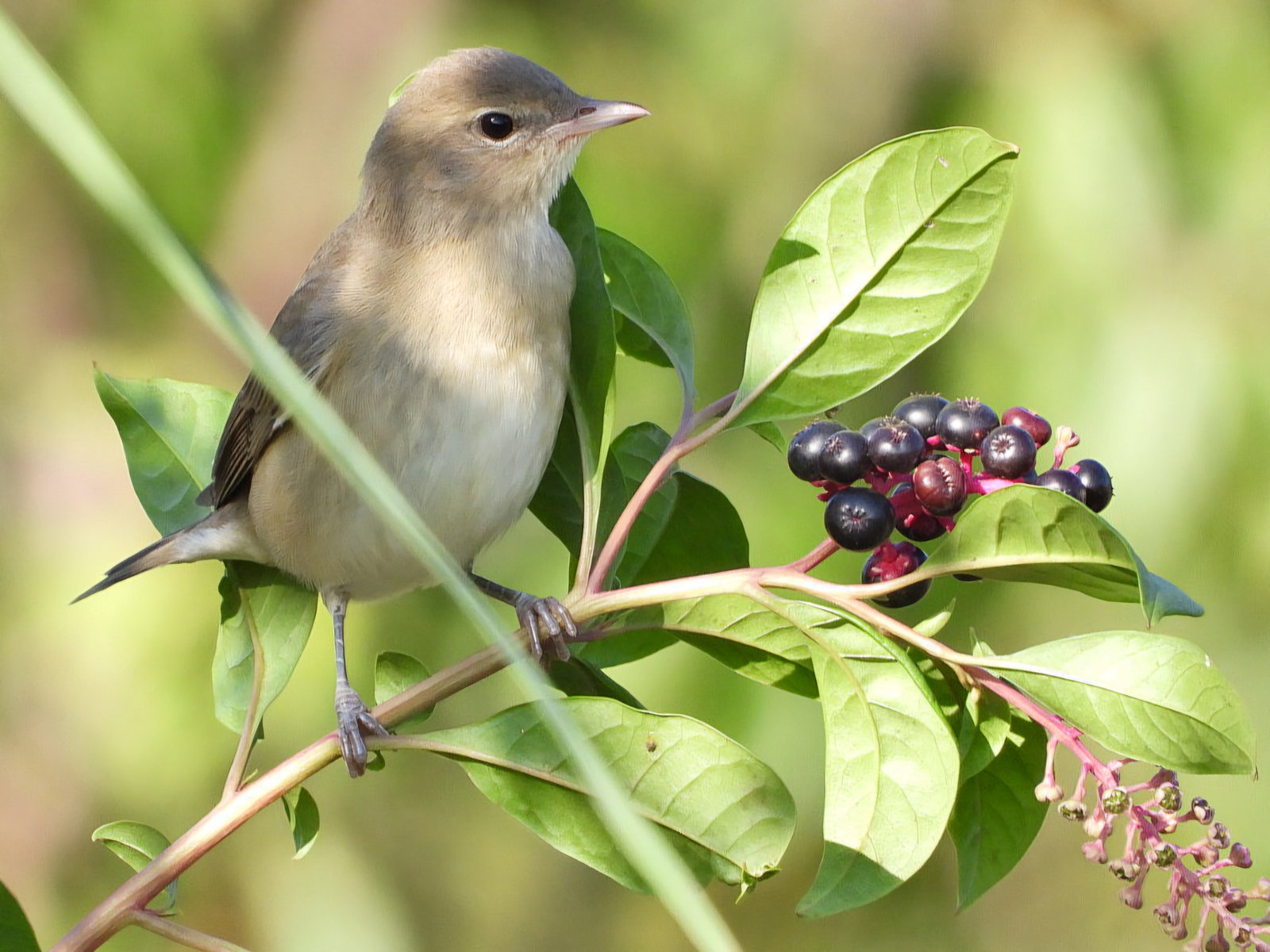
14 cm, a compact, rather plump warbler with a round head and a short, thick, dark bill. The upperparts are plain grey-brown, the underparts paler brownish-grey with a warm buff tone to the breast and flanks. There is a grey patch on the side of the neck and a narrow, faint pale eye-ring around the dark eye, but no clear supercilium or wing-bar. The legs are grey. The sexes are alike. It moves slowly and secretively in dense foliage and eats many berries.
Confusion species
Female and juvenile Eurasian Blackcap Sylvia atricapilla have a red-brown cap. Icterine Warbler Hippolais icterina is greenish-yellow with a long, broad, orange-pink bill; Olive-Tree Warbler Hippolais olivetorum is larger and greyer, with a long bill and a pale wing panel. Marsh Warbler Acrocephalus palustris has a flat forehead, a longer, pointed bill and more distinct pale lores. Willow Warbler Phylloscopus trochilus is smaller and slimmer, with a fine bill and a supercilium.
Habitat
Dense thicket, riverine forest and forest edges, bush clumps and thicket-covered termite mounds in savanna and woodland, overgrown gardens and fruit trees; rarely in open savanna. Besides insects it eats a lot of fruit and berries, for example of figs and Lantana.
Where the bird is most at home, classified by the vegetation units of southern Africa.



Range and movements
Within the region mainly in the north and east: Angola (except the arid south-west), Zambia, Malawi, Mozambique, Zimbabwe, northern Botswana (Okavango and Chobe), north-eastern Namibia, Eswatini and in South Africa Limpopo, Mpumalanga, Gauteng, KwaZulu-Natal and the Eastern Cape; rare further west and south-west. It breeds in Europe and western Siberia and winters in sub-Saharan Africa, mainly south of the equator.
- Summer visitor (c. Oct–Mar)
- Passage (Mar–Apr, Oct–Nov)
- dark = core range, pale = thinly spread
How and when to look
From November to April, most numerous from December to March. Search dense thickets and bush clumps around fruiting shrubs and listen in February and March for the long song. The plain appearance with the short, stubby bill and round head is the key; a ‘featureless’ grey-brown warbler in a berry bush is often this species.
Conservation status
Not threatened. The European breeding population is large, although the species is declining in parts of western Europe. In the wintering area the clearing of thicket plays a local role; dense, neglected scrub is in fact favourable for this species.
Scientific name
Sylvia borin | (Boddaert, 1783)
Boddaert described the species in 1783 as Motacilla Borin; because it was later moved to another genus, the author and year stand in brackets. The genus Sylvia was introduced in 1769 by Scopoli. Sylvia is Modern Latin silvia, a woodland nymph, related to silva 'wood'; the name passed to small songbirds of scrub and undergrowth. borin is a local name for the bird in the Genoa area of Italy, derived from Latin bos 'ox', because the warbler was believed to accompany oxen. The specimen the first description was based on came from France.