All species › Gamebirds › Pheasants and partridges › Crested Francolin
Crested Francolin | Ortygornis sephaena
Kuiffrankolijn | Francolín Capirotado
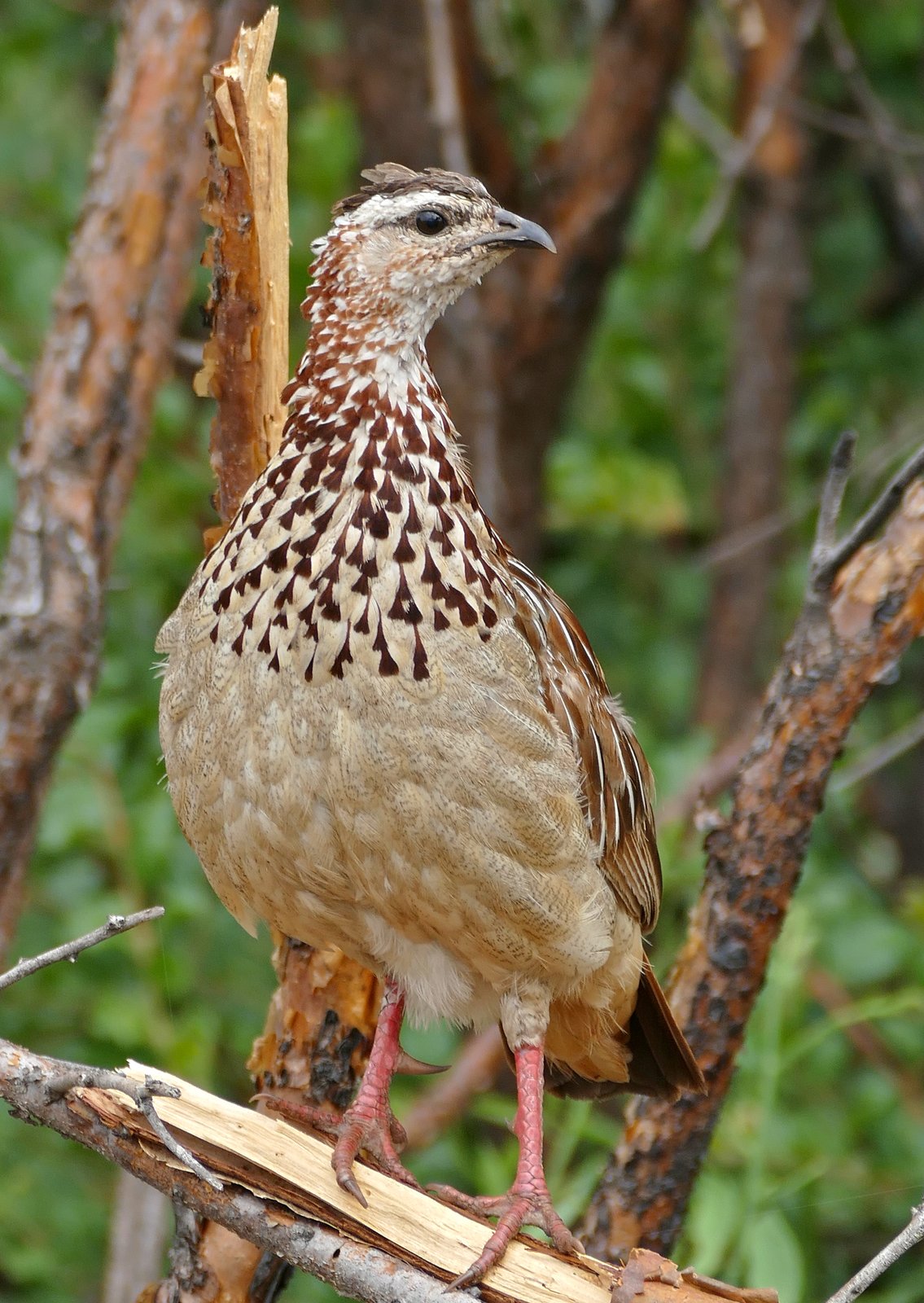
The Crested Francolin is the common, noisy francolin of thorny bushveld and riverine woodland in the north and east of the region. With its raised dark crown and bantam-like cocked tail it stands apart from every other gamebird.
Voice
A fast rattling duet from both partners, chee-kerrie-chee-kerrie-chee, often rendered as beer-and-cognac, mainly at dawn and dusk and frequently answered by neighbouring pairs.
Recording: Kileo Jumah — CC0 · converted to mono · xeno-canto
Identification
About 33 cm, slender for a francolin. The crown is dark brown and is raised as a small crest when excited. A broad white supercilium and a dark eye-stripe give the head strong contrast; the throat is white. The upperparts are brown with conspicuous white shaft streaks and fine vermiculation. The breast carries dark brown drop- or arrowhead-shaped spots on a creamy ground, and the belly is paler. The legs are red. The tail is often held cocked, especially when running off. The female is duller with finer barring on the upperparts.
Confusion species
Coqui Francolin (Campocolinus coqui) is smaller, lacks white shaft streaks on the back and has fully black-and-white barred underparts. Natal Spurfowl (Pternistis natalensis) and Swainson's Spurfowl (Pternistis swainsonii) are larger and heavier, with no white supercilium and no cocked tail. Shelley's Francolin (Scleroptila shelleyi) shows rufous wings in flight and a black-and-white barred belly.
Habitat
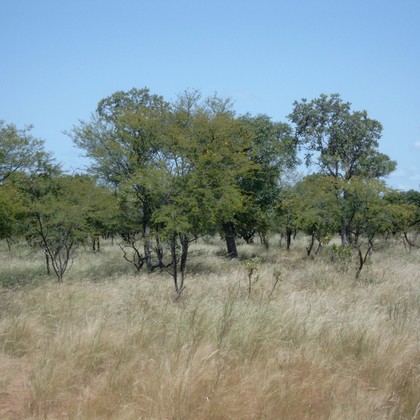
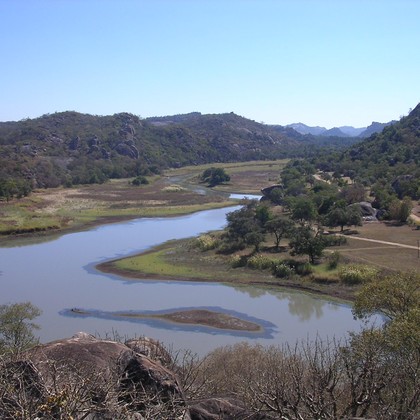
Dense shrubs and undergrowth in savanna, thornveld, mopane and along rivers with riparian woodland, also rank ground around villages and camps. It scratches under bushes for seeds, fruit, tubers, termites and other insects, and quickly takes cover in thickets when alarmed.
Where the bird is most at home, classified by the vegetation units of southern Africa.

Range and movements
Widespread across the north and east: Zimbabwe, Mozambique, Zambia, Malawi, most of Botswana except the dry south-west, northern Namibia, southern Angola, and in South Africa Limpopo, Mpumalanga, North West and northern KwaZulu-Natal, and also Eswatini. Beyond the region through East Africa to Ethiopia and Somalia.
- Resident
- Summer visitor (c. Oct–Mar)
- Winter visitor (c. Apr–Sep)
- Passage (Mar–Apr, Oct–Nov)
- dark = core range, pale = thinly spread
How and when to look
In Kruger National Park and other lowveld reserves pairs are often seen walking along road verges and around camps with tails cocked. The duet at dawn or dusk is the quickest way to locate the species; in camps birds can become very tame.
Conservation status
Not threatened and common in suitable bushveld. It tolerates some disturbance and also occurs around farms and lodges. It is hunted, but the population is large and stable.
Scientific name
Ortygornis sephaena | (Smith, 1836)
Smith described the species in 1836 as Perdix Sephaena; because it was later moved to another genus, the author and year stand in brackets. The genus Ortygornis was introduced in 1853 by Reichenbach. Ortygornis comes from the Greek ortux, 'quail', and ornis, 'bird' — 'quail-bird'. sephaena is a Tswana name for this francolin; Andrew Smith (1836) deliberately adopted the names the local people gave to the animals he described. The specimen the first description was based on came from Marico and Limpopo rivers, Transvaal (South Africa).