All species › Gamebirds › Pheasants and partridges › Hartlaub's Spurfowl
Hartlaub's Spurfowl | Pternistis hartlaubi
Hartlaubs frankolijn | Francolín de Hartlaub
Hartlaub's Spurfowl is the smallest spurfowl in southern Africa and a near-endemic of the rocky koppies and granite hills of north-western Namibia and south-western Angola. The sexes differ so much that they look like two species, and the male has a strikingly heavy bill.

Voice
At dawn the pair sings a loud, ringing duet from a boulder: the male a forceful kwee-kwee-kwee-kweerr, the female answering with a high, fast kek-kek-kek. Also heard at dusk; the duet carries far across the rock faces.
Recording: Gareth K. — CC BY-NC-SA 4.0 · shortened to the first 60 s, mono · xeno-canto
Identification
About 26 cm. The male has a dark crown, a white supercilium, a dark eye-stripe and a very heavy, curved horn-coloured bill with a yellowish lower mandible. The upperparts are finely vermiculated grey-brown, the underparts whitish with dense brown streaks. The female is plainer, with a cinnamon head and uniform orange-brown underparts. Both sexes have a small bare yellow patch around the eye and dull yellow legs. It seldom flies, preferring to run off between boulders.
Confusion species
The Red-Billed Spurfowl is much larger, with a red bill and red legs, and lives mainly in thornveld near water rather than on bare rock. The Orange River Francolin is a grassland bird with a rufous head and a black-bordered white throat. The female, with her plain rufous underparts, is best told by her small size and rocky setting.
Habitat
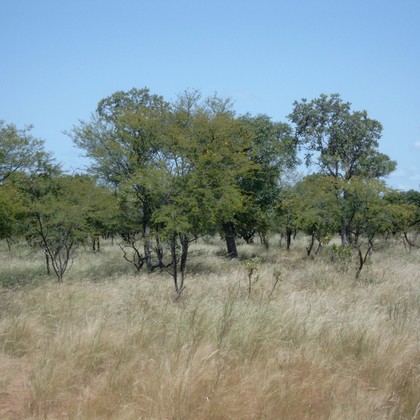
Rocky koppies, granite hills, gorges and scree slopes with scattered shrubs and grass tufts, in dry savanna and on the edge of the Namib. It forages on the ground among the rocks for seeds, bulbs, tubers and insects. It roosts in rock crevices and under overhangs, and depends less on drinking water than larger spurfowl.
Where the bird is most at home, classified by the vegetation units of southern Africa.

Range and movements
Within the region restricted to north-western and west-central Namibia, from the Kaokoveld through the Brandberg, Erongo and Spitzkoppe to the Waterberg Plateau, and to south-western Angola (Namibe and Huíla). Not found beyond; a near-endemic of the Namibian escarpment.
- Resident
- Winter visitor (c. Apr–Sep)
- Passage (Mar–Apr, Oct–Nov)
- dark = core range, pale = thinly spread
How and when to look
Best at dawn, when pairs call from a lookout rock: listen at campsites in the Erongo, at Spitzkoppe or on the Waterberg Plateau and scan the rock tops. By day the birds hide well among the stones; standing still at a viewpoint yields more than walking about.
Conservation status
Not threatened. The range is small, but the rocky habitat is hardly affected by agriculture and the species is little hunted. Locally, overgrazing can reduce ground cover between the rocks.
Scientific name
Pternistis hartlaubi | (Bocage, 1869)
Bocage described the species in 1869 as Francolinus Hartlaubi; because it was later moved to another genus, the author and year stand in brackets. The genus Pternistis was introduced in 1832 by Wagler. Pternistis comes from Greek pternistēs 'one who strikes with the heel', from pterna 'heel', after the spurs on the legs. hartlaubi honours the German physician and ornithologist Gustav Hartlaub (1814–1900). The specimen the first description was based on came from Huíla, Angola.