All species › Gamebirds › Pheasants and partridges › Harlequin Quail
Harlequin Quail | Coturnix delegorguei
Harlekijnkwartel | Codorniz Arlequín
The Harlequin Quail is a nomadic summer visitor that moves into the region with the rains and in wet years can suddenly appear in large numbers in tall grass. With its black-and-white head, black breast and chestnut flanks the male is the most boldly patterned quail of southern Africa.

Voice
The male gives a series of three to five high, metallic notes, whit-whit-whit, faster and sharper than the Common Quail and without its three-part rhythm; it calls day and night early in the rainy season.
Recording: Paul Lenrumé — CC BY-NC-SA 4.0 · converted to mono · xeno-canto
Identification
About 17 cm, slightly darker and more compact than Common Quail. The male has a black-and-white striped head with a white throat cut by a black anchor mark, a large black patch on the centre of breast and belly, and deep chestnut flanks streaked black. The upperparts are dark brown with pale lengthwise streaks. The female resembles female Common Quail but is darker and warmer brown, with a pale throat and a nearly unspotted ochre breast. It flushes low and fast on a plain brown wing.
Confusion species
The female Common Quail (Coturnix coturnix) is paler and more clearly streaked on the flanks, with fine spots on the breast; the male lacks the black breast patch. Blue Quail (Synoicus adansonii) is smaller, the male slate-blue. Common Buttonquail (Turnix sylvaticus) and Black-Rumped Buttonquail (Turnix nanus) show a pale wing panel in flight and rufous breasts without a black patch.
Habitat
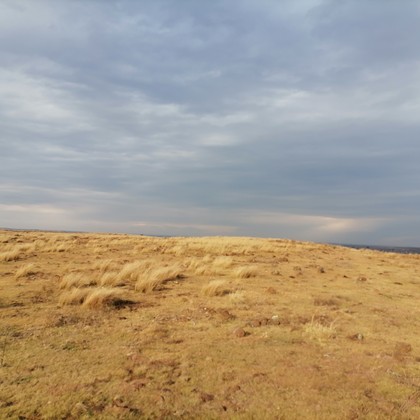
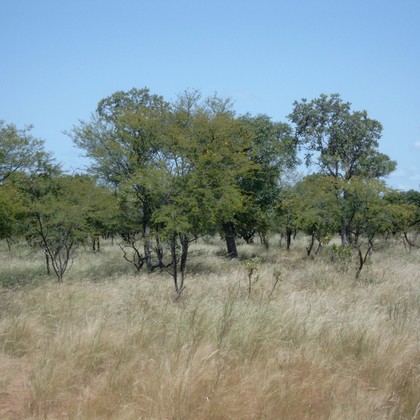
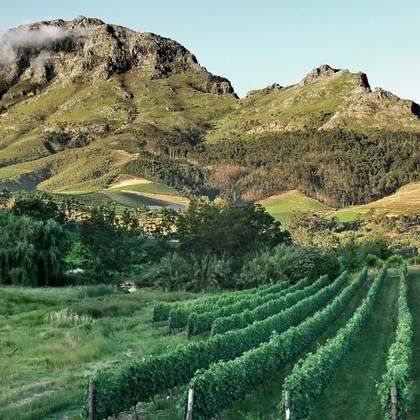
Tall, dense grassland and grassy savanna, often on moist ground on the edge of vleis, also fallow land and lucerne and grain fields. It appears after the first heavy rains and leaves again when the grass dries out. It eats seeds and insects.
Where the bird is most at home, classified by the vegetation units of southern Africa.
Range and movements
In the north and east of the region, from Angola, Zambia, Malawi and Mozambique across Zimbabwe and northern Botswana to eastern South Africa and Eswatini; in wet years further west into Namibia, the Free State and the eastern Karoo, rarely to the Cape. Beyond the region across much of sub-Saharan Africa, with isolated populations in south-western Arabia and on Madagascar.
- Resident
- Summer visitor (c. Oct–Mar)
- Passage (Mar–Apr, Oct–Nov)
- dark = core range, pale = thinly spread
How and when to look
After good summer rains, males on the Highveld, the Zimbabwean midlands or around the Okavango often call simultaneously from tall grass. Drive slowly along grassy verges in the morning; quail sometimes cross the road at dusk.
Conservation status
Not threatened. Numbers fluctuate strongly from year to year according to rainfall. Hunted locally and affected by mowing during the breeding season, but widespread and common across its range.
Scientific name
Coturnix delegorguei | Delegorgue, 1847
Delegorgue described the species in 1847 and placed it straight away in the genus where it still stands. The genus Coturnix was introduced in 1764 by De Garsault. Coturnix is the Latin word for the quail. delegorguei honours the French explorer and hunter Adulphe Delegorgue (1814–1850), who collected in Natal and Transvaal. The specimen the first description was based on came from Oury, upper Limpopo River, Transvaal (South Africa).