All species › Gannets and cormorants › Cormorants › Crowned Cormorant
Crowned Cormorant | Microcarbo coronatus
Kroonaalscholver | Cormorán Coronado
The Crowned Cormorant is a small, black marine cormorant with a permanent crest on the forehead, found only along the cold coast of Namibia and western South Africa. It is the marine counterpart of the Reed Cormorant and forages alone or in small groups close inshore.

Voice
Silent away from the colony. At the nest soft cackling and rasping calls and a hissing ka-ka-ka in greeting and threat.
No recording with a suitable Creative Commons licence is available for this species yet.
Identification
About 54 cm, compact, with a short tail and an erect forehead crest present all year. Adult plumage is glossy black, with some silvery-grey, black-edged feathers on the upperparts. The eye is red, the facial skin and bill base yellow to orange-yellow, and the bill is short with a small hook at the tip. The sexes are alike. Juveniles are dark brown with a slightly paler throat but have a dark belly and breast. It flies low over the water on rapid wingbeats.
Confusion species
The Reed Cormorant (Microcarbo africanus) has a distinctly longer tail, lacks the crest outside the breeding season, and juveniles have a dirty-white belly; it lives mainly on fresh water but also uses estuaries and lagoons, where the two species can meet. The Cape Cormorant (Phalacrocorax capensis) and the Bank Cormorant (Phalacrocorax neglectus) are much larger and heavier, with no long tail and no forehead crest.
Habitat
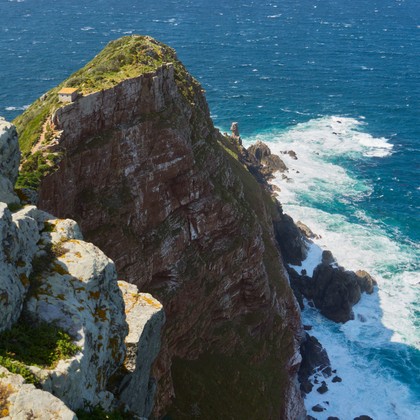
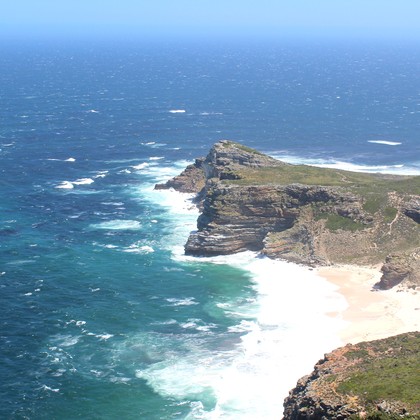
Rocky shores, intertidal zones, kelp beds and sheltered bays of the cold Benguela Current. It forages close inshore, often in less than ten metres of water, on small bottom fish such as klipfish and on crustaceans. It breeds in small colonies on rocky islands, coastal rocks, shipwrecks, jetties and harbour structures; the nest is a heap of seaweed, sticks and feathers.
Where the bird is most at home, classified by the vegetation units of southern Africa.
Range and movements
Endemic to the west coast of southern Africa: from the Walvis Bay area in Namibia south along the coast of the Sperrgebiet and Namaqualand to the Cape Peninsula and Cape Agulhas. It occurs nowhere else in the world.
- Resident
- Passage (Mar–Apr, Oct–Nov)
- dark = core range, pale = thinly spread
How and when to look
Easily seen in Kalk Bay and Hout Bay harbours and along the rocks of the Cape Peninsula, where birds sit drying on mooring posts and jetties. In Namibia around Lüderitz and on the jetties of Walvis Bay and Swakopmund. Check the short tail and the crest to separate it from the Reed Cormorant.
Conservation status
Not threatened, but with a small world population of a few thousand pairs and a very restricted range. It is vulnerable to oil pollution, drowning in rock-lobster traps and fishing nets, disturbance at breeding sites and predation by Cape fur seals and gulls. Colonies on protected islands and in harbours have increased locally.
Scientific name
Microcarbo coronatus | (Wahlberg, 1855)
Wahlberg described the species in 1855 as Graculus coronatus; because it was later moved to another genus, the author and year stand in brackets. The genus Microcarbo was introduced in 1856 by Bonaparte. Microcarbo combines Greek mikros 'small' with the genus name Carbo, and thus means 'small cormorant'. coronatus is Latin for 'crowned' — for the short crest on the forehead. The specimen the first description was based on came from Possession Island, Namibia.