All species › Gannets and cormorants › Cormorants › Reed Cormorant
Reed Cormorant | Microcarbo africanus
Afrikaanse dwergaalscholver | Cormorán Africano
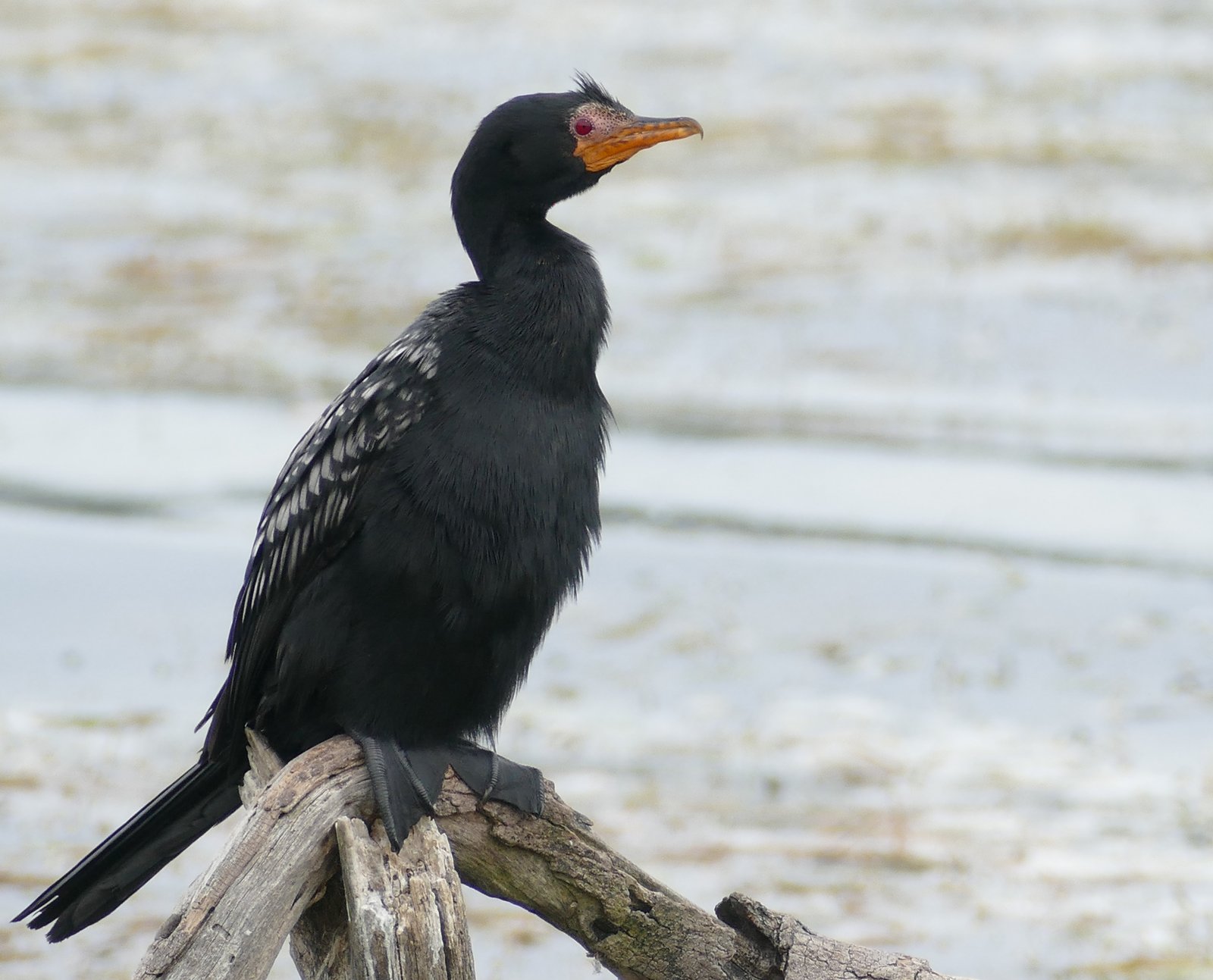
The Reed Cormorant is the small, long-tailed cormorant of almost every body of fresh water in the region, from rivers and marshes to farm dams. It often perches low on a branch or post over the water with wings spread to dry.
Voice
Silent away from the colony. In the colony cackling and hissing sounds and a rapid, bleating ka-ka-ka-ka.
Recording: Bram Piot — CC BY-NC-SA 4.0 · converted to mono · xeno-canto
Identification
About 52 cm, small and slim, with a noticeably long, stiff tail. Breeding plumage is black with a green gloss, the upperparts silvery-grey with black edges, giving a scaly pattern; a small crest then stands on the forehead. The eye is red and the facial skin yellow to orange. Outside the breeding season it is browner and lacks the crest. Juveniles are brown above with a dirty-white throat, breast and belly. The bill is short, with a small hook at the tip. It flies low and fast on rapid wingbeats, the long tail obvious.
Confusion species
The Crowned Cormorant (Microcarbo coronatus) is stockier with a shorter tail and a crest all year, and juveniles have a dark belly; it lives at sea on the west coast, where the Reed Cormorant occurs only in estuaries and lagoons. The Great Cormorant (Phalacrocorax carbo) is almost twice the size, with a white breast and throat in adults and a heavy bill. The African Darter (Anhinga rufa) has a much longer, kinked neck and a dagger bill without a hook.
Habitat
Almost any fresh water with some vegetation or perches along the edge: rivers, lakes, marshes, floodplains, farm dams and sewage works, and also estuaries, lagoons and mangroves. It hunts small fish and frogs underwater, sometimes in small groups. It breeds in colonies, often mixed with herons and darters, in trees, reedbeds or bushes over water.
Where the bird is most at home, classified by the vegetation units of southern Africa.


Range and movements
Throughout the region wherever there is fresh water, from Angola and Zambia to the Cape; common in the Okavango Delta, along the Zambezi, in Malawi and in eastern South Africa; scarce and local in the driest parts of Namibia, Botswana and the Karoo, where it moves to temporary pans after rain. Beyond the region over almost all of sub-Saharan Africa and on Madagascar.
- Resident
- Summer visitor (c. Oct–Mar)
- Winter visitor (c. Apr–Sep)
- Passage (Mar–Apr, Oct–Nov)
- dark = core range, pale = thinly spread
How and when to look
One of the easiest waterbirds in the region: nearly every dam has a few perched on dead branches at the edge. Breeding colonies in reedbeds and trees in wet summers show the scaly breeding plumage well. At west-coast lagoons check the tail length to separate it from the Crowned Cormorant.
Conservation status
Not threatened, widespread and locally common. It has benefited from the building of dams and reservoirs throughout the region. Locally threatened by the draining of wetlands, pollution, drowning in fishing nets and persecution at fish farms.
Scientific name
Microcarbo africanus | (Gmelin, 1789)
Gmelin described the species in 1789 as Pelecanus africanus; because it was later moved to another genus, the author and year stand in brackets. The genus Microcarbo was introduced in 1856 by Bonaparte. Microcarbo combines Greek mikros 'small' with the genus name Carbo, and thus means 'small cormorant'. africanus is Latin for 'African' — for its range. The specimen the first description was based on came from Africa (not specified).