All species › Gannets and cormorants › Cormorants › Bank Cormorant
Bank Cormorant | Phalacrocorax neglectus
Kustaalscholver | Cormorán de Bajío
The Bank Cormorant is a heavy, dark marine cormorant that spends its whole life in the kelp beds and on the wave-washed rocks of the Benguela coast. It is the least numerous and most threatened cormorant in the region; almost the entire world population breeds on a handful of Namibian and South African islands.

Voice
Silent away from the colony. At the nest a high, wheezing wheeeee in display and greeting, and various rasping and hissing sounds.
No recording with a suitable Creative Commons licence is available for this species yet.
Identification
About 75 cm, bulky and thickset, with a thick neck, a short tail and woolly-looking, blackish-brown plumage without obvious gloss. The forehead carries a small tuft. In breeding plumage a small white rump patch and a few white filoplumes on the head and neck appear. The eye is two-toned: the upper half brown, the lower half green. The facial skin is black and the bill heavy and dark. The sexes are alike. Juveniles are duller brown with a brown eye. It flies low over the sea on heavy wingbeats.
Confusion species
The Cape Cormorant (Phalacrocorax capensis) is slimmer, with bright yellow to orange gular skin, a green eye and glossy blue-black plumage. The Great Cormorant (Phalacrocorax carbo) is larger, with a white throat and breast in adults and yellow gular skin. The Crowned Cormorant (Microcarbo coronatus) is much smaller, with a long tail and a red eye.
Habitat
Cold, shallow inshore waters of the Benguela Current with rocky bottoms and kelp beds, rarely more than ten kilometres offshore. It dives to the bottom for klipfish, gobies and crustaceans, including the Cape rock lobster. It breeds in colonies on wave-washed rocks, islands and ledges; the nest is a heap of kelp and other seaweed cemented with guano.
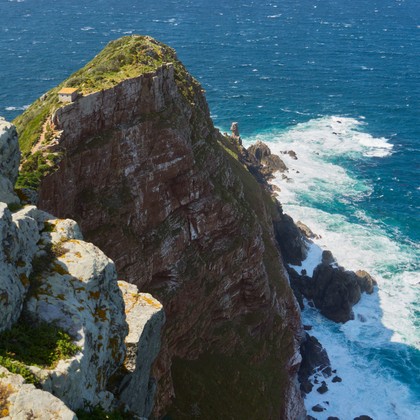
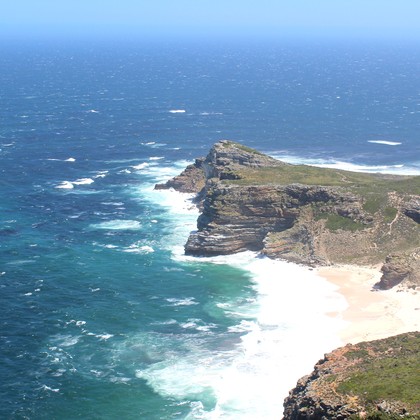
Where the bird is most at home, classified by the vegetation units of southern Africa.
Range and movements
Endemic to the west coast of southern Africa: from Hollamsbird Island south of Walvis Bay in Namibia to Quoin Point near Cape Agulhas in South Africa. The largest colonies are on Mercury and Ichaboe off Namibia; smaller ones on Robben Island, Dyer Island and at Stony Point. It occurs nowhere else in the world.
- Resident
- Summer visitor (c. Oct–Mar)
- dark = core range, pale = thinly spread
How and when to look
Stony Point at Betty’s Bay is the best site: the birds breed there on the rocks beside the penguin colony, together with Cape, Crowned and Great Cormorants, so all four species can be compared side by side. Look for the woolly, dull plumage, the white rump patch and the two-toned eye.
Conservation status
Endangered. The breeding population has fallen by more than half since the 1970s, to a few thousand pairs. The causes are the collapse of rock-lobster stocks and other food sources through overfishing and changes in the Benguela Current, disturbance of colonies, predation by Cape fur seals and gulls, oil pollution and drowning in rock-lobster traps. Most breeding sites lie within protected areas.
Scientific name
Phalacrocorax neglectus | (Wahlberg, 1855)
Wahlberg described the species in 1855 as Graculus neglectus; because it was later moved to another genus, the author and year stand in brackets. The genus Phalacrocorax was introduced in 1760 by Brisson. Phalacrocorax is the Latinised form of Greek phalakrokorax, from phalakros 'bald' and korax 'raven'. neglectus is Latin for 'overlooked' — the species had long gone unrecognised among other cormorants. The specimen the first description was based on came from islands off the coast of Namibia.