All species › Gannets and cormorants › Cormorants › Cape Cormorant
Cape Cormorant | Phalacrocorax capensis
Kaapse aalscholver | Cormorán del Cabo
The Cape Cormorant is the most numerous seabird of the Benguela coast: colonies of tens of thousands of pairs on the guano islands and endless streams of birds flying low over the sea to the fish shoals. The species depends heavily on pilchard and anchovy, and its numbers track the swings in those fish stocks.

Voice
Silent at sea. In the colony a continuous raw croaking and gargling, and a hoarse gaa-gaa-gaa on landing and in greeting.
No recording with a suitable Creative Commons licence is available for this species yet.
Identification
About 63 cm, medium-sized and slim, with a short tail. Adults are glossy blue-black, with bright yellow to orange gular skin at the base of the bill that is brightest in the breeding season. The eye is turquoise to green, with a blue eye-ring. The sexes are alike. Juveniles are brown, with a paler, brownish-grey to dirty-white throat and breast and duller gular skin. It flies in long, undulating lines just above the water, often hundreds to thousands of birds one behind another.
Confusion species
The Bank Cormorant (Phalacrocorax neglectus) is heavier, with dull, woolly blackish-brown plumage, black facial skin and a two-toned eye. The Great Cormorant (Phalacrocorax carbo) is clearly larger with a heavier bill, and adults have a white throat and breast. The Crowned Cormorant (Microcarbo coronatus) is much smaller, with a long tail and a crest. Pale-breasted juvenile Cape Cormorants can resemble juvenile Great Cormorants; check the size and the finer bill.
Habitat
Cold, productive inshore waters of the Benguela Current and the western Agulhas Bank, usually within a few tens of kilometres of the coast. It hunts in large flocks on shoals of pelagic fish, chiefly anchovy and pilchard, and in Namibia also gobies. It breeds in dense colonies on flat islands, coastal rocks, guano platforms and at times on jetties and wrecks; the nest is a flat heap of seaweed, sticks and feathers.
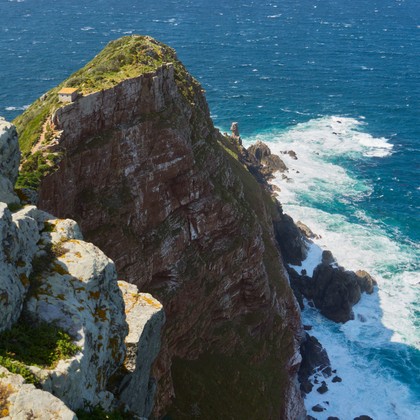
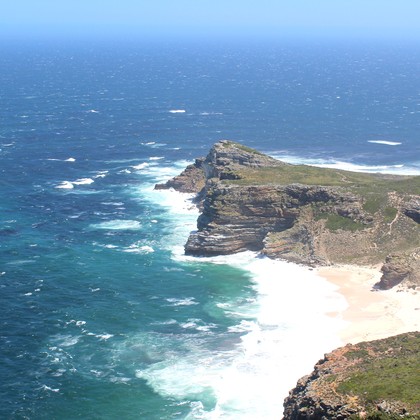
Where the bird is most at home, classified by the vegetation units of southern Africa.
Range and movements
Breeds along the west coast of Namibia and South Africa, from the Walvis Bay and Swakopmund area to the Cape Peninsula and in smaller numbers east to Algoa Bay; the largest colonies are on the islands and guano platforms of Namibia and the South African west coast. Outside the breeding season birds spread along the coast, in the west into Angola and in the east to KwaZulu-Natal and occasionally southern Mozambique. It occurs nowhere else in the world.
- Resident
- Summer visitor (c. Oct–Mar)
- Winter visitor (c. Apr–Sep)
- Passage (Mar–Apr, Oct–Nov)
- dark = core range, pale = thinly spread
How and when to look
From the shore at Lambert’s Bay, Saldanha Bay, Cape Point or Walvis Bay, the long streams of birds commuting between roosts and the sea are visible in the morning and afternoon. Over a fish shoal thousands of birds may plunge in together, often with Cape Gannets. The guano platforms near Walvis Bay and Swakopmund hold large colonies visible from the coast.
Conservation status
Endangered. The world population has fallen steeply over three generations, from well over a hundred thousand pairs to a fraction of that in poor years. The main causes are the collapse and shift of the pilchard stock through overfishing and changes in the Benguela Current, repeated outbreaks of avian cholera and avian influenza in the colonies, oil pollution, disturbance and predation by Cape fur seals and gulls. Oiled and weakened birds are taken in and rehabilitated by SANCCOB.
Scientific name
Phalacrocorax capensis | (Sparrman, 1788)
Sparrman described the species in 1788 as Pelecanus capensis; because it was later moved to another genus, the author and year stand in brackets. The genus Phalacrocorax was introduced in 1760 by Brisson. Phalacrocorax is the Latinised form of Greek phalakrokorax, from phalakros 'bald' and korax 'raven'. capensis is Latin for 'of the Cape' — for the Cape of Good Hope, where the first specimen was collected. The specimen the first description was based on came from False Bay, Cape of Good Hope.