All species › Cuckoos › Cuckoos › Dusky Long-Tailed Cuckoo
Dusky Long-Tailed Cuckoo | Cercococcyx mechowi
Grijze langstaartkoekoek | Cuco Colilargo Oscuro
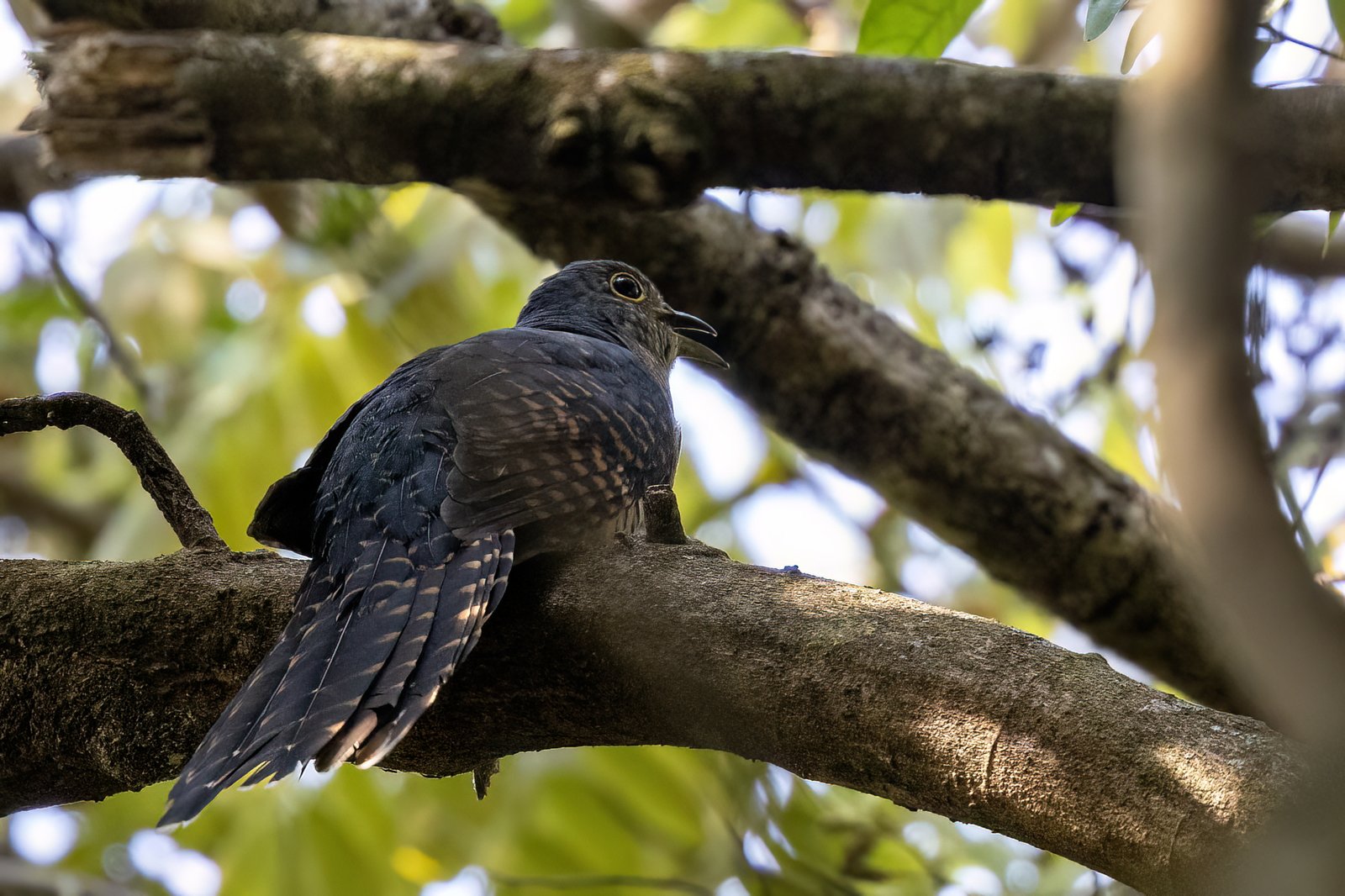
The Dusky Long-Tailed Cuckoo is a shy, dark cuckoo of the Central African rainforest that reaches the region only in northern Angola. With its long, graduated tail and short wings it looks more like a sparrowhawk than a cuckoo, but nearly all records are based on its call.
Voice
A three-part whistled phrase, hu-hee-wheeu, the middle note highest and the last long and falling; also a series of notes that first accelerates, then slows and descends. It often calls from the canopy, sometimes in pairs, and also at dusk and by moonlight.
Recording: isaac kilusu — CC BY-NC-SA 4.0 · converted to mono · xeno-canto
Identification
32–33 cm, half of it tail. Dark brown above with a purple-blue gloss; the wing coverts and flight feathers carry small buff and white spots. The underparts are white to off-white with broad blackish-brown bars, densest on breast and flanks. The tail is long and graduated, dark with pale spots along the edges and white tips. The sexes are alike. Juveniles have a blackish throat and rufous fringes on the upperparts. Flight is fast and direct through the forest, with the long tail used as a rudder.
Confusion species
Olive Long-Tailed Cuckoo (Cercococcyx olivinus) occurs in the same forest and is barely separable in the field: it is warmer olive-brown above, lacks the purple gloss, has fewer wing spots and gives a different call. Seen briefly, the species resembles an immature accipiter such as African Goshawk (Aerospiza tachiro), but that has a heavier head, a shorter tail and yellow legs.
Habitat
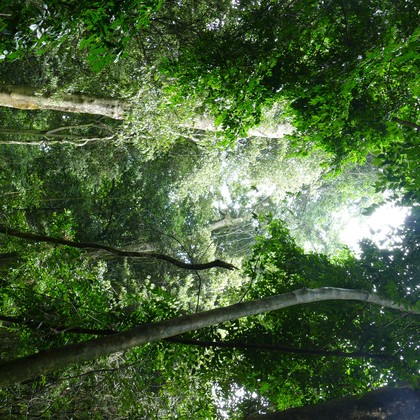
Humid lowland rainforest with dense undergrowth and lianas, as well as tall secondary forest and gallery forest along rivers. It forages in the undergrowth and mid-storey, mainly on caterpillars. As a brood parasite, known hosts include Blue-Headed Crested Flycatcher and Brown Illadopsis.
Where the bird is most at home, classified by the vegetation units of southern Africa.

Range and movements
Within the region only in northern Angola, in the rainforest remnants of Cabinda, Uíge, Cuanza Norte and the Lunda provinces. Beyond the region it ranges through the Congo Basin, from Cameroon and Gabon east to Uganda and western Tanzania.
How and when to look
Only to be searched for deliberately in the northern forests of Angola, and then by call, especially at the start of the rains. Stand still near a calling bird and scan the mid-storey: it sits motionless on a horizontal branch and only gives itself away when it flicks its tail or flies. Listening to a recording beforehand helps to separate it from Olive Long-Tailed Cuckoo.
Conservation status
Not threatened; the population is considered stable within the vast Central African forest block. In Angola it is poorly known and depends on fragmented forest remnants under pressure from logging and farming.
Scientific name
Cercococcyx mechowi | Cabanis, 1882
Cabanis described the species in 1882 and placed it straight away in the genus where it still stands. He introduced the genus Cercococcyx in that same work. Cercococcyx comes from the Greek kerkos, 'tail', and kokkyx, 'cuckoo' — for the exceptionally long tail. mechowi honours the Prussian major and explorer Friedrich Wilhelm Alexander von Mechow (1831–1890), who collected in Angola in 1873–1875 and 1879–1882. The specimen the first description was based on came from Angola.