All species › Passerines › Chats and flycatchers › East Coast Akalat
East Coast Akalat | Sheppardia gunningi
Blauwvleugelakalat | Akelat de Gunning
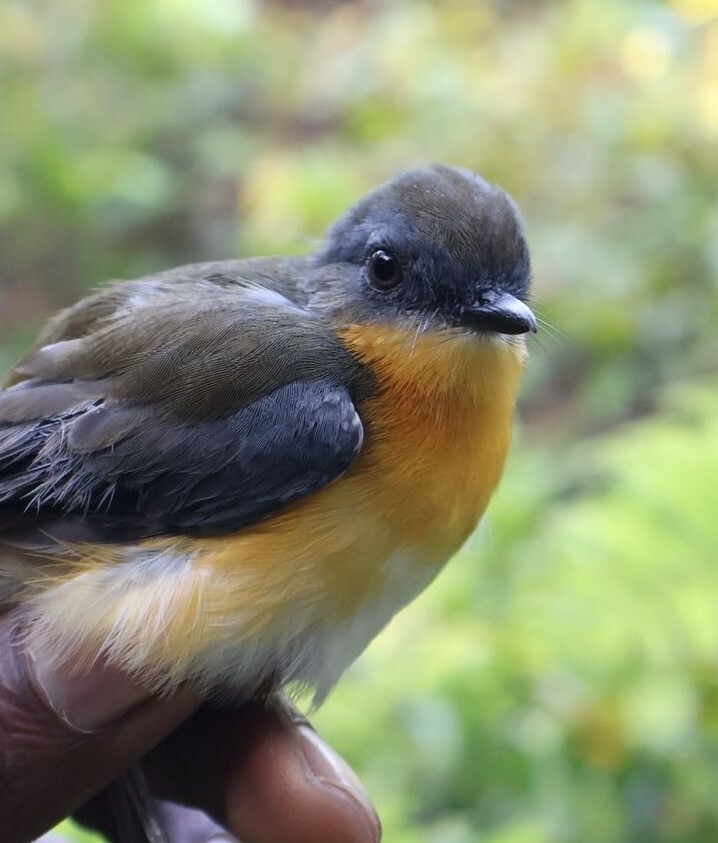
The East Coast Akalat is a small, shy robin of the undergrowth of dry and moist lowland forest along the East African coast. Within the region it occurs in the coastal forests of central Mozambique and in a small area by Lake Malawi; its blue-grey wing coverts gave it its Dutch name.
Voice
The song is a high, thin series of short, pure whistles, often with small jumps in pitch, soft and hard to locate. The alarm is a dry, rattling trrrt, sometimes followed by a soft tseep. It sings mainly at the start of the rainy season, at dawn.
Recording: Lars Lachmann — CC BY-NC-SA 4.0 · converted to mono · xeno-canto
Identification
A small, round akalat of 12 to 13 cm. Crown and back are olive-brown, the lesser and median wing coverts and the edges of the secondaries slate- to blue-grey. A short white stripe above the lores gives the face a spectacled look. Throat and breast are bright orange, the flanks greyish olive and the centre of the belly white. The tail is brown. Sexes alike. Juveniles are dark brown with buff spots. It sits low and still in shade and makes short hops to the forest floor.
Confusion species
Sharpe's Akalat (Sheppardia sharpei) lacks the blue-grey wing and lives in montane forest; they do not overlap within the region. Swynnerton's Robin (Swynnertonia swynnertoni) has a slate-grey head and a white breast patch with a black band. Brown Scrub Robin (Tychaedon signata) and Forest Scrub Robin (Tychaedon leucosticta) have white wing bars and white tail tips and lack an orange breast. Red-Capped Robin-Chat (Cossypha natalensis) is much larger and entirely orange below, with an orange tail.
Habitat
Undergrowth of evergreen and semi-evergreen lowland forest, dry coastal forest and riverine forest, mostly below 500 m, in Malawi up to about 1000 m. Forages on and just above the forest floor for small insects and sometimes follows driver-ant swarms.
Where the bird is most at home, classified by the vegetation units of southern Africa.


Range and movements
In Mozambique in the lowland forests of the centre of the country, from the Beira and Dondo area north via Cheringoma and the Zambezi delta to Catapu Forest near Caia, and locally further north. In Malawi only the subspecies bensoni, in the lowland forests along Lake Malawi around Nkhata Bay. Beyond the region along the coast of Tanzania and Kenya.
- Resident
- Summer visitor (c. Oct–Mar)
- Passage (Mar–Apr, Oct–Nov)
- dark = core range, pale = thinly spread
How and when to look
Catapu Forest (M’phingwe) near Caia and the forest remnants around Nkhata Bay are the most visited sites. Walk slowly along forest trails in the early morning, stop where the undergrowth opens up and listen for the dry rattling alarm. Watch the low layer just above the ground: the orange breast then glows briefly.
Conservation status
Near Threatened. Its habitat consists of highly fragmented lowland forests that are disappearing rapidly through logging, charcoal production and conversion to farmland. The Malawian population is particularly small and confined to a few forest remnants.
Scientific name
Sheppardia gunningi | Haagner, 1909
Haagner described the species in 1909 and placed it straight away in the genus where it still stands. He introduced the genus Sheppardia in that same work. Sheppardia honours P. A. Sheppard, a farmer and bird collector near Beira in Mozambique, who found the first specimen of East Coast Akalat. gunningi honours the Dutch physician and zoologist Jan Gunning (1860–1913), director of the Transvaal Museum in Pretoria. The specimen the first description was based on came from Mzimbiti near Beira, Mozambique.