All species › Passerines › Chats and flycatchers › Gabela Akalat
Gabela Akalat | Sheppardia gabela
Gabela-akalat | Akelat de Gabela
The Gabela Akalat is a small, inconspicuous robin found only in the forests of Angola's western escarpment around the town of Gabela. It is one of the key species of this area and one of the most threatened birds in the whole region covered by this guide.

Voice
The song is a simple, sweet series of high, clear whistles, often slightly descending and repeated from cover, mainly in the early morning. The alarm is a dry, rattling trrrt. Song and alarm are the best way to find the bird.
Recording: Ken Behrens — CC BY-NC-SA 4.0 · converted to mono · xeno-canto
Identification
A small akalat of 12 to 13 cm. The upperparts are plain olive-brown, the tail slightly warmer rufous-brown. The face is greyish, with a pale stripe above the lores. Throat and breast are warm orange-tawny, the flanks olive-grey and the centre of the belly whitish. The eye is large and dark, the legs pinkish-grey. Sexes alike. Juveniles are dark with buff spots. It lives low in the undergrowth, sits still for long periods and drops to the ground onto prey.
Confusion species
Bocage's Akalat (Sheppardia bocagei) is slightly larger, with a more orange-rufous head and breast and a rufous tail, and lives mainly higher on the plateau. Forest Scrub Robin (Tychaedon leucosticta), which lives in the same forests, has white wing bars and white tail tips and no orange breast. In the field, a small, upright, orange-breasted robin in escarpment forest around Gabela, together with its song, is enough.
Habitat
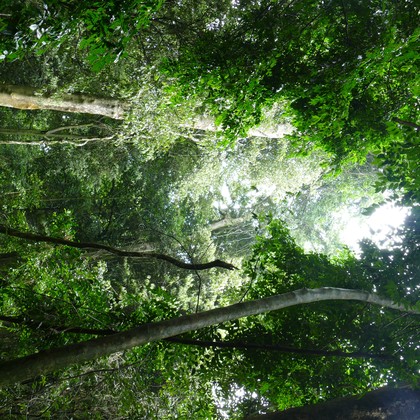
Undergrowth of moist evergreen escarpment forest, forest edges and older secondary growth, also shade-coffee plantations under tall trees, between about 800 and 1300 m. Prefers dense, shady undergrowth. Forages on the ground and low in the undergrowth for small invertebrates.
Where the bird is most at home, classified by the vegetation units of southern Africa.
Range and movements
Endemic to Angola: only in a small area on the western escarpment in Cuanza Sul, around Gabela, Kumbira Forest and surrounding forest remnants in the Amboim area. The total range covers about 1000 km². The species occurs nowhere outside Angola.
- Resident
- dark = core range, pale = thinly spread
How and when to look
Kumbira Forest near Conda and the forest remnants around Gabela are where the species is most often seen. Go out early, preferably with a local guide, and listen for the high whistled series and the rattling alarm; the bird often then comes to look from a low branch. Combine the visit with the other escarpment endemics, such as Gabela Bushshrike and Monteiro's Bushshrike.
Conservation status
Endangered. The species has a very small range, and the escarpment forest around Gabela is being cleared rapidly for crops and charcoal and through thinning of shade trees in coffee plantations. There are no formally protected areas within its range; protection of Kumbira Forest is of great importance for this and other endemic species.
Scientific name
Sheppardia gabela | (Rand, 1957)
Rand described the species in 1957 as Muscicapa gabela; because it was later moved to another genus, the author and year stand in brackets. The genus Sheppardia was introduced in 1909 by Haagner. Sheppardia honours P. A. Sheppard, a farmer and bird collector near Beira in Mozambique, who found the first specimen of East Coast Akalat. gabela refers to Gabela in western Angola, near which town the species was discovered. The specimen the first description was based on came from 15 km south of Gabela, Angola.