All species › Passerines › Chats and flycatchers › Herero Chat
Herero Chat | Namibornis herero
Hererotapuit | Papamoscas Herero
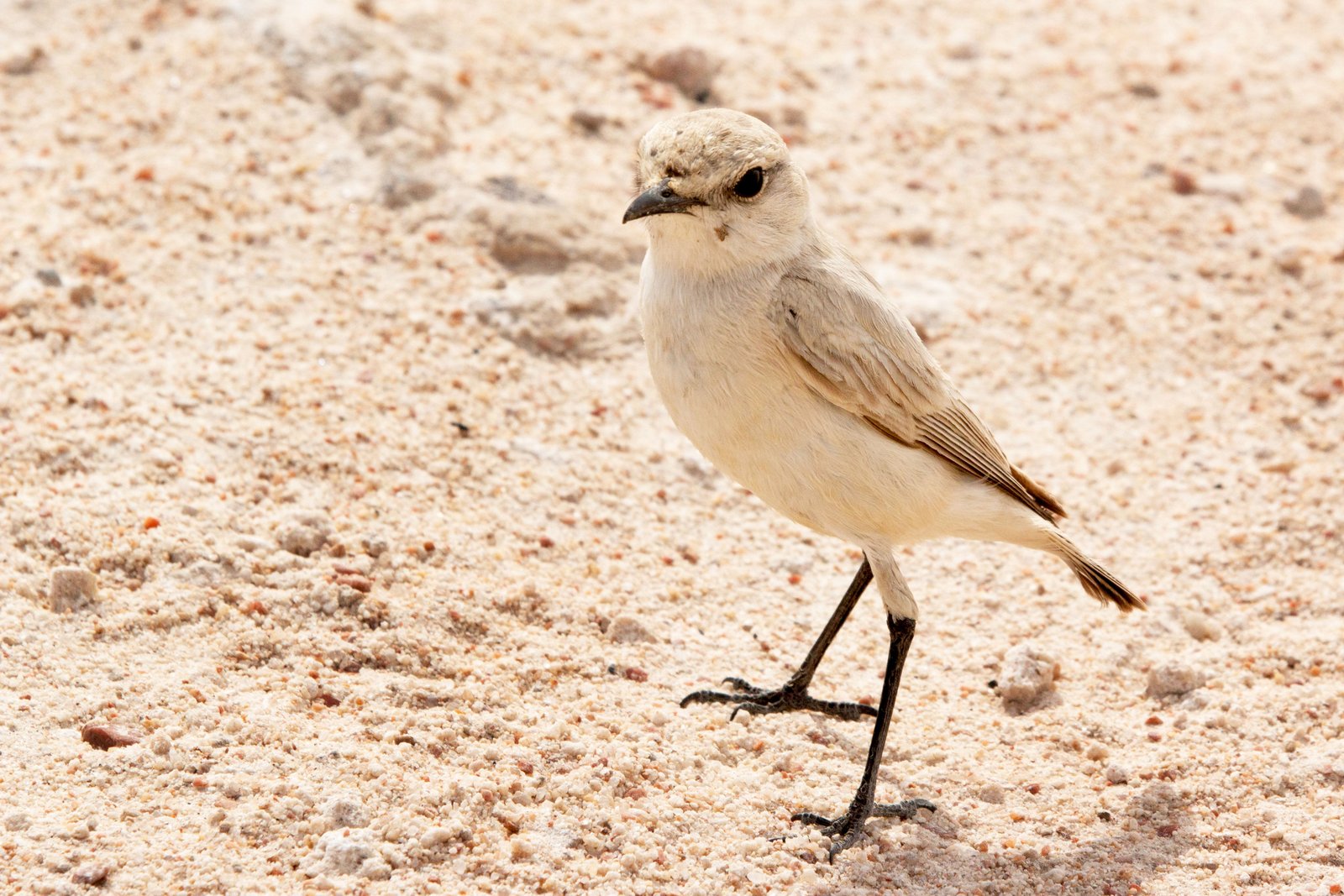
The Herero Chat is an unobtrusive grey-brown flycatcher of the dry rocky slopes along the Namibian escarpment, one of the region's most sought-after near-endemics. It sits quietly and low in the shade of a bush or small tree, and is noticed mostly by its rufous rump as it flies off.
Voice
The song is a short, clear and melodious phrase of a few whistles, roughly twee-deedle-oo-dee, mainly early in the morning and in the breeding season during the summer rains. A soft chik and a dry trrr serve as contact and alarm calls. Outside the breeding season the species is largely silent and often overlooked.
Recording: Bram Vogels — CC BY-NC-SA 4.0 · shortened to the first 60 s, mono · xeno-canto
Identification
16–17 cm, a slender, upright bird with a fairly long tail. The upperparts are grey-brown, the rump and tail base warm rufous, and the tail tip and central feathers dark brown. The head shows a clear white supercilium above a dark eye-stripe and a pale cheek with a thin dark malar stripe. The underparts are dull white with fine dark streaks on throat and breast. Bill and legs are black. The sexes are alike; juveniles are lightly spotted above. It drops from a low branch to the ground to seize an insect and then returns to a shady perch.
Confusion species
Chat Flycatcher (Agricola infuscatus) is larger, plain brown without a supercilium or rufous rump and shows a pale wing panel; it also perches openly on bush tops. Familiar Chat (Oenanthe familiaris) has a rufous tail with a dark T pattern, no breast streaks and constantly flicks its wings. Kalahari Scrub Robin (Cercotrichas paena) has a rufous tail with black-and-white tips that it cocks and fans, and usually sits on the ground in sandy thornveld. Female Short-Toed Rock Thrush (Monticola brevipes) is scaled on the breast and has wholly rufous outer tail feathers.
Habitat
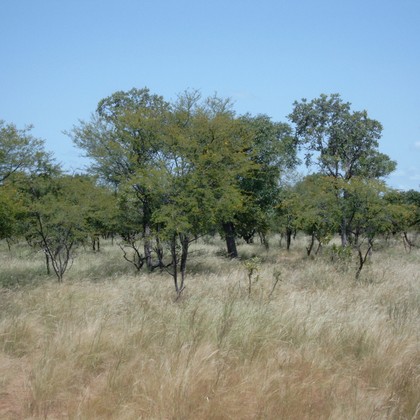
Dry, rocky slopes, hill bases and inselbergs with scattered trees and shrubs such as Commiphora, acacias and mopane, especially in the transition zone between the Namib Desert and the plateau. It forages for insects taken on the ground from a low perch. The nest is a small cup in a tree fork, often in a Commiphora; it breeds after the summer rains.
Where the bird is most at home, classified by the vegetation units of southern Africa.

Range and movements
Almost confined to the region: a narrow belt along the western escarpment of Namibia, from the Naukluft and the Rehoboth area north through the Erongo, Spitzkoppe, Brandberg and Damaraland to the Kaokoveld, and on into south-western Angola (Namibe province and the foot of the escarpment in Huíla). The species occurs nowhere else.
- Resident
- Passage (Mar–Apr, Oct–Nov)
- dark = core range, pale = thinly spread
How and when to look
Look for it in the Erongo and around the Spitzkoppe, and on rocky slopes in Damaraland near Kamanjab and Hobatere. Walk slowly in the early morning along the foot of rocky hills with scattered Commiphora bushes and watch for a grey bird sitting low in the shade and dipping briefly to the ground. After the summer rains, from February to April, it sings most and is most often found.
Conservation status
Not threatened; formerly regarded as sensitive, but the population has proved larger and more stable than thought. Its habitat is sparsely populated and little threatened, although overgrazing and woodcutting on rocky hill bases can degrade the vegetation locally.
Scientific name
Namibornis herero | (Meyer de Schauensee, 1931)
Meyer de Schauensee described the species in 1931 as Bradornis herero; because it was later moved to another genus, the author and year stand in brackets. The genus Namibornis was introduced in 1935 by Bradfield. Namibornis combines 'Namib' with the Greek ornis, 'bird' — for the Namib Desert and its escarpment, home of Herero Chat. herero refers to the Herero people and former Hereroland (Damaraland) in Namibia, where the species was discovered. The specimen the first description was based on came from Karibib, Namibia.