All species › Passerines › Chats and flycatchers › Short-Toed Rock Thrush
Short-Toed Rock Thrush | Monticola brevipes
Kortteenrotslijster | Roquero de Namibia
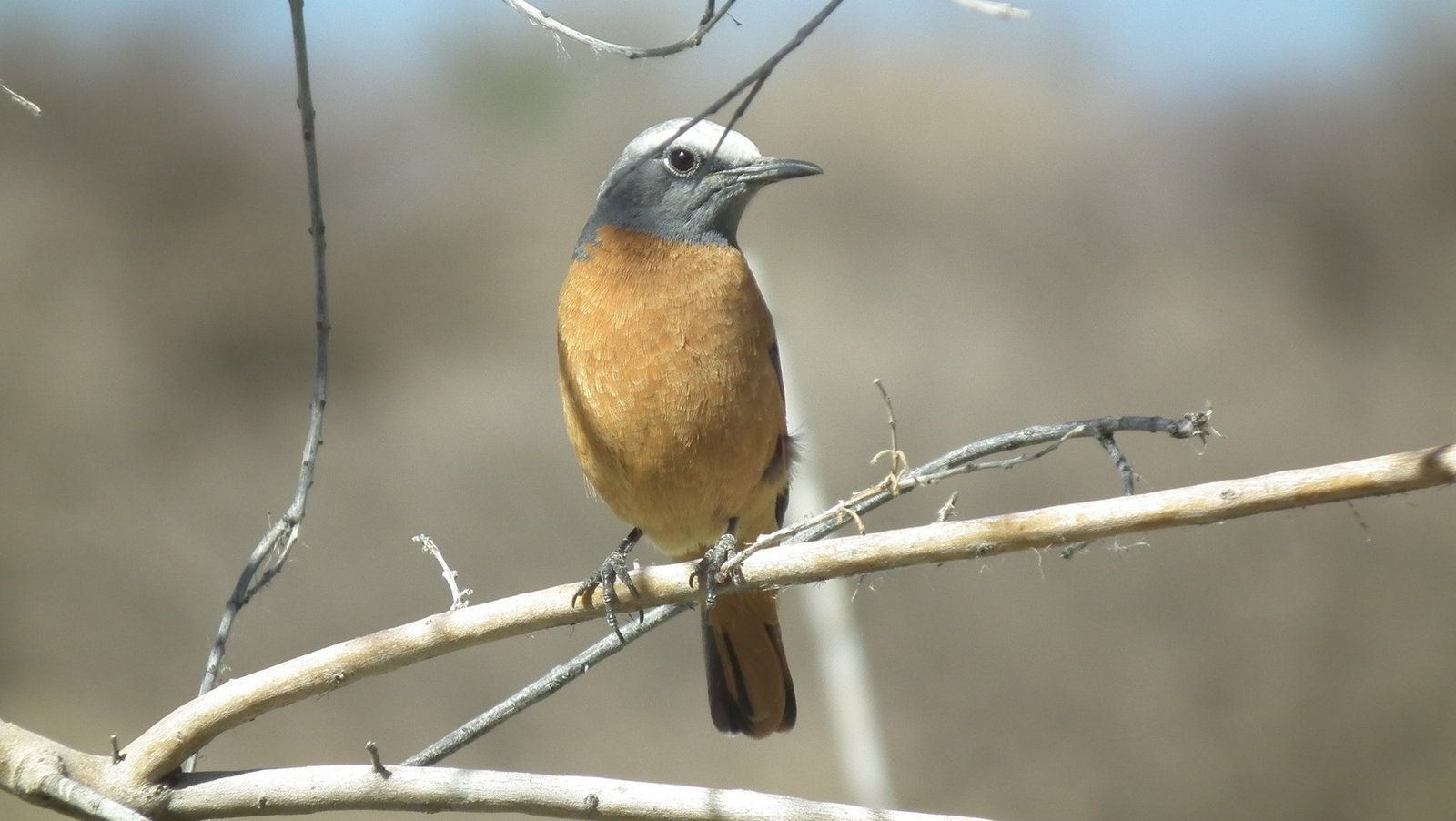
The Short-Toed Rock Thrush is the rock thrush of the dry rocky hills and cliffs of the west and north of southern Africa. The male perches upright on a boulder or a roof edge and stands out by its pale crown and orange belly. An eastern form lives in the hills around Pretoria and in the Waterberg.
Click a thumbnail to switch the photo above.
Voice
The song is a varied series of clear whistles and scratchy notes, often including mimicry of other birds, delivered from a rock or a roof. The call is a soft chee or tseet and a dry, grating alarm.
Recording: Joris Komen — CC BY-SA 4.0 · converted to mono · xeno-canto
Identification
A slim rock thrush of 18 cm with rather short legs and toes. The male has a blue-grey head and throat with a conspicuously pale, almost white crown and forehead (greyer and less contrasting in the east), a grey-brown mantle without blue, and bright orange-red breast, belly and rump. The tail is orange-red with dark central feathers. The female is grey-brown above, with a whitish throat with dark spotting, and orange underparts. It sits still for long periods on a lookout and drops to the ground for insects; it bobs its tail.
Confusion species
Cape Rock Thrush (Monticola rupestris) is larger and heavier, with a brown back and a blue-grey head without a pale crown; the female has a brown head. Sentinel Rock Thrush (Monticola explorator) has blue-grey extending over the mantle, wing coverts and upper breast, and lives in grassy mountains in the east and south. Familiar Chat (Oenanthe familiaris) is smaller and plain grey-brown with only a rusty rump and tail, and constantly flicks its wings.
Habitat
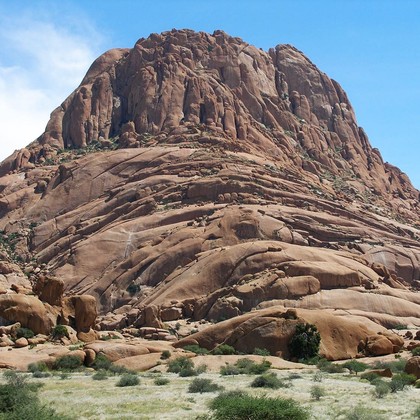
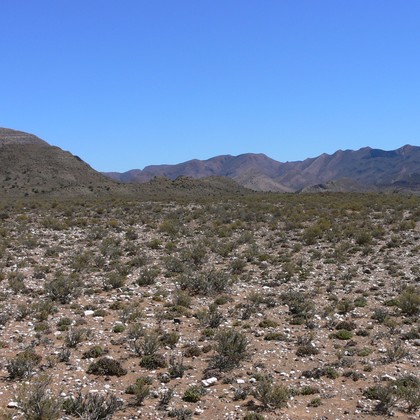
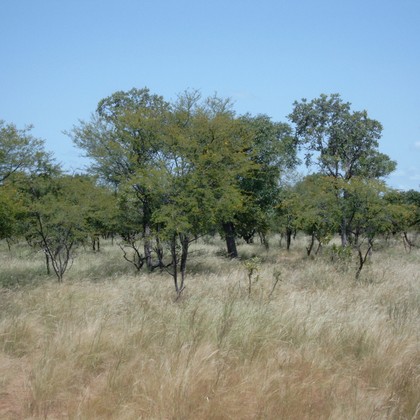
Rocky hills, koppies, cliffs and gorges in dry savanna and karoo landscapes with scattered bushes and trees; also around farmsteads and mountain huts. In the east in rocky, wooded hill country with bushveld.
Where the bird is most at home, classified by the vegetation units of southern Africa.
Range and movements
Near-endemic to southern Africa. Widespread in Namibia, from the Kaokoveld and central highlands to the Orange River, and in extreme south-western Angola; also in the Northern Cape, western Free State, North West, Gauteng and Limpopo, and in south-eastern Botswana. In winter some birds appear in lower, flatter country outside the breeding range. It does not occur outside the region.
- Resident
- Winter visitor (c. Apr–Sep)
- dark = core range, pale = thinly spread
How and when to look
In Namibia and the Northern Cape scan rocky hills from the road: the male often sits on top of a large boulder and shows its orange-red tail on landing. The pale crown is the best feature compared with Cape Rock Thrush. Around Pretoria and in the Magaliesberg the eastern form can be found on wooded rocky ridges.
Conservation status
Not threatened. The species has a large range and numbers appear stable. Its rocky habitat is little threatened, although local urbanisation around Gauteng may reduce the eastern population.
Scientific name
Monticola brevipes | (Waterhouse, 1838)
Waterhouse described the species in 1838 as Petrocincla brevipes; because it was later moved to another genus, the author and year stand in brackets. The genus Monticola was introduced in 1822 by Boie. Monticola is Latin for 'mountain-dweller', from mons, montis 'mountain' and colere 'to dwell'. brevipes comes from the Latin brevis, 'short', and pes, 'foot' — for the short toes and legs compared with Sentinel Rock Thrush. The specimen the first description was based on came from Tans Mountain near Walvis Bay, Namibia.