All species › Passerines › Chats and flycatchers › Sentinel Rock Thrush
Sentinel Rock Thrush | Monticola explorator
Langteenrotslijster | Roquero Centinela
The Sentinel Rock Thrush is the rock thrush of the grassy mountain slopes of South Africa, Lesotho and Eswatini. It likes to perch like a sentinel on a boulder above open grassland. In winter many birds move from the highest parts to lower slopes and even to the coastal plain.
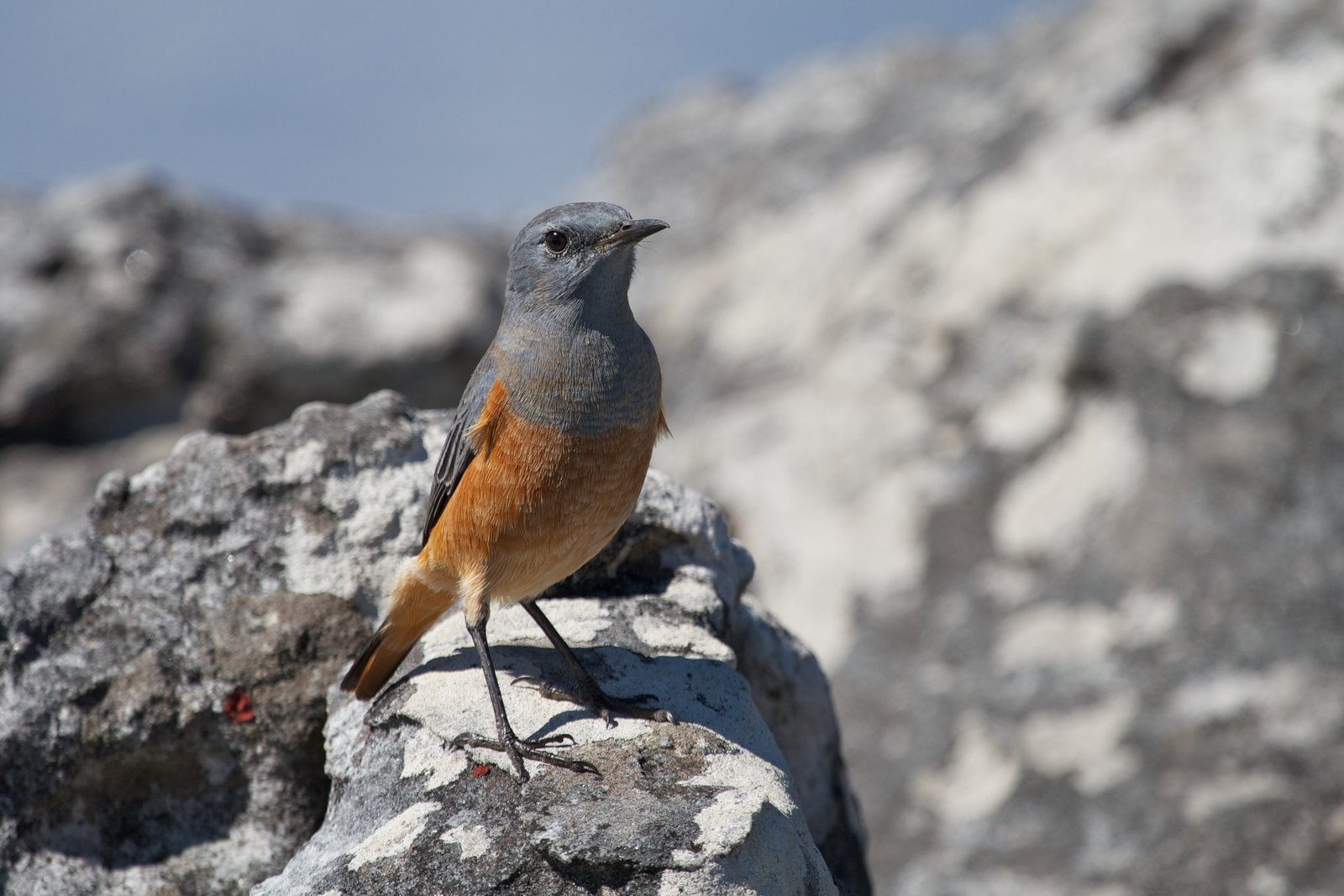
Click a thumbnail to switch the photo above.
Voice
The song is a series of short, clear whistles and softer scratchy notes, less loud and less melodious than that of Cape Rock Thrush, often with mimicry. Calls are a soft, whistled chee-chee and a grating chak in alarm.
Recording: Lynette Rudman — CC BY-NC-SA 4.0 · converted to mono · xeno-canto
Identification
A rock thrush of 18 cm with long legs and toes. The male is blue-grey on the head, throat, upper breast, mantle and wing coverts, so that the blue-grey falls like a cape over the back and shoulders; the rest of the underparts and the rump are orange, the tail orange with brown central feathers. The female is brown above, with a whitish throat, a brown-mottled breast and a dull orange-brown belly. It stands upright on rocks or posts and runs quickly over the ground after insects.
Confusion species
Cape Rock Thrush (Monticola rupestris) is larger, with a brown back and wings; in the male the blue-grey reaches only the throat. The female has a brown head and plainer, richer orange underparts. Short-Toed Rock Thrush (Monticola brevipes) has a pale crown and a grey-brown back without blue, and lives in dry rocky terrain in the west and north. Familiar Chat (Oenanthe familiaris) is smaller and plain grey-brown with a rusty tail.
Habitat
Short, rocky grassland and fynbos on mountain slopes and plateaus, mainly above 1,500 m in the east and lower in the Cape mountains; also rocky field edges and bare eroded slopes. In winter also in lower-lying grassland, renosterveld and the edge of the Karoo.
Where the bird is most at home, classified by the vegetation units of southern Africa.


Range and movements
Endemic to South Africa, Lesotho and Eswatini. Breeds in the Cape Fold Mountains of the Western Cape, the mountains of the Eastern Cape, the Drakensberg and highlands of KwaZulu-Natal, the eastern Free State, Lesotho, the Mpumalanga highveld and western Eswatini. In winter many birds descend to lower slopes, mid-altitude grassland and locally to the coast. It does not occur outside the region.
- Resident
- Summer visitor (c. Oct–Mar)
- Winter visitor (c. Apr–Sep)
- dark = core range, pale = thinly spread
How and when to look
In summer best found on the high passes of the Drakensberg and in Lesotho, for example along Sani Pass, where the birds perch on boulders beside the road. In a male look for the extensive blue-grey ‘cape’ down onto the shoulders; in a female for the mottled breast. After the first frosts the species also appears on lower slopes.
Conservation status
Near Threatened. Atlas data show a clear decline, linked to climate change, loss of high-altitude grassland to afforestation and agriculture, and overgrazing and changes in fire management in the mountains.
Scientific name
Monticola explorator | (Vieillot, 1818)
Vieillot described the species in 1818 as Turdus explorator; because it was later moved to another genus, the author and year stand in brackets. The genus Monticola was introduced in 1822 by Boie. Monticola is Latin for 'mountain-dweller', from mons, montis 'mountain' and colere 'to dwell'. explorator is Latin for 'scout, spy' — for its habit of scanning its surroundings from a lookout on a rock. The specimen the first description was based on came from mountains near the Cape of Good Hope.