All species › Passerines › Chats and flycatchers › Cape Rock Thrush
Cape Rock Thrush | Monticola rupestris
Kaapse rotslijster | Roquero del Cabo
The Cape Rock Thrush is the largest and best-known rock thrush of southern Africa, a robust orange-and-grey bird of rocky slopes, cliffs and mountain passes. It sings loudly from rocks, houses and telephone poles and is often tame around mountain huts and farmsteads.

Click a thumbnail to switch the photo above.
Voice
The song is a loud, clear series of descending whistles, like chee-chee-choo-choo-churr, often repeated from a high perch, especially early in the morning and in the breeding season from August to January. Calls are a soft chak and a whistled chooee.
Recording: Tim Cockcroft — CC BY-NC-SA 4.0 · converted to mono · xeno-canto
Identification
A robust rock thrush of 21 cm. The male has a blue-grey head and throat that contrast sharply with the rich orange-red breast, belly and rump; back and wings are brown. The tail is rusty orange with dark central feathers. The female has a brown, finely mottled head, a brown back and slightly duller orange underparts. It stands upright on a lookout, bobs its tail and drops to the ground for insects, lizards and berries.
Confusion species
Sentinel Rock Thrush (Monticola explorator) is smaller; in the male the blue-grey extends over the mantle, wing coverts and upper breast, and the female has a mottled breast. Short-Toed Rock Thrush (Monticola brevipes) is slimmer with a pale, almost white crown and lives mainly in the dry west and north. The female Cape Rock Thrush can resemble Olive Thrush (Turdus olivaceus), but that species has an orange bill, a streaked throat and no orange tail.
Habitat
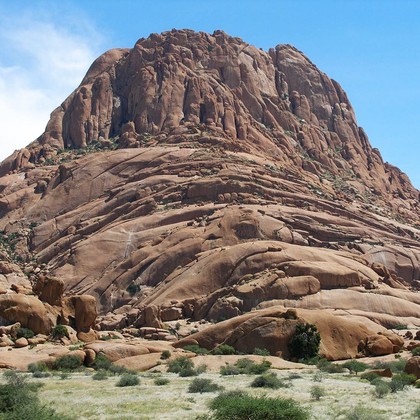
Rocky mountain slopes, cliffs, gorges and koppies with grassland, fynbos or scrub, from sea level on the Cape coast to above 2,000 m; also around farmsteads, mountain villages and rocky road cuttings.
Where the bird is most at home, classified by the vegetation units of southern Africa.


Range and movements
Endemic to South Africa, Lesotho and Eswatini. Widespread in the Western and Eastern Cape, KwaZulu-Natal, the eastern Free State, Lesotho, Mpumalanga, Gauteng and the east and north of Limpopo (to the Soutpansberg), and in western Eswatini; absent from the arid north-west and the lowveld. It does not occur outside the region.
- Resident
- Passage (Mar–Apr, Oct–Nov)
- dark = core range, pale = thinly spread
How and when to look
Easiest to see on mountain passes in the Western Cape and the Drakensberg, for example at Cape Point, in the Cederberg or on Sani Pass, where it perches on rocks and roofs. A male with blue-grey confined to the head and a brown back is the key; for a female in rocky terrain, the orange tail on take-off helps.
Conservation status
Not threatened. The species is fairly common, tolerates people well and even breeds on buildings. No major threats are known, although it declines locally where mountain slopes become overgrown with alien trees.
Scientific name
Monticola rupestris | (Vieillot, 1818)
Vieillot described the species in 1818 as Turdus rupestris; because it was later moved to another genus, the author and year stand in brackets. The genus Monticola was introduced in 1822 by Boie. Monticola is Latin for 'mountain-dweller', from mons, montis 'mountain' and colere 'to dwell'. rupestris is Latin for 'rock-dwelling', from rupes, 'rock' — for its rocky habitat. The specimen the first description was based on came from Table Mountain, Cape Town, South Africa.