All species › Passerines › Chats and flycatchers › Miombo Rock Thrush
Miombo Rock Thrush | Monticola angolensis
Miomborotslijster | Roquero Angoleño
The Miombo Rock Thrush is the only rock thrush that lives in woodland: a quiet, unobtrusive inhabitant of open miombo, often near rocky hills. It sits motionless for long periods on a low branch and often blends in against bark and canopy.
Voice
The song is a soft, melodious series of whistles and trills, interspersed with scratchy notes, often from a high branch in the breeding season from September to November. Calls are a soft, whistled chee-oo and a dry chak.
Recording: Dries Van de Loock — CC BY-NC-SA 4.0 · converted to mono · xeno-canto
Identification
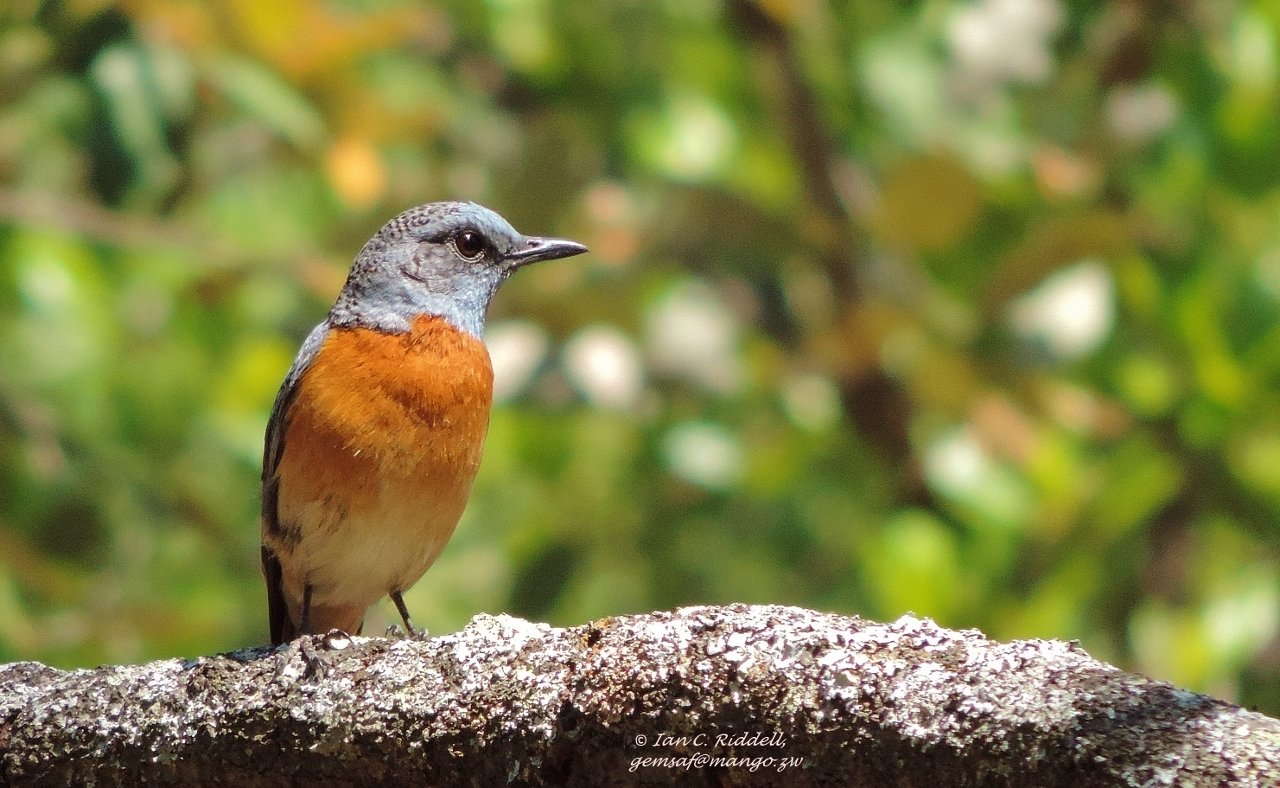
A compact rock thrush of 17 cm. The male has a blue-grey head, throat and mantle with dark scaly or streaked markings on the crown and back, an orange breast and flanks and a white belly and undertail coverts. Wings brown, tail orange-brown with dark central feathers. The female is mottled brown above, with a white throat bordered by a bold black malar stripe, and an orange, finely spotted breast. It perches upright on a branch, drops to the ground for insects and then returns to a perch.
Confusion species
Short-Toed Rock Thrush (Monticola brevipes) and Cape Rock Thrush (Monticola rupestris) do not occur in miombo and live further south and west on rocks; both lack the white belly and streaked back. Kurrichane Thrush (Turdus libonyana) has an orange bill, a grey-brown back and a white throat with black malar stripes, but no orange tail. If in doubt, watch for the orange tail when the bird flies.
Habitat
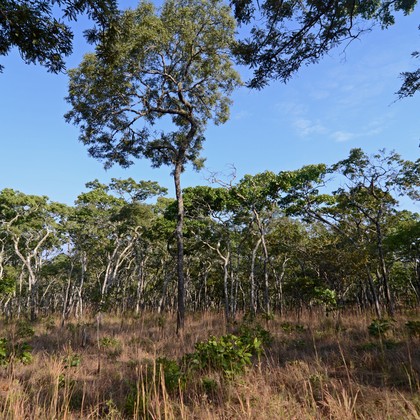
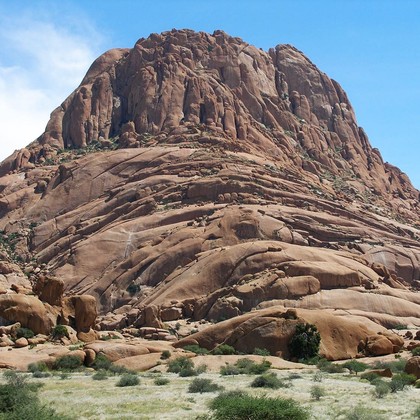
Open, mature miombo and other deciduous woodland with little undergrowth, especially on slopes and around rocky koppies and granite domes; up to about 2,000 m.
Where the bird is most at home, classified by the vegetation units of southern Africa.
Range and movements
Within the region in the miombo belt: the central plateau of Angola, Zambia (especially the north, east and centre), Malawi, northern and eastern Zimbabwe (Mashonaland and the Eastern Highlands) and western and northern Mozambique (Tete, Manica, Niassa). Beyond the region in southern DR Congo and Tanzania.
- Resident
- dark = core range, pale = thinly spread
How and when to look
Search open miombo around granite domes and rocky hills early in the morning, for example around Harare or at Kasanka and Nyika, and scan the lower branches for an upright bird. It is usually noticed as it drops to the ground and shows its orange tail. From September to November the song gives it away.
Conservation status
Not threatened. The species is widespread but scarce and local. The ongoing clearance of miombo for cultivation and charcoal reduces its habitat, particularly in Malawi and Zimbabwe.
Scientific name
Monticola angolensis | Sousa, 1888
Sousa described the species in 1888 and placed it straight away in the genus where it still stands. The genus Monticola was introduced in 1822 by Boie. Monticola is Latin for 'mountain-dweller', from mons, montis 'mountain' and colere 'to dwell'. angolensis means 'from Angola', where the first specimen was collected. The specimen the first description was based on came from Caconda, Angola.