All species › Passerines › Swallows and martins › Eastern Red-Rumped Swallow
Eastern Red-Rumped Swallow | Cecropis daurica
Oostelijke roodstuitzwaluw | Golondrina Dáurica Oriental
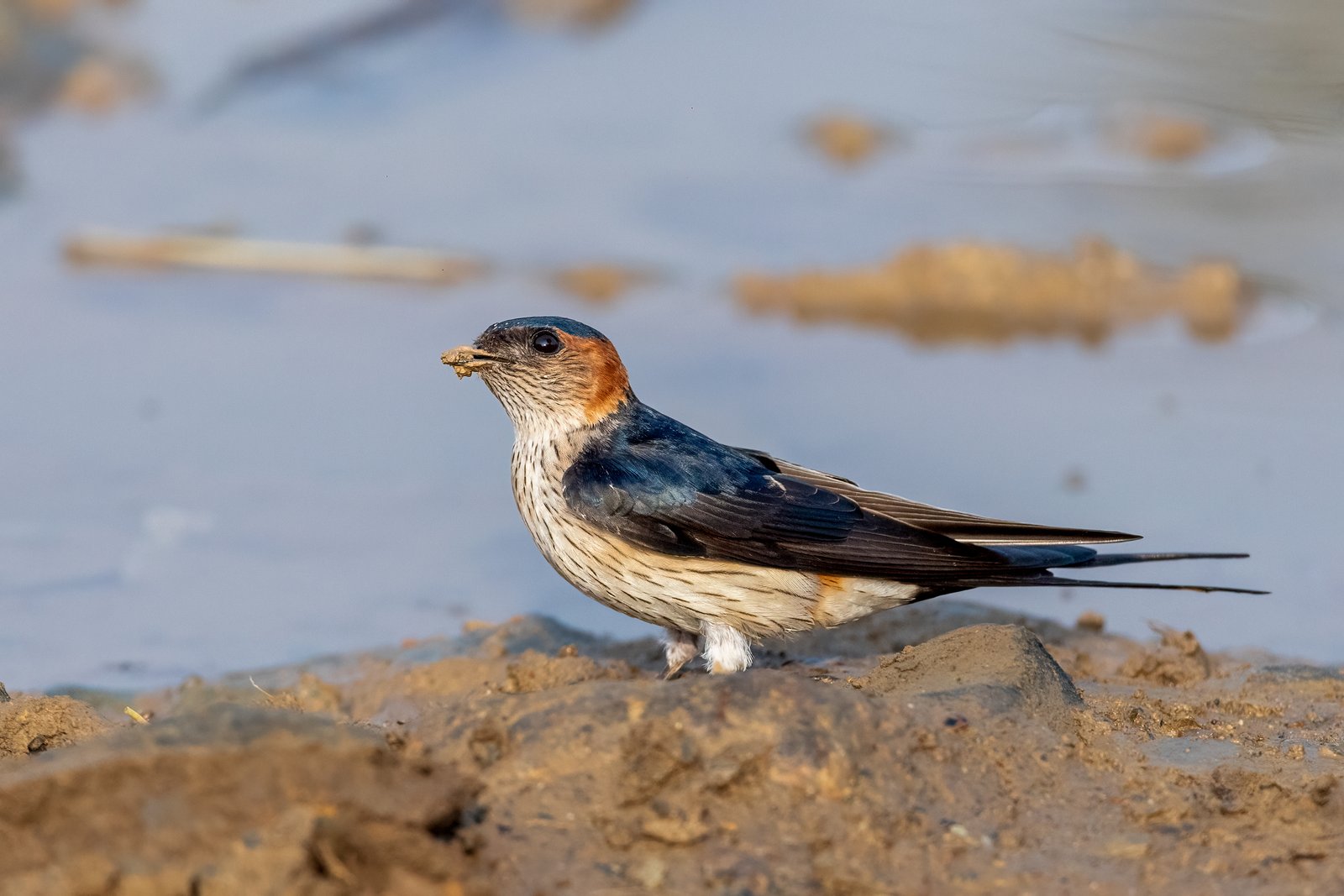
The Eastern Red-Rumped Swallow is a slender swallow with long tail streamers, a pale rufous rump and finely streaked, warm-toned underparts. In the region it is a resident of the highlands in the north-east, where pairs fix their bottle-shaped mud nests under rock overhangs, bridges and roofs.
Voice
A short nasal tweit or kweech, often in flight. The song is a soft, scratchy twitter with rolling notes, calmer and lower than that of the Barn Swallow.
Recording: João Ferreira Tomás — CC BY-NC-SA 4.0 · shortened to the first 60 s, mono · xeno-canto
Identification
16–17 cm including the streamers. Crown, mantle and wings glossy blue-black. A rufous collar across the nape and a rufous stripe behind the eye separate the dark crown from the cheeks. The rump is pale rufous, paler towards the rear. The underparts are warm rufous-buff with fine dark streaks; the undertail coverts are jet black, so that in flight the tail looks 'cut off' from the body. Deeply forked tail without white spots. Juveniles are duller with shorter streamers. It often flies low and unhurriedly, with more gliding than the Barn Swallow.
Confusion species
Lesser Striped Swallow Cecropis abyssinica has heavy black streaks on white underparts and a wholly rufous head. Greater Striped Swallow Cecropis cucullata is larger and paler, with an orange crown, whitish finely streaked underparts and rufous undertail coverts. Red-Breasted Swallow Cecropis semirufa has blue-black cheeks down below the eye and unstreaked, deep rufous underparts with no nape collar. Mosque Swallow Cecropis senegalensis is larger, with white cheeks and throat and white underwing coverts. Always check the combination of nape collar, streaked underparts and black undertail.
Habitat
Open highlands with grassland, rock faces and cliffs, mixed with villages and cultivation, mostly above about 1200 m. It hunts flying insects low over grassland and along slopes. The nest is a bottle-shaped mud bowl with a long entrance tunnel, built under a rock overhang, a bridge or the roof of a building.
Where the bird is most at home, classified by the vegetation units of southern Africa.


Range and movements
Resident in the highlands of Malawi, such as the Nyika and Viphya plateaus and around Dedza and Zomba, and in the far north and north-east of Zambia; there are a few scattered reports further south, including from South Africa and Angola. The African population (subspecies emini) extends from Tanzania and Kenya to Uganda and South Sudan; other forms breed in Asia.
How and when to look
Look for it on the highland plateaus of Malawi around rock faces, bridges and buildings, where pairs stay near the nest all year. In flight the pale rump and black undertail give it away at once, especially in comparison with the Greater and Lesser Striped Swallows that are often present. Check under bridges for the bottle-shaped nests with their long tunnels.
Conservation status
Not threatened; very numerous worldwide. In the region locally fairly common but confined to the north-eastern highlands. It benefits from bridges and buildings as nest sites; the taxonomy of the African forms is under debate.
Scientific name
Cecropis daurica | (Laxmann, 1769)
Laxmann described the species in 1769 as Hirundo daurica; because it was later moved to another genus, the author and year stand in brackets. The genus Cecropis was introduced in 1826 by Boie. Cecropis is from Ancient Greek Kekropis, 'Athenian woman'. daurica refers to Dauria, a mountainous region east of Lake Baikal in Russia. The specimen the first description was based on came from Zmeinogorsk, Siberia.