All species › Passerines › Swallows and martins › Mosque Swallow
Mosque Swallow | Cecropis senegalensis
Moskeezwaluw | Golondrina Senegalesa
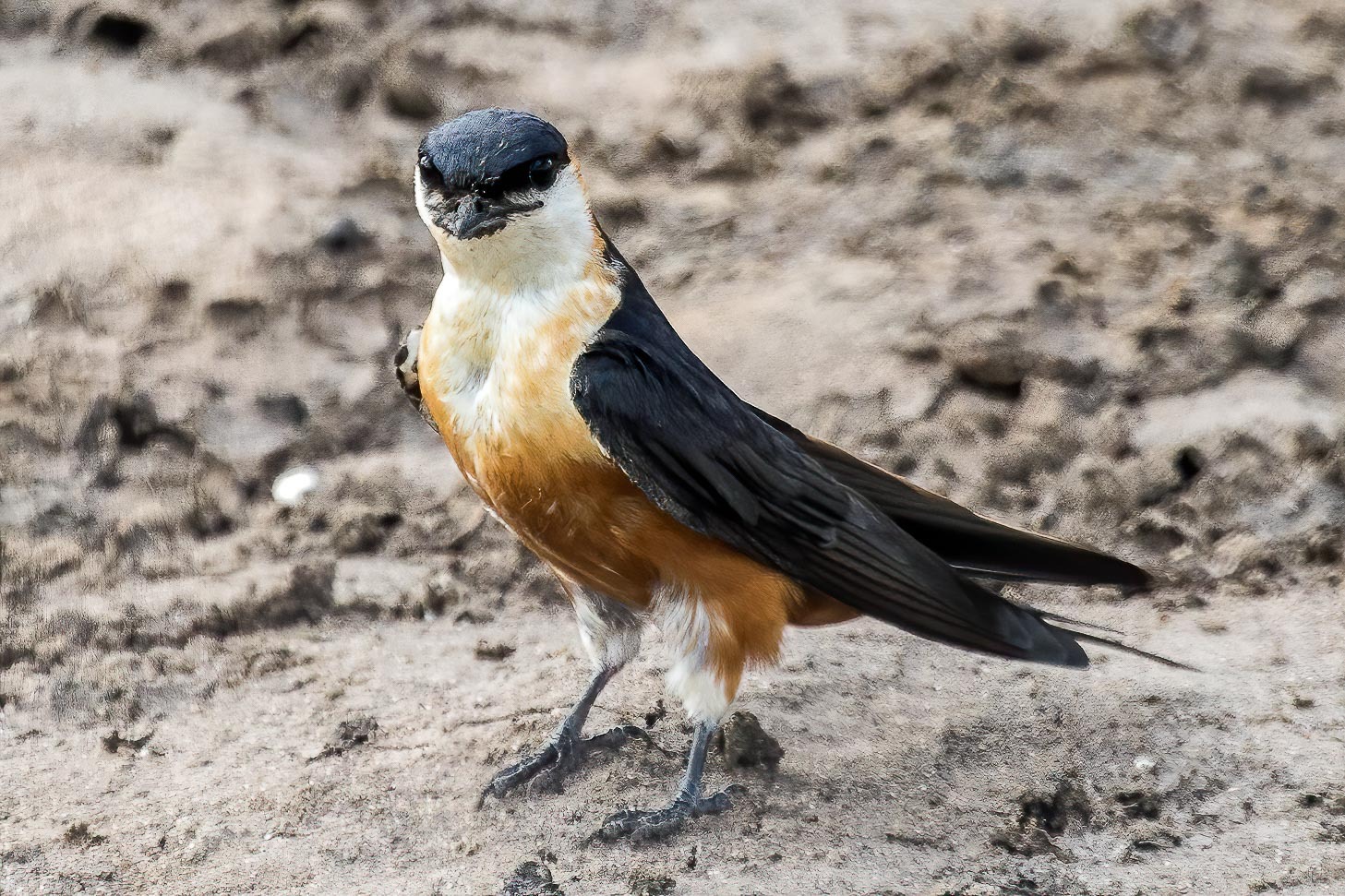
The Mosque Swallow is the largest swallow in the region: a bulky, long-winged bird with white cheeks and throat, rufous underparts and bright white underwing coverts. It lives in open woodland with tall trees, often near baobabs and dead trees, and usually nests in tree holes.
Voice
A nasal, tinny, somewhat croaking call, harrrp or nyaa, sometimes in series, recalling a toy trumpet. The song is a soft creaking and twittering, often from a high dead branch.
Recording: Ehren Eksteen — CC BY-NC-SA 4.0 · converted to mono · xeno-canto
Identification
22–24 cm, including the long tail streamers; heavily built, with broad, long wings. The upperparts are glossy blue-black, the cap reaching down to the eye. The cheeks, ear coverts and throat are white to pale buff, merging gradually into the rufous breast and belly; the underparts are unstreaked or have a few fine streaks on the throat. The rump is rufous, the undertail coverts rufous to blackish at the rear edge. In flight the white underwing coverts stand out, contrasting strongly with the black flight feathers. Juveniles are duller, with a shorter tail. It flies slowly and buoyantly, with long glides, often around treetops.
Confusion species
The Red-Breasted Swallow Cecropis semirufa is slightly smaller, has a blue-black cap enclosing the cheek, a wholly rufous throat, deeper rufous underparts, rufous to buff underwing coverts and black undertail coverts; it lives in open grassland and savanna rather than in woodland with tall trees. The Lesser Striped Swallow Cecropis abyssinica and the Greater Striped Swallow Cecropis cucullata are smaller and have streaked white underparts. The white throat and white underwing are decisive.
Habitat
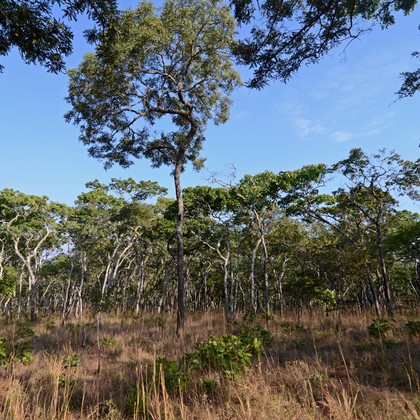
Open, tall woodland: mopane, miombo, baobab woodland and riverine forest, often near rivers, vleis and clearings with tall dead trees; also near villages and in farmland with scattered large trees. It builds a retort-shaped mud nest in a hole in a baobab or other tree, sometimes under roofs or bridges. It hunts flying insects high around treetops and likes to perch on bare branches.
Where the bird is most at home, classified by the vegetation units of southern Africa.


Range and movements
In the region in Angola, Zambia, Malawi, northern and central Mozambique, northern and eastern Zimbabwe (including the Zambezi Valley and the south-eastern lowveld), northern Botswana and north-eastern Namibia; in South Africa rare in the extreme north-east, in the Limpopo Valley. Locally it wanders in the dry season. Otherwise from Senegal and Gambia east to Ethiopia and south through eastern and central Africa.
- Resident
- Summer visitor (c. Oct–Mar)
- Winter visitor (c. Apr–Sep)
- Passage (Mar–Apr, Oct–Nov)
- dark = core range, pale = thinly spread
How and when to look
In the dry season search at baobabs and tall dead trees along rivers, as at Mana Pools and in the Zambezi Valley, around Chobe and in Namibia's Zambezi Region, in South Luangwa or in Gorongosa. Pairs often sit high on bare branches and fly wide circles round the treetops; the nasal trumpeting call and the white underwing in flight make the species quickly recognisable.
Conservation status
Not threatened. The species is widespread; the felling of large old trees and baobabs locally reduces the number of nest sites.
Scientific name
Cecropis senegalensis | (Linnaeus, 1766)
Linnaeus described the species in 1766 as Hirundo senegalensis; because it was later moved to another genus, the author and year stand in brackets. The genus Cecropis was introduced in 1826 by Boie. Cecropis is from Ancient Greek Kekropis, 'Athenian woman'. senegalensis means 'from Senegal', where the first specimen was collected. The specimen the first description was based on came from Senegal.