All species › Penguins › Penguins › Eastern Rockhopper Penguin
Eastern Rockhopper Penguin | Eudyptes filholi
Oostelijke rotspinguïn | Pingüino de Penacho Amarillo
The Eastern Rockhopper Penguin is a small, pugnacious crested penguin that hops over the rocks of subantarctic islands instead of waddling. Within the region it breeds only on Marion and Prince Edward, where it is the most numerous crested penguin after the Macaroni Penguin.

Voice
In the colony a loud, harsh, trumpeting bray given with the head raised and flippers waving: kaa-kaa-kaa-kaaah, accelerating. Also short barking contact calls and, in disputes, a hoarse growl. At sea a short bark.
No recording with a suitable Creative Commons licence is available for this species yet.
Identification
About 45 to 55 cm, slate black on the upperparts and head and white below. A narrow, sharply defined yellow eyebrow runs above the eye and extends behind it into drooping yellow and black crest plumes; the stripe starts above the lores rather than at the bill. The bill is short, stout and orange-red, the eye red, and a narrow edge of bare pink skin borders the base of the bill. The feet are pink. Males are larger and heavier-billed. Juveniles have a greyish chin and throat, a faint, short yellow eyebrow and a dull bill.
Confusion species
The Macaroni Penguin (Eudyptes chrysolophus) is larger, with a much heavier bill and orange-yellow plumes that meet in the centre of the forehead. The Northern Rockhopper Penguin (Eudyptes moseleyi) has much longer, denser and drooping crest plumes and a broader yellow eyebrow, and shows a broader black leading edge on the underwing. The Western Rockhopper Penguin (Eudyptes chrysocome) of South America and the Falklands is barely separable in the field, but lacks the pink skin edge at the bill base.
Habitat
It breeds in dense, noisy colonies among boulders and on lava slopes near the shore, often close to the surf and at times beside cormorants or other penguins. It hops with both feet together from rock to rock and comes ashore on rough, wave-washed coasts. At sea it feeds on krill, other crustaceans, squid and small fish, mostly at depths of a few tens of metres.
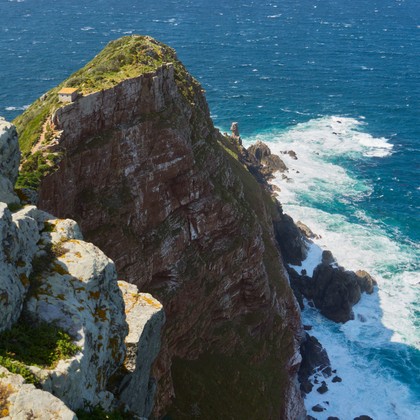
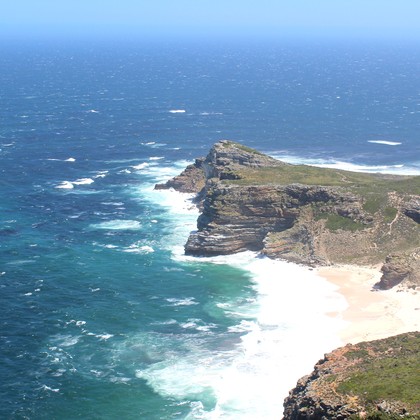
Where the bird is most at home, classified by the vegetation units of southern Africa.
Range and movements
Within the region confined to the Prince Edward Islands: most pairs breed on Marion, spread over many colonies around the coast, with a smaller number on Prince Edward. Moulting or weakened birds very rarely come ashore on the coast of South Africa; most crested penguins found there are Northern Rockhoppers. Elsewhere it breeds on Crozet, Kerguelen, Heard, Macquarie and the New Zealand subantarctic islands (Campbell, Auckland and Antipodes). Outside the breeding season birds disperse across the southern oceans.
How and when to look
For most visitors seen only as a vagrant or on a relief voyage to Marion; the islands are not open to the public. Always examine a beached crested penguin on the Cape coast carefully: note the length and density of the crest plumes, the width of the eyebrow, the pink edge to the bill and the underwing pattern. Report such birds to a seabird rehabilitation centre.
Conservation status
Not assessed separately by the IUCN; it is included in Western (Southern) Rockhopper Penguin (Eudyptes chrysocome, Vulnerable). The population on Marion has declined steeply since the 1990s, probably through changes in food supply at sea linked to warming. Comparable declines have been measured elsewhere in the range, including on Campbell.
Scientific name
Eudyptes filholi | Hutton, 1879
Hutton described the species in 1879 and placed it straight away in the genus where it still stands. The genus Eudyptes was introduced in 1816 by Vieillot. Eudyptes comes from the Greek eu, 'good', and duptēs, 'diver' — 'good diver', for the agility with which these crested penguins hunt underwater. filholi honours the French naturalist Henri Filhol (1843–1902), who stayed on Campbell Island with the French transit-of-Venus expedition in 1874. The specimen the first description was based on came from Campbell Island, New Zealand.