All species › Birds of prey › Hawks, eagles and kites › Forest Buzzard
Forest Buzzard | Buteo trizonatus
Kaapse bergbuizerd | Busardo del Cabo
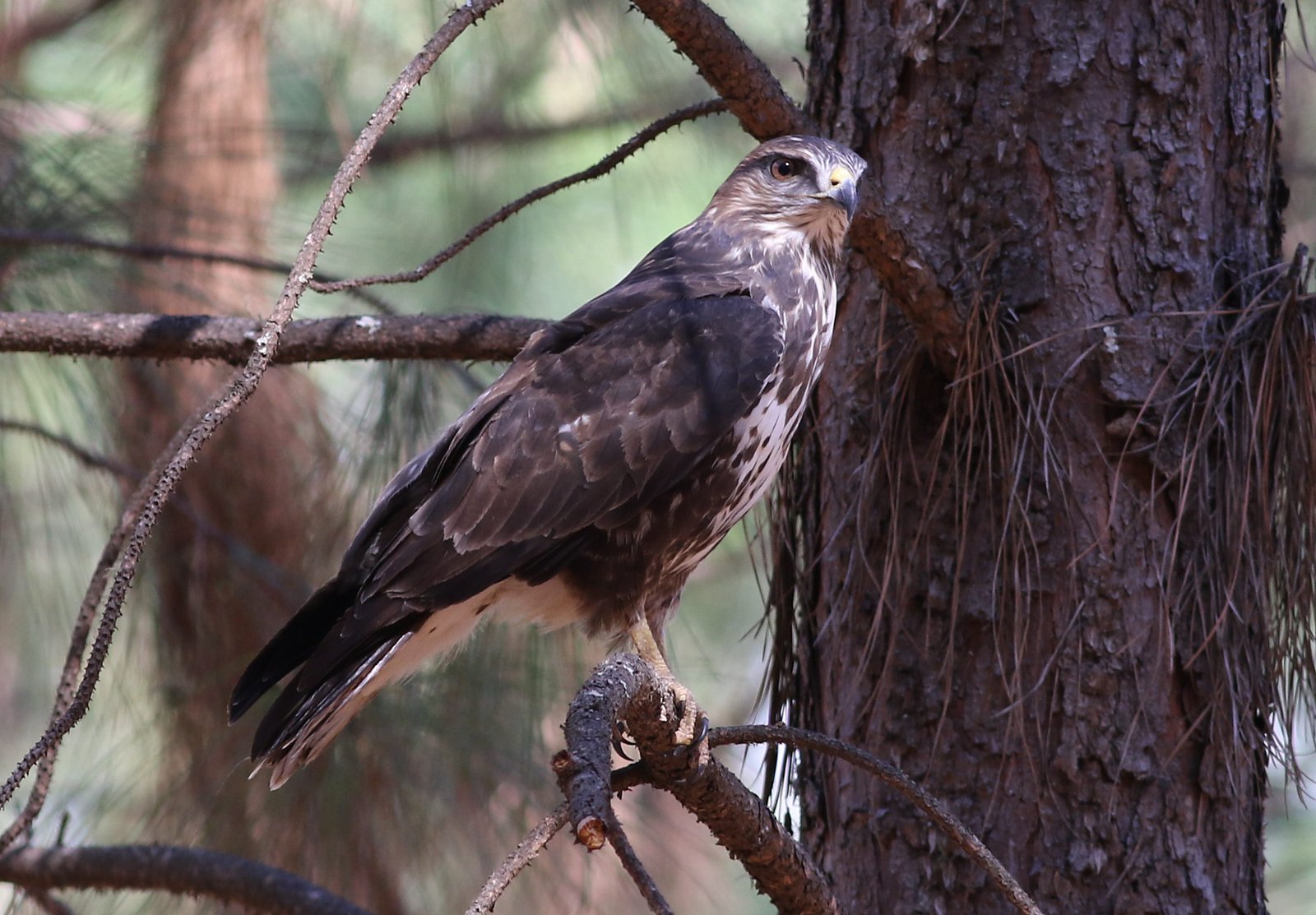
The Forest Buzzard is a small, endemic buzzard of the forests of South Africa and Eswatini. It breeds in indigenous forest and in pine and eucalyptus plantations along the eastern escarpment and the south coast, and in the austral summer it is often hard to separate from the far more numerous Steppe Buzzard, which then winters in the same area.
Voice
A high, plaintive, mewing peeeoo, higher and sharper than that of Jackal Buzzard, especially when circling above the forest in the breeding season (August–December).
Recording: Lynette Rudman — CC BY-NC-SA 4.0 · converted to mono · xeno-canto
Identification
41–48 cm, wingspan 102–117 cm. A small, compact buzzard. Adults are dark brown above. The underparts are white with large, drop-shaped dark brown spots on the breast and flanks; a broad, almost unspotted white band across the lower breast and a white belly are characteristic. The throat is white with a dark central stripe. The tail is grey-brown to rufous-tinged with fine dark bars and a narrow dark subterminal band. In flight the underwing is white with a small dark carpal patch and black wingtips. Juveniles are white below with narrow brown streaks and have a finely barred brown tail.
Confusion species
Common Buzzard Buteo buteo, especially the Steppe Buzzard (vulpinus), is present in the same area from October to March and looks very like the Forest Buzzard. It is larger and longer-winged on average, usually rufous-brown to dark below with a pale breast band and less white, and more often perches on roadside poles in open country. Juvenile Steppe Buzzards are the most difficult, differing mainly in their streaked rather than spotted underparts and the lack of a clean white belly. Juvenile Jackal Buzzard Buteo rufofuscus is larger and rusty brown below. African Goshawk Aerospiza tachiro has short, rounded wings and a long tail.
Habitat
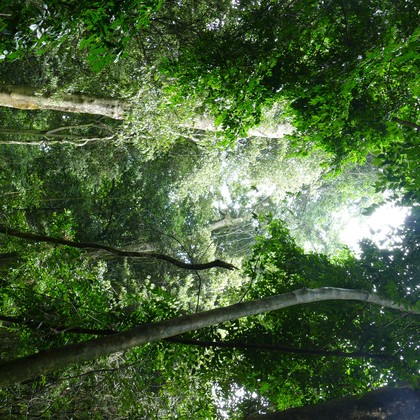
Montane and temperate indigenous forest and forest edges, often alongside pine and eucalyptus plantations, in which it also breeds; on the south coast also coastal forest. It hunts from a perch at the forest edge or in a clearing for rodents, frogs, reptiles, birds and large insects. It nests high in a tree, often a pine or eucalyptus.
Where the bird is most at home, classified by the vegetation units of southern Africa.

Range and movements
Endemic to the region: from the mountains of eastern Limpopo (Soutpansberg, Magoebaskloof) and the Mpumalanga escarpment south through Eswatini and the midlands and Drakensberg of KwaZulu-Natal, via the Amatola Mountains in the Eastern Cape to the forests of the Garden Route and the Cape Peninsula in the Western Cape. Outside the breeding season young and some adult birds move to the Western Cape.
- Resident
- Summer visitor (c. Oct–Mar)
- dark = core range, pale = thinly spread
How and when to look
Best in the breeding season (August–December) in the forests around Knysna and Tsitsikamma, in the Cape Peninsula plantations (for example Tokai) and at Magoebaskloof. Look for the white belly and the drop-shaped spots; in winter (May–September) the Steppe Buzzard is absent and a buzzard at the forest edge is almost always this species.
Conservation status
Near Threatened on the Red List, with a small world population and a restricted range. The loss of indigenous forest is partly offset by plantations, but the conversion or felling of plantations, nest disturbance and collisions with wind turbines are risks.
Scientific name
Buteo trizonatus | Rudebeck, 1957
Rudebeck described the species in 1957 and placed it straight away in the genus where it still stands. The genus Buteo was introduced in 1799 by De Lacépède. Buteo is the Latin word for a buzzard. trizonatus is Latin for 'three-banded', from tri-, 'three', and zonatus, 'banded'. The specimen the first description was based on came from Knysna, Cape Province.