All species › Passerines › Sunbirds › Forest Double-Collared Sunbird
Forest Double-Collared Sunbird | Cinnyris fuelleborni
Fülleborns honingzuiger | Suimanga de Fülleborn
The Forest Double-Collared Sunbird is the double-collared sunbird of the montane forests of Malawi, northern Mozambique and south-western Tanzania. It was long included in Eastern Double-Collared Sunbird and appears under that name in older guides to the region.
Click a thumbnail to switch the photo above.
Voice
A hard tchik and a sharp tchit-tchit. The song is a fast, penetrating and rattling series of high twittering notes, often sustained for a long time from a branch at the forest edge or in the canopy.
Recording: isaac kilusu — CC BY-NC-SA 4.0 · converted to mono · xeno-canto
Identification
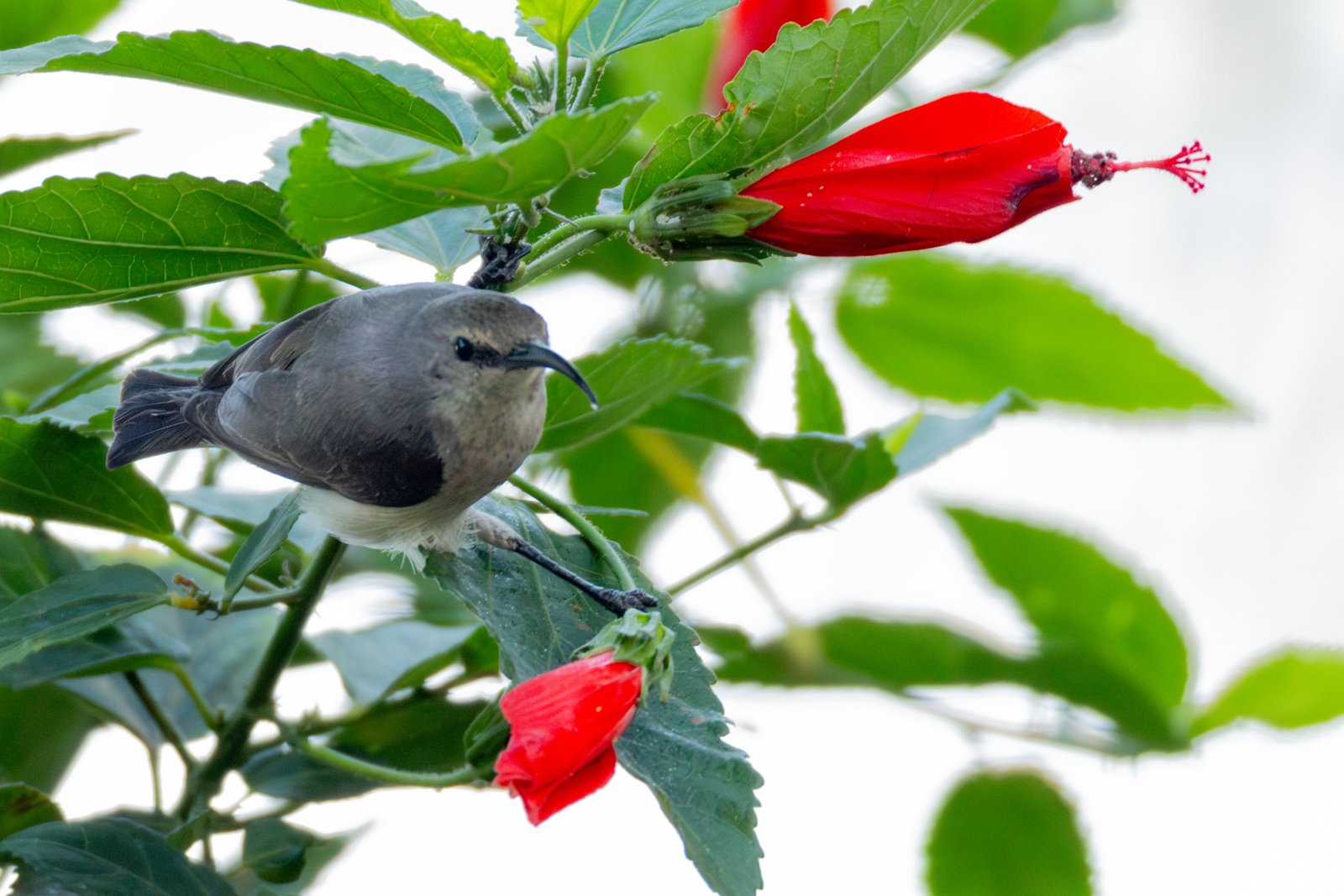
12 to 14 cm, with a fairly long, decurved bill. The male has the head, throat and upperparts dark metallic green and the uppertail coverts blue-violet; below the throat a narrow blue line and a broad scarlet breast band, below that a grey-olive belly. Yellow pectoral tufts show in display. The female is dark olive-grey above and grey-olive below, darker than females of the miombo sunbirds. Juveniles resemble the female.
Confusion species
Eastern Miombo Sunbird (Cinnyris manoensis) lives lower on the slopes in miombo and on rocky hills, and has a paler grey belly; at the transition from forest to woodland the two occur close together and habitat is the best guide. Ludwig's Double-Collared Sunbird (Cinnyris ludovicensis) of the Nyika Plateau is very similar but keeps more to open scrub and forest edge. Eastern Double-Collared Sunbird (Cinnyris mediocris) is smaller and does not occur in the region with certainty.
Habitat
Montane forest, forest edge, clearings and bracken-briar scrub, and highland gardens, mostly above 1,400 m. It feeds at flowering shrubs, creepers, mistletoes and Leonotis, both in the canopy and low at the edge.
Where the bird is most at home, classified by the vegetation units of southern Africa.

Range and movements
Within the region in the highlands of Malawi, including Misuku, Nyika, Viphya, Dedza, Zomba and Mulanje, in north-eastern Zambia in the Mafinga and Makutu mountains, and in northern Mozambique on Namuli, Mabu and Chiperone among others. Beyond the region in the southern highlands of Tanzania.
- Resident
- Summer visitor (c. Oct–Mar)
- Passage (Mar–Apr, Oct–Nov)
- dark = core range, pale = thinly spread
How and when to look
The Zomba Plateau and the forest edges around Chingwe's Hole are the easiest sites; the species is also common on Mulanje and in the Viphya forest. Scan forest edges at flowering shrubs and listen for the long, rattling song from the forest.
Conservation status
Not threatened. Locally common, but montane forest in Malawi and northern Mozambique is shrinking through clearance, fire and the spread of agriculture, which leaves the isolated populations on individual mountains vulnerable.
Scientific name
Cinnyris fuelleborni | Reichenow, 1899
Reichenow described the species in 1899 and placed it straight away in the genus where it still stands. The genus Cinnyris was introduced in 1816 by Cuvier, GLCFD. Cinnyris derives from the Greek kinnuris, the name of a small bird mentioned by the lexicographer Hesychius that cannot be identified further. fuelleborni honours the German army doctor and naturalist Friedrich Fülleborn (1866–1933), who collected in German East Africa. The specimen the first description was based on came from Kalinga, Iringa district, Tanzania.