All species › Passerines › Sunbirds › Marico Sunbird
Marico Sunbird | Cinnyris mariquensis
Maricohoningzuiger | Suimanga del Marico
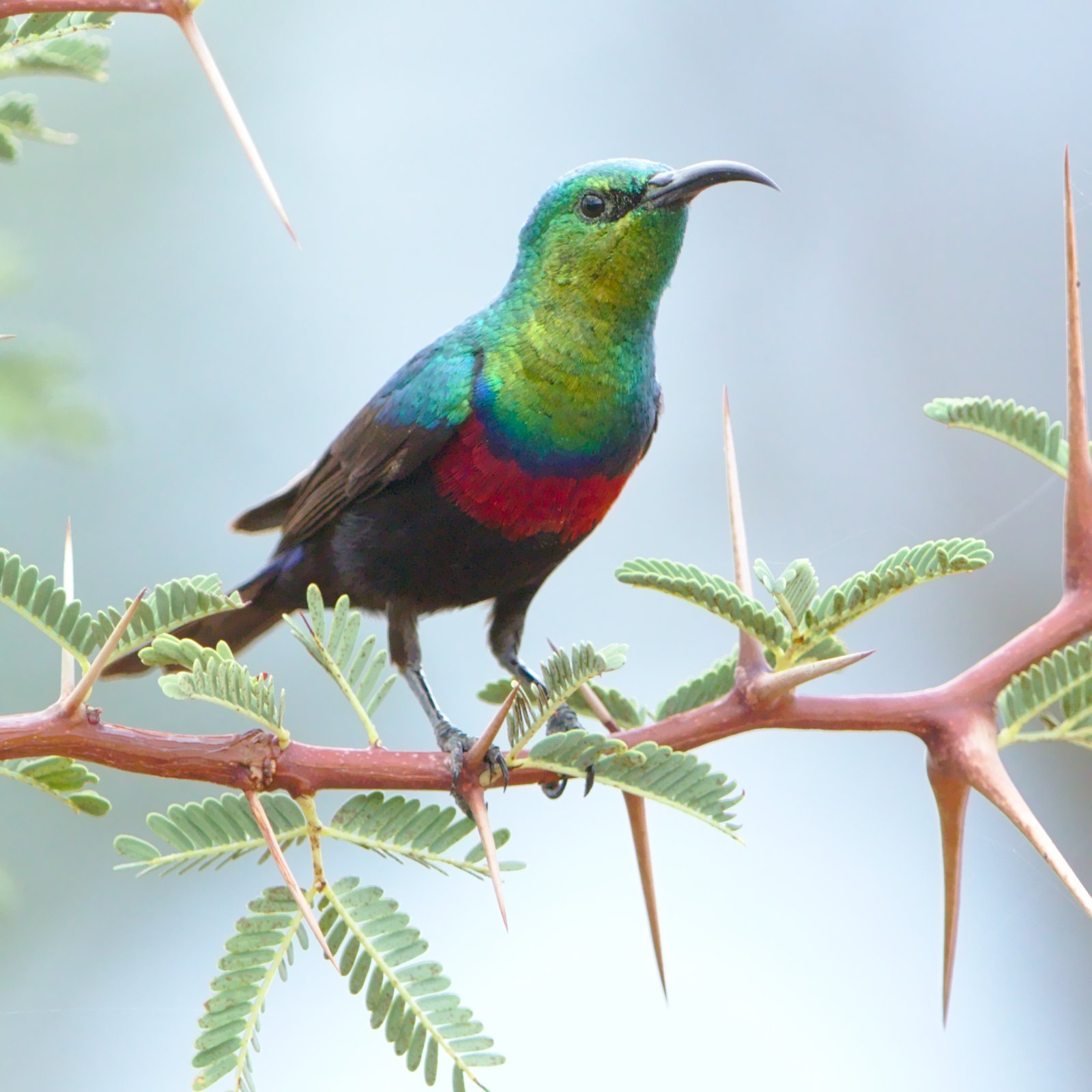
The Marico Sunbird is the large, long-billed sunbird of dry thornveld. Below a metallic green throat the male carries a broad wine-red breast band above a black belly.
Click a thumbnail to switch the photo above.
Voice
A dry, hard tchip-tchip contact call. The song is a rapid, accelerating series of high twittering notes, tchip-tchip-tchiwi-tchiwi-tchirrr, running excitedly into a jumbled warble; often from the top of a thorn tree.
Recording: Niall Perrins — CC BY-NC-SA 4.0 · shortened to the first 60 s, mono · xeno-canto
Identification
13 to 14 cm, with a strikingly long and strongly decurved bill. The male has a metallic green head, back and throat, then a narrow glossy blue band and a broad, glossy wine-red to purple-brown breast band. The belly is dull black. There are no pectoral tufts. In poor light the whole male looks dark. The male largely keeps its breeding dress outside the breeding season, but young males are blotchy green and olive. The female is grey-olive above, with a pale supercilium and dark ear-coverts, and pale yellow below with distinct dark streaking on the breast and flanks.
Confusion species
Purple-Banded Sunbird (Cinnyris bifasciatus) is a miniature look-alike: clearly smaller, with a shorter bill and a narrower purple band, and found in moister coastal and riverine forest rather than dry thornveld. Shelley's Sunbird (Cinnyris shelleyi) has a scarlet rather than wine-red breast band. Amethyst Sunbird (Chalcomitra amethystina) is all black with a violet throat and green crown. Females are named by bill length and size together; the streaked yellowish female Marico is larger and longer-billed than the female Purple-banded.
Habitat
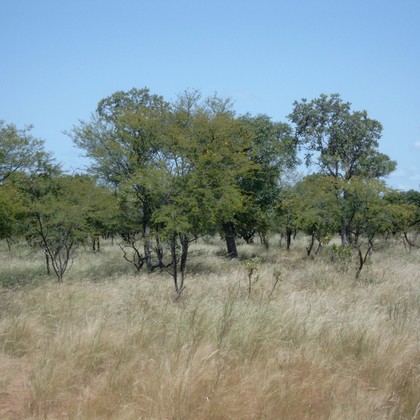
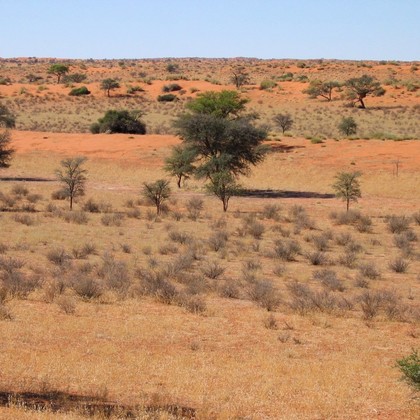
Acacia savanna, thornveld, dry woodland, mopane and riverine woodland in drier country, also farmyards and gardens. It feeds at flowering acacias, aloes, Erythrina and mistletoe (Tapinanthus), and takes many insects and spiders.
Where the bird is most at home, classified by the vegetation units of southern Africa.

Range and movements
Widespread in the drier savannas of the region: southern Angola, northern and eastern Namibia, most of Botswana, Zimbabwe, the interior of central and southern Mozambique, southern and western Zambia, and in South Africa Limpopo, Mpumalanga, North West, Gauteng and northern KwaZulu-Natal, with Eswatini. Beyond the region from Tanzania and Kenya north to Ethiopia, Eritrea and Somalia.
- Resident
- Summer visitor (c. Oct–Mar)
- Winter visitor (c. Apr–Sep)
- Passage (Mar–Apr, Oct–Nov)
- dark = core range, pale = thinly spread
How and when to look
One of the commonest large sunbirds in Kruger, Pilanesberg and along the Okavango fringes; check flowering aloes in winter and Tapinanthus mistletoe in acacias. With a dark male showing a purple band, look first at bill and size: a long, heavy bill and large size point to Marico, a short bill to Purple-banded.
Conservation status
Not threatened. Common and widespread, with stable numbers. It benefits locally from gardens and planted nectar sources.
Scientific name
Cinnyris mariquensis | Smith, 1836
Smith described the species in 1836 and placed it straight away in the genus where it still stands. The genus Cinnyris was introduced in 1816 by Cuvier, GLCFD. Cinnyris derives from the Greek kinnuris, the name of a small bird mentioned by the lexicographer Hesychius that cannot be identified further. mariquensis refers to the Marico River in north-western South Africa, where the species was first collected. The specimen the first description was based on came from north of Kurrichaine, North West Province, South Africa.