All species › Waterfowl › Ducks and geese › Fulvous Whistling Duck
Fulvous Whistling Duck | Dendrocygna bicolor
Rosse fluiteend | Suirirí Bicolor
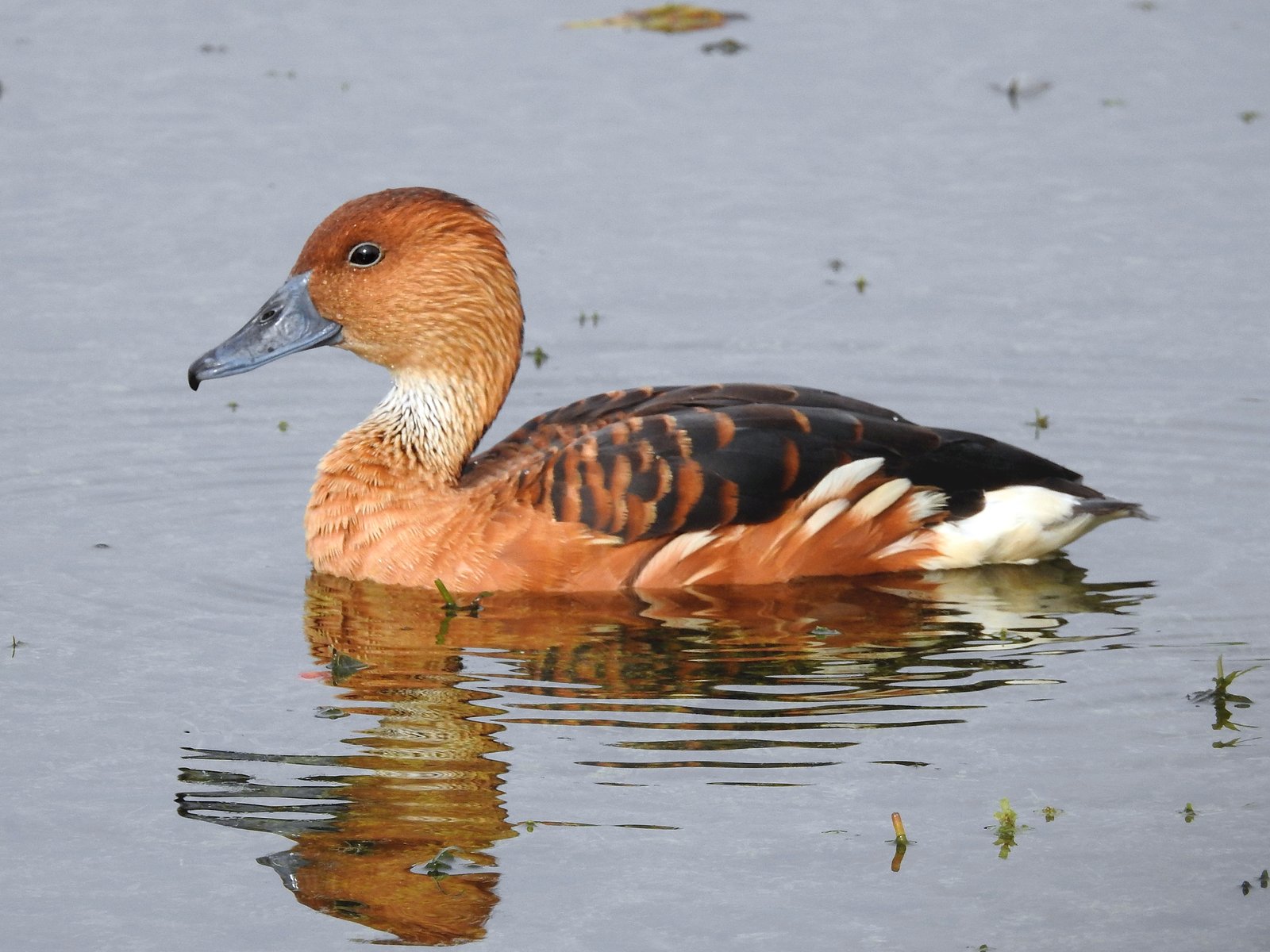
The Fulvous Whistling Duck is a warm tawny, long-necked duck with the upright stance and long legs of the whistling ducks. It is scarcer and more irregular than the White-Faced Whistling Duck and prefers deeper, well-vegetated water, where it swims and dives rather than resting on the shore.
Voice
A thin, squeaky two-note whistle, ti-wheeoo, softer and less clear than the three-note whistle of White-Faced Whistling Duck; often in flight and at night.
Recording: José María Loaiza B. — CC BY-NC-SA 4.0 · converted to mono · xeno-canto
Identification
45–53 cm. The head, neck and underparts are rich tawny to orange-brown, with a narrow blackish stripe down the hindneck and a pale, finely streaked patch on the side of the neck. The back is dark brown with rufous fringes, giving a scaly pattern, and long creamy feathers along the flanks form a pale stripe. The bill and legs are blue-grey. In flight the wings are dark and the white U-shaped band on the rump stands out against the black tail. The sexes are alike; juveniles are duller, with less distinct flank stripes.
Confusion species
White-Faced Whistling Duck Dendrocygna viduata has a white face on a black head, a black belly and finely black-and-white barred flanks, and lacks the white rump. Juvenile White-Faced Whistling Ducks with a dingy grey-brown head are identified by the barred flanks. Female South African Shelducks Tadorna cana are larger and more rufous, with a white head and a white wing panel.
Habitat
Deeper fresh water with plenty of reeds, sedges and floating plants: vleis, marshes, flooded grassland, dams with fringing vegetation and rice fields. More than the White-Faced Whistling Duck it feeds by swimming and diving, often at night, for seeds, tubers and aquatic plants. It nests in dense vegetation over or right beside the water.
Where the bird is most at home, classified by the vegetation units of southern Africa.

Range and movements
Local and irregular in the east and north of the region: the Okavango, the Zambezi and Chobe floodplains, Zimbabwe, Zambia, Malawi, Mozambique and Angola, and in South Africa on the Gauteng and Mpumalanga highveld and in KwaZulu-Natal; rare in Namibia outside the Zambezi Region and in the Cape. Beyond the region it occurs in tropical Africa, on Madagascar, in southern Asia and in North and South America.
- Resident
- Summer visitor (c. Oct–Mar)
- Winter visitor (c. Apr–Sep)
- Passage (Mar–Apr, Oct–Nov)
- dark = core range, pale = thinly spread
How and when to look
Search vegetated vleis and dams on the highveld and in the Okavango in summer, often among flocks of White-Faced Whistling Ducks. When a flock flushes, watch for the white rump, which gives the species away even in poor light, and listen for the softer two-note whistle.
Conservation status
Not threatened; globally one of the most widespread ducks. In the region the draining and overgrazing of vleis affect numbers locally, while irrigation and rice growing provide new habitat elsewhere.
Scientific name
Dendrocygna bicolor | (Vieillot, 1816)
Vieillot described the species in 1816 as Anas bicolor; because it was later moved to another genus, the author and year stand in brackets. The genus Dendrocygna was introduced in 1837 by Swainson. Dendrocygna comes from the Greek dendron, 'tree', and the Latin cygnus, 'swan' — 'tree swan', because some whistling ducks perch or nest in trees. bicolor is Latin for 'two-coloured', for the contrast between the rufous body and the dark back. The specimen the first description was based on came from Paraguay.