All species › Waterfowl › Ducks and geese › Garganey
Garganey | Spatula querquedula
Zomertaling | Cerceta Carretona
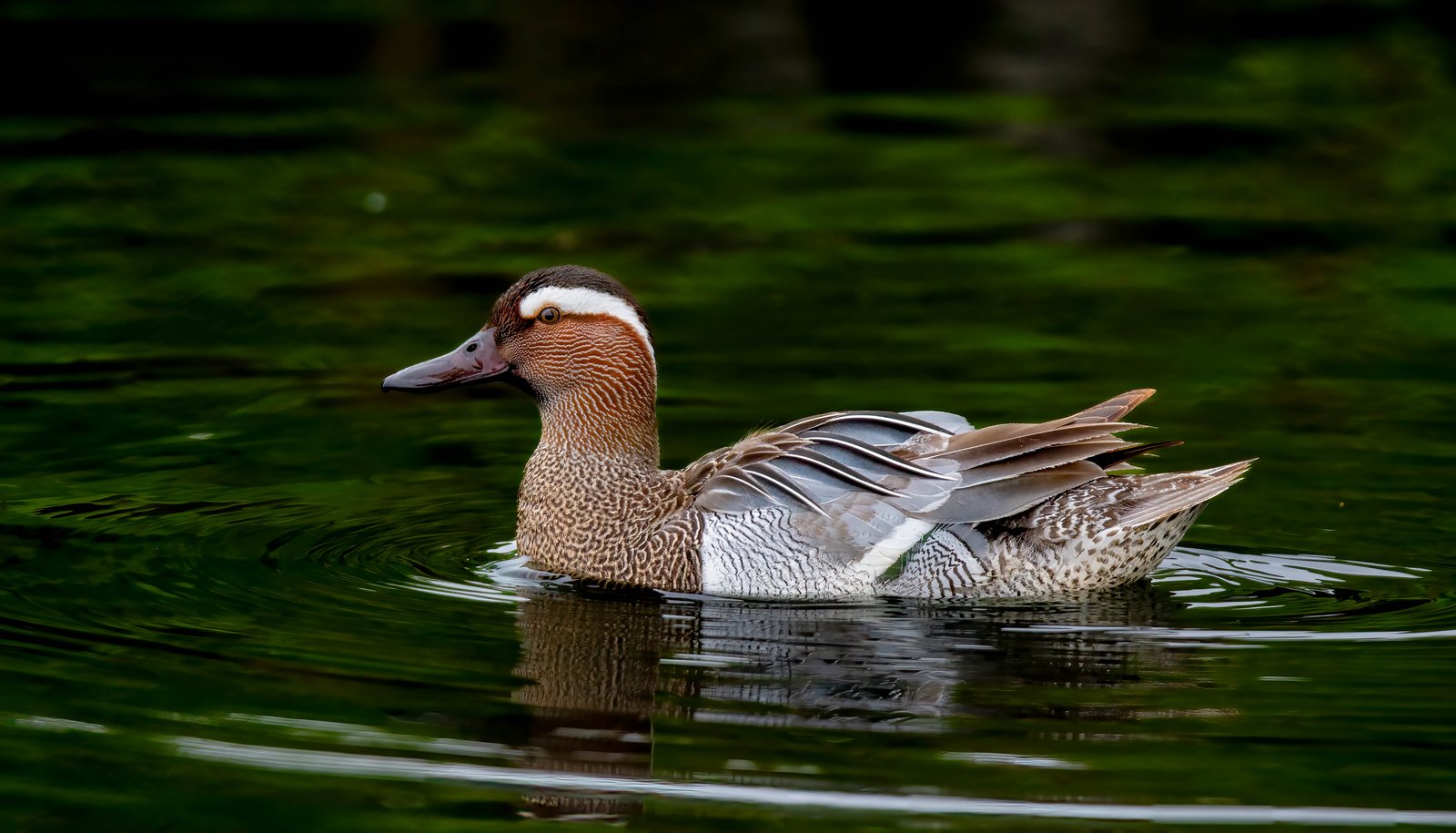
The Garganey is a small Eurasian dabbling duck that winters mostly north of the equator and reaches the region only in small numbers. The breeding-plumaged male, with a broad white supercilium curving to the nape, is unmistakable; most birds here, however, are females or males in eclipse.
Click a thumbnail to switch the photo above.
Voice
Mostly silent in the region. The male gives a dry mechanical rattle, knerrrr, like a fingernail run along a comb; the female a short, high quack.
Recording: Stanislas Wroza — CC BY-NC-SA 4.0 · converted to mono · xeno-canto
Identification
37–41 cm, slightly larger than a Green-Winged Teal, with a straight dark grey bill and a flat crown. The breeding male has a chocolate-brown head with a broad white stripe curving from above the eye to the nape, a brown breast, grey flanks and long drooping black-and-white scapulars; in Africa this plumage is completed only in January–March. Females and eclipse males are mottled brown with a strongly striped head: dark eye-stripe, pale supercilium, a pale spot at the bill base and a second dark line across the cheek. In flight the male shows a blue-grey forewing, the female a grey-brown one, both with a green to brown speculum broadly bordered white.
Confusion species
Green-Winged Teal Anas crecca, an exceptional vagrant here, has a less striped face, a white or yellow line along the tail side and a narrower wing bar. Blue-Billed Teal Spatula hottentota is smaller, with a blue bill, a dark cap and a dark smudge on a pale cheek. Cape Teal Anas capensis is pale grey-speckled with a pink bill, and Red-Billed Teal Anas erythrorhyncha has a red bill and a dark cap above pale cheeks.
Habitat
Shallow fresh water with plenty of marginal vegetation: floodplains, flooded grassland, vleis, pans, rice fields and sewage ponds. It feeds while swimming with bill and head submerged, sieving for seeds, aquatic insects and snails; it rarely up-ends. It often joins flocks of Red-Billed Teal and other dabbling ducks.
Where the bird is most at home, classified by the vegetation units of southern Africa.

Range and movements
Mainly in the north of the region: Zambia, Malawi, northern Mozambique and Zimbabwe, the Okavango Delta and the Caprivi Strip; sporadic in Angola and Namibia and rare in South Africa. It breeds from western Europe to eastern Siberia and winters chiefly in the Sahel, West and East Africa, and South and South-East Asia.
How and when to look
In the rains, work through Red-Billed Teal flocks on floodplains and large vleis, especially in Zambia and Malawi. Look for the strongly striped face and the broad white borders to the speculum on birds taking off. From February into March males in breeding plumage are easiest to pick out, shortly before departure.
Conservation status
Not threatened, though European breeding populations have declined through wetland drainage and hunting. Too scarce in the region to track a trend; numbers vary from year to year with the extent of flooding.
Scientific name
Spatula querquedula | (Linnaeus, 1758)
Linnaeus described the species in 1758 as Anas Querquedula; because it was later moved to another genus, the author and year stand in brackets. The genus Spatula was introduced in 1822 by Boie. Spatula is Latin for 'spoon' or 'spatula', after the broad, spoon-shaped bill of the shoveler. querquedula is a Latin name for a small duck or teal, thought to imitate the bird's rattling call. The specimen the first description was based on came from Sweden.