All species › Turacos › Turacos › Great Blue Turaco
Great Blue Turaco | Corythaeola cristata
Reuzentoerako | Turaco Gigante
The Great Blue Turaco is by far the largest turaco: a turquoise-blue forest bird the size of a turkey, with a black crest, a bright yellow bill and a long tail with a black terminal band. Unlike the green turacos it lacks red in the wing altogether.

Voice
A deep, bubbling, rolling brrrrrou, followed by a long loud series of kok-kok-kok-kok, often by several group members at once. The chorus carries for kilometres and is one of the signature sounds of the Central African rainforest.
Recording: Bernard BOUSQUET — CC BY-NC-SA 4.0 · converted to mono · xeno-canto
Identification
About 70 to 76 cm, more than half of it tail. Head, neck, back and wings are bright turquoise-blue, with a tall, laterally compressed blue-black crest. The bill is yellow with a red tip and extends as a yellow shield onto the forehead. The lower breast is yellow-green, the belly and undertail coverts chestnut. The long graduated tail is blue with yellow-green sides and a broad black band just before the tip. No red in the wing. Sexes alike. It lives in groups of three to seven, runs and hops nimbly through the crowns and glides heavily from tree to tree.
Confusion species
Unmistakable in the region. Guinea Turaco (Tauraco persa) and Ross's Turaco (Tauraco rossae) share the same forests in northern Angola, but are much smaller, differently coloured and flash bright red primaries in flight.
Habitat
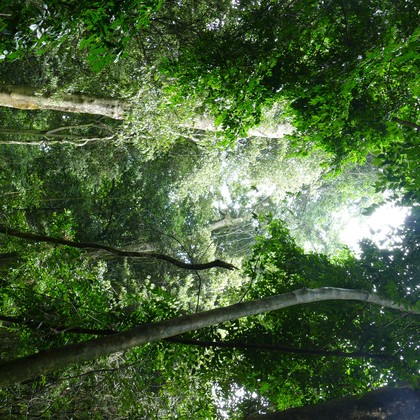
High canopy of lowland rainforest, gallery forest along rivers, forest edges, secondary forest and plantations with tall shade trees. It eats almost exclusively fruit, also leaves, flowers and buds, and forages mainly in the upper storey.
Where the bird is most at home, classified by the vegetation units of southern Africa.

Range and movements
Within the region only in northern Angola, from Cabinda and Zaire and Uíge provinces to Cuanza Norte and the Lundas, and in the extreme north-west of Zambia, in the gallery forest around Mwinilunga. Beyond the region from Guinea through West and Central Africa to South Sudan, Uganda and western Kenya.
- Resident
- dark = core range, pale = thinly spread
How and when to look
In Zambia this is a target species of the gallery forests near Mwinilunga and the Source of the Zambezi; in Angola mainly in the forests of Uíge and Cuanza Norte. Listen early in the morning for the rolling chorus, then look for the big blue shapes gliding between the crowns with tail spread.
Conservation status
Not threatened and still fairly common in the core of its range. At the southern edge, in Angola and Zambia, it is vulnerable to deforestation and hunting for meat and feathers; in densely settled areas it has declined sharply.
Scientific name
Corythaeola cristata | (Vieillot, 1816)
Vieillot described the species in 1816 as Musophaga cristata; because it was later moved to another genus, the author and year stand in brackets. The genus Corythaeola was introduced in 1860 by Heine. Corythaeola comes from the Greek koruthaiolos, 'with shaking plume', from korus, koruthos, 'helmet', and aiollō, 'to shake to and fro'. cristata is Latin for 'crested', from crista 'crest', for the large blue-black crest. The specimen the first description was based on came from Africa (unspecified).