All species › Bustards › Bustards and korhaans › Kori Bustard
Kori Bustard | Ardeotis kori
Koritrap | Avutarda Kori
The Kori Bustard is the heaviest flying bird in Africa and walks with measured strides across open savanna and grassland. Displaying males inflate the neck into a white ball and give a deep booming sound that carries for kilometres.

Voice
Usually silent. The displaying male gives a deep booming oom-oom-oom that carries up to a kilometre, mainly in the first and last hour of the day. In alarm a growling bark; birds taking flight rarely call.
Recording: Andrew Spencer — CC BY-NC-SA 4.0 · converted to mono · xeno-canto
Identification
Very large and strongly different between the sexes: males are 105 to 135 cm long with a wingspan up to 275 cm and weigh 7 to 19 kg, while females are 90 to 112 cm long with a wingspan up to about 220 cm and weigh 3 to 7 kg. The upperparts are grey-brown and finely vermiculated, with a black crest on the hindcrown, a white eyebrow and a finely black-and-white barred neck that looks plain grey at distance. The belly is white and the wing coverts are patterned black and white. The legs are long and pale with three toes. Flight is heavy but powerful, on slow deep beats with the neck outstretched and the legs trailing.
Confusion species
Ludwig's Bustard (Neotis ludwigii) of the arid west and Denham's Bustard (Neotis denhami) of eastern grassland are considerably smaller, show rufous on the hindneck and lack both the black crest and the finely barred grey neck. Within southern Africa no other bustard comes anywhere near the Kori's size.
Habitat
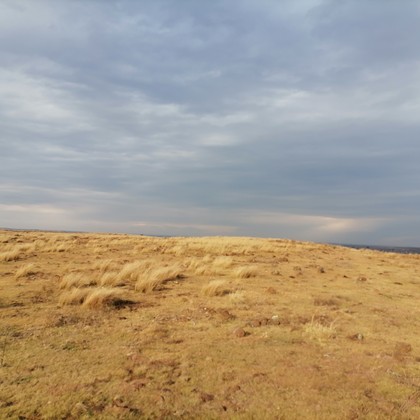
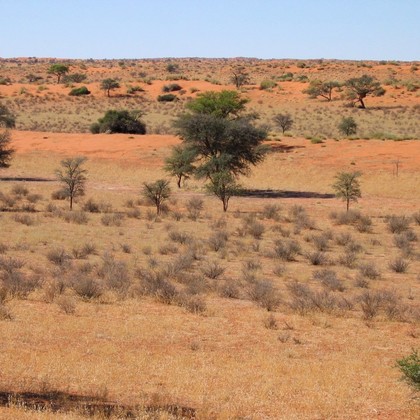
Open and lightly wooded savanna, grassland, semi-desert and Kalahari sandveld, preferring short grass and a clear view. Omnivorous: locusts and other insects, reptiles, small mammals, seeds, berries and the gum of acacia trees.
Where the bird is most at home, classified by the vegetation units of southern Africa.
Range and movements
In southern Africa widespread across the dry interior: the Kalahari in Botswana and Namibia, Etosha, the Northern Cape and Free State, the Limpopo and Mpumalanga lowveld, much of Zimbabwe and the margins of Zambia and southern Mozambique. It has largely gone from the cropping areas of the south. Beyond the region a second subspecies occurs in East Africa, from Ethiopia to Tanzania.
- Resident
- Winter visitor (c. Apr–Sep)
- Passage (Mar–Apr, Oct–Nov)
- dark = core range, pale = thinly spread
How and when to look
Drive slowly across open grassland plains in the early morning; the size makes the birds visible at hundreds of metres, walking with a measured stride. The display season runs from September to January, after the first Kalahari rains, when males stand booming with the neck inflated and the tail flipped over the back. Watch too for Southern Carmine Bee-Eaters riding on the backs of foraging birds.
Conservation status
Near Threatened. Numbers are declining through collisions with power lines and fences, one of the leading causes of death in southern Africa, and further through hunting, disturbance, poisoning and the conversion of grassland to cropland. Outside large protected areas such as the Central Kalahari, Etosha and Kruger, densities are low.
Scientific name
Ardeotis kori | (Burchell, 1822)
Burchell described the species in 1822 as Otis Kori; because it was later moved to another genus, the author and year stand in brackets. The genus Ardeotis was introduced in 1853 by Le Maout. Ardeotis combines the Latin ardea, 'heron', with the Greek otis, 'bustard' — a name that emphasises the heron-like height of the largest bustards. kori is taken from kgori, the Tswana name for this bustard, as recorded by the English naturalist William John Burchell, who first described the species in 1822. The specimen the first description was based on came from the confluence of the Vaal and Orange rivers.