All species › Bustards › Bustards and korhaans › Ludwig's Bustard
Ludwig's Bustard | Neotis ludwigii
Ludwigs trap | Avutarda de Namibia
Ludwig's Bustard is the large bustard of the dry Karoo and Namibia, a near-endemic of southern Africa. It follows the rain over hundreds of kilometres, so it can be absent from one area for months and suddenly common in another. Collisions with power lines have made it an endangered species.

Voice
Usually silent. The displaying male gives a deep, hollow, far-carrying woomp, inflating the throat sac into a white ball and cocking the tail over the back. When disturbed, a soft croaking sound.
Recording: Lynette Rudman — CC BY-NC-SA 4.0 · converted to mono · xeno-canto
Identification
Large, males 80–95 cm and females 76–85 cm, with a marked difference in weight: males about 6 kg, females about 3.5 kg. Head, throat and foreneck are dark brownish grey and the hindneck rufous, so the neck looks two-toned in profile. A dark crown cap extends onto the nape. The upperparts are brown with fine dark markings, the belly white. In flight there is much white on the wing coverts and a dark trailing primary edge. The legs are long and yellowish. Females are smaller and paler, with less contrast in the neck.
Confusion species
Denham's Bustard (Neotis denhami) has a pale grey foreneck, a black-and-white head stripe and a contrasting black-and-white wing panel; both may occur in the transition zone in the Eastern and Western Cape. The Kori Bustard (Ardeotis kori) is larger, with a finely barred grey neck and a black crest, and lacks the rufous hindneck.
Habitat
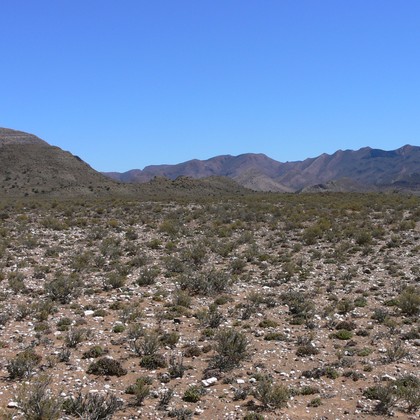
Open, dry dwarf-shrub plains of the Nama and Succulent Karoo, semi-desert and sparsely grassed flats, often on stony ground. It eats grasshoppers, beetles and other insects, as well as small vertebrates, seeds, flowers and young shoots.
Where the bird is most at home, classified by the vegetation units of southern Africa.

Range and movements
Almost endemic to the region: western and central South Africa (Northern Cape, the Karoo of the Western and Eastern Cape, Namaqualand) and most of Namibia except the north-east, reaching south-western Angola and the edge of south-western Botswana. In winter many birds move west, in summer into the eastern Karoo.
- Resident
- Summer visitor (c. Oct–Mar)
- Winter visitor (c. Apr–Sep)
- dark = core range, pale = thinly spread
How and when to look
Drive the gravel roads of the Karoo and Bushmanland and scan the plains: the rufous hindneck and upright stance give the bird away even at long range. In Namaqualand they are most numerous from June to September, after the winter rains; in the eastern Karoo in summer. Watch the wires: dead bustards beneath power lines are sadly a familiar sight.
Conservation status
Endangered. Research has shown that thousands of birds die every year in collisions with power lines, which bustards see poorly because of their limited forward vision; for such a long-lived, slow-breeding species this cannot be absorbed. New lines for wind and solar farms add to the problem; markers on the wires partly reduce the number of casualties.
Scientific name
Neotis ludwigii | (Rüppell, 1837)
Rüppell described the species in 1837 as Otis Ludwigii; because it was later moved to another genus, the author and year stand in brackets. The genus Neotis was introduced in 1893 by Sharpe. Neotis comes from the Greek neos, 'new', and ōtis, 'bustard' — a 'new bustard', split off from the old genus Otis. ludwigii honours Carl Ferdinand von Ludwig (1784–1847), a German-born pharmacist and naturalist in Cape Town. The specimen the first description was based on came from South Africa.