All species › Waders, gulls and terns › Plovers and lapwings › Greater Sand Plover
Greater Sand Plover | Anarhynchus leschenaultii
Woestijnplevier | Chorlitejo Mongol Grande
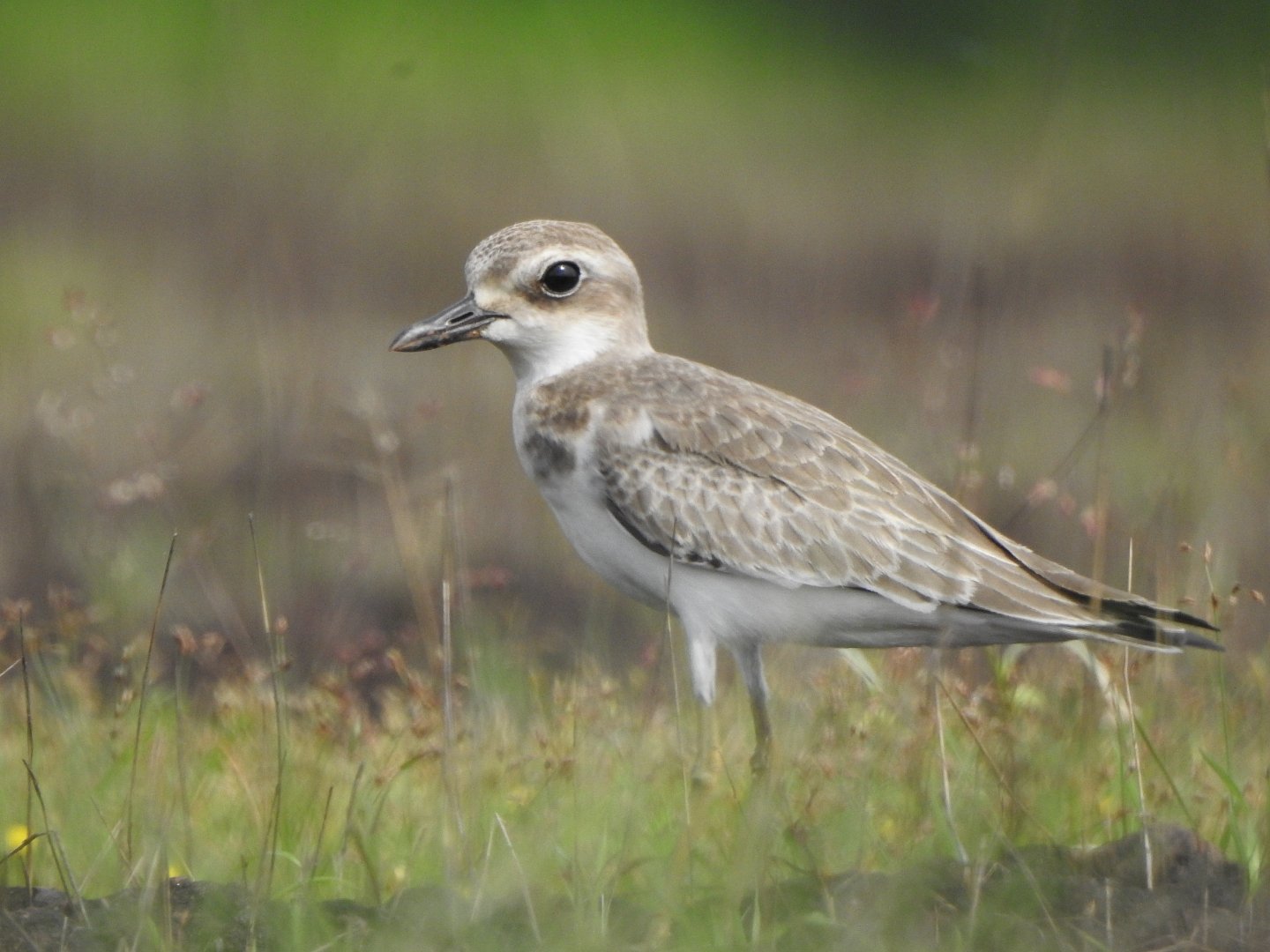
The Greater Sand Plover is the largest sand plover and a regular winter visitor to the tidal flats of Mozambique, where flocks of tens to hundreds gather on sandbanks at high tide. A big head, long heavy bill and long legs give it a bulkier, more angular outline than the related Siberian Sand Plover.
Voice
A soft rolling trill, trrri or prrrp, more melodious and longer than the short hard call of the Siberian Sand Plover.
No recording with a suitable Creative Commons licence is available for this species yet.
Identification
22–25 cm. In non-breeding plumage the upperparts are pale grey-brown, the forehead and supercilium white, and there are grey-brown patches on the sides of the breast. The black bill is long and heavy, with a swollen tip, and about as long as or longer than the distance from bill base to the rear of the eye. The legs are long and pale grey to yellowish-green. In breeding plumage the male has a black mask and a narrow orange-rufous breast band. In flight there is a clear white wing bar, a white underwing and white tail sides; the toes project beyond the tail.
Confusion species
The Siberian Sand Plover Anarhynchus mongolus is smaller and rounder, with a short blunt bill, a smaller head and shorter, darker legs. The Caspian Plover Anarhynchus asiaticus has a thin bill, a broader breast band and a greyish underwing and keeps to dry grassland. The Common Ringed Plover Charadrius hiaticula has a complete breast band and orange legs.
Habitat
Tidal mudflats, sandbanks and estuaries, also open sandy beaches and the margins of lagoons and salt pans near the coast. On the flats it hunts mainly crabs, which it breaks up with its heavy bill, and also worms and molluscs. At high tide it roosts in tight flocks on sandbanks, often with other waders.
Where the bird is most at home, classified by the vegetation units of southern Africa.

Range and movements
Common along the coast of Mozambique, especially in Maputo Bay, on Inhaca, around Inhambane and Vilankulo and near Beira; in small numbers each year in KwaZulu-Natal (Richards Bay, Durban) and beyond that scarce to rare west to the Western Cape and Namibia (Walvis Bay). It breeds from Turkey and the Middle East to Central Asia and Mongolia and winters on the coasts of East Africa, Arabia and South Asia to Australia.
- Resident
- Summer visitor (c. Oct–Mar)
- Passage (Mar–Apr, Oct–Nov)
- dark = core range, pale = thinly spread
How and when to look
The flats of Inhaca and Maputo Bay are the best place: arrive two hours before high tide, when the flocks move up to the highest sandbanks and can be compared easily. In South Africa the estuaries of Richards Bay and St Lucia are the best places to search in summer.
Conservation status
Not threatened, although populations migrating through East Asia are declining with the loss of intertidal habitat. Birds wintering in Africa come from the western part of the breeding range and are more stable. Disturbance and reclamation of tidal flats are a local problem.
Scientific name
Anarhynchus leschenaultii | (Lesson, 1826)
Lesson described the species in 1826 as Charadrius Leschenaultii; because it was later moved to another genus, the author and year stand in brackets. The genus Anarhynchus was introduced in 1832 by Quoy & Gaimard. Anarhynchus is Greek, from ana- 'backward' and rhunkhos 'bill', after the sideways-bent bill of the wrybill, the type species of the genus. leschenaultii honours the French botanist and ornithologist Jean-Baptiste Leschenault de La Tour (1773–1826), who collected in Java and India. The specimen the first description was based on came from Pondicherry, India.