All species › Waders, gulls and terns › Plovers and lapwings › Kittlitz's Plover
Kittlitz's Plover | Anarhynchus pecuarius
Herdersplevier | Chorlitejo Pecuario
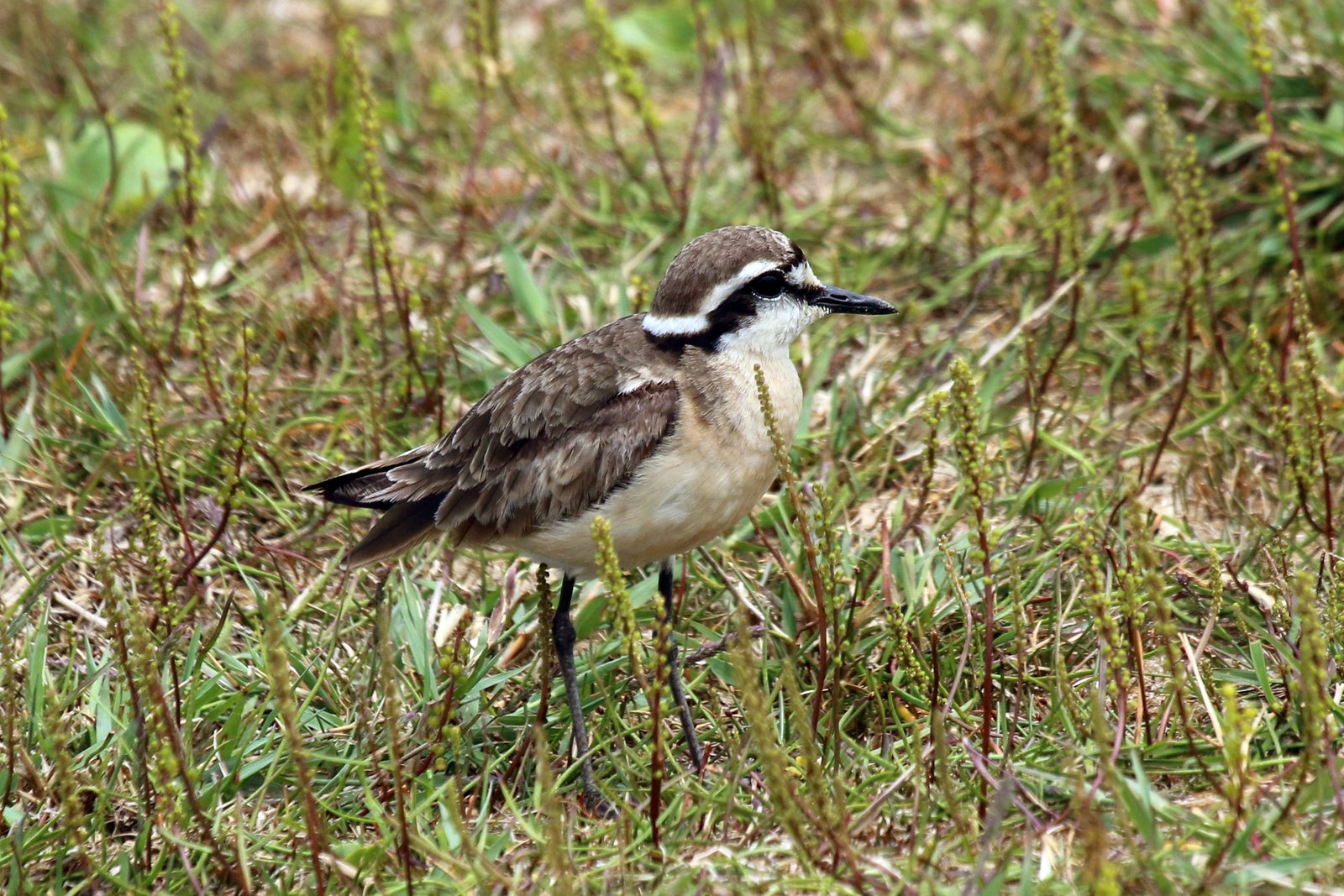
Kittlitz's Plover is a small, long-legged plover of dry mud margins and closely grazed shores, often standing some way back from the water. The breeding plumage, with black-and-white head bands and warm creamy-buff underparts, is unique in the region; when leaving the nest the bird kicks sand over the eggs.
Voice
A short dry tip or tip-pip and a short whistled pipip when flushed; a rattling trill in display.
No recording with a suitable Creative Commons licence is available for this species yet.
Identification
14–16 cm. Adults have a black bar across the forehead and a black eye-stripe running back to the nape, bordered above by a white stripe that forms a V behind the crown. The upperparts are dark brown with pale fringes and look scaly. Throat white, breast and belly warm ochre-buff to cream, with no breast band. There is a dark patch at the bend of the wing. Bill black, legs long and grey-black to greenish-black. Juveniles lack the black on the head, have a pale buff supercilium and pale underparts, but still show the dark carpal patch. In flight there is a narrow white wing bar and white tail sides.
Confusion species
The Three-Banded Plover Thinornis tricollaris has two black breast bands, a red eye-ring and a red bill base. The White-Fronted Plover Anarhynchus marginatus is paler, with a white collar and no ochre below, and is tied to sandy beaches and riverbanks. The Chestnut-Banded Plover Anarhynchus pallidus is smaller, has a narrow chestnut breast band and lives on salt pans. Juvenile Kittlitz's may suggest a juvenile Common Ringed Plover Charadrius hiaticula, but lack the breast band.
Habitat
Dry mud margins, closely grazed and trampled shores of dams, pans and floodplains, salt marsh and the edges of coastal lagoons; also airstrips and bare ground near water. It feeds on insects, small crustaceans and larvae, often on dry ground above the waterline. The nest is a scrape on bare ground, often near dung or small stones.
Where the bird is most at home, classified by the vegetation units of southern Africa.

Range and movements
Throughout virtually the whole region: South Africa, Lesotho, Eswatini, Namibia, Botswana, Zimbabwe, Mozambique, Zambia, Malawi and Angola; most numerous on the highveld, around the pans of Botswana and along the coast, and scarce in the driest parts of the Namib and at high altitude. Beyond the region it occurs over much of sub-Saharan Africa, in the Nile valley and on Madagascar.
- Resident
- Summer visitor (c. Oct–Mar)
- Winter visitor (c. Apr–Sep)
- Passage (Mar–Apr, Oct–Nov)
- dark = core range, pale = thinly spread
How and when to look
Search not along the waterline but behind it, on the dry mud and grazed grass. A bird that crouches flat against the ground and only runs off at the last moment is often a Kittlitz's Plover. Around the pans and dams of the highveld and in the St Lucia estuary they can be found all year.
Conservation status
Not threatened and common. It benefits locally from farm dams and overgrazed shores. Nests are lost to sudden rises in water level and to trampling by livestock.
Scientific name
Anarhynchus pecuarius | (Temminck, 1823)
Temminck described the species in 1823 as Charadrius pecuarius; because it was later moved to another genus, the author and year stand in brackets. The genus Anarhynchus was introduced in 1832 by Quoy & Gaimard. Anarhynchus is Greek, from ana- 'backward' and rhunkhos 'bill', after the sideways-bent bill of the wrybill, the type species of the genus. pecuarius is Latin for 'of cattle, cattleman', from pecus, 'cattle' — probably for its liking for short-grazed flats trampled by livestock. The specimen the first description was based on came from Cape of Good Hope.