All species › Waders, gulls and terns › Plovers and lapwings › Chestnut-Banded Plover
Chestnut-Banded Plover | Anarhynchus pallidus
Kaapse plevier | Chorlitejo Pálido
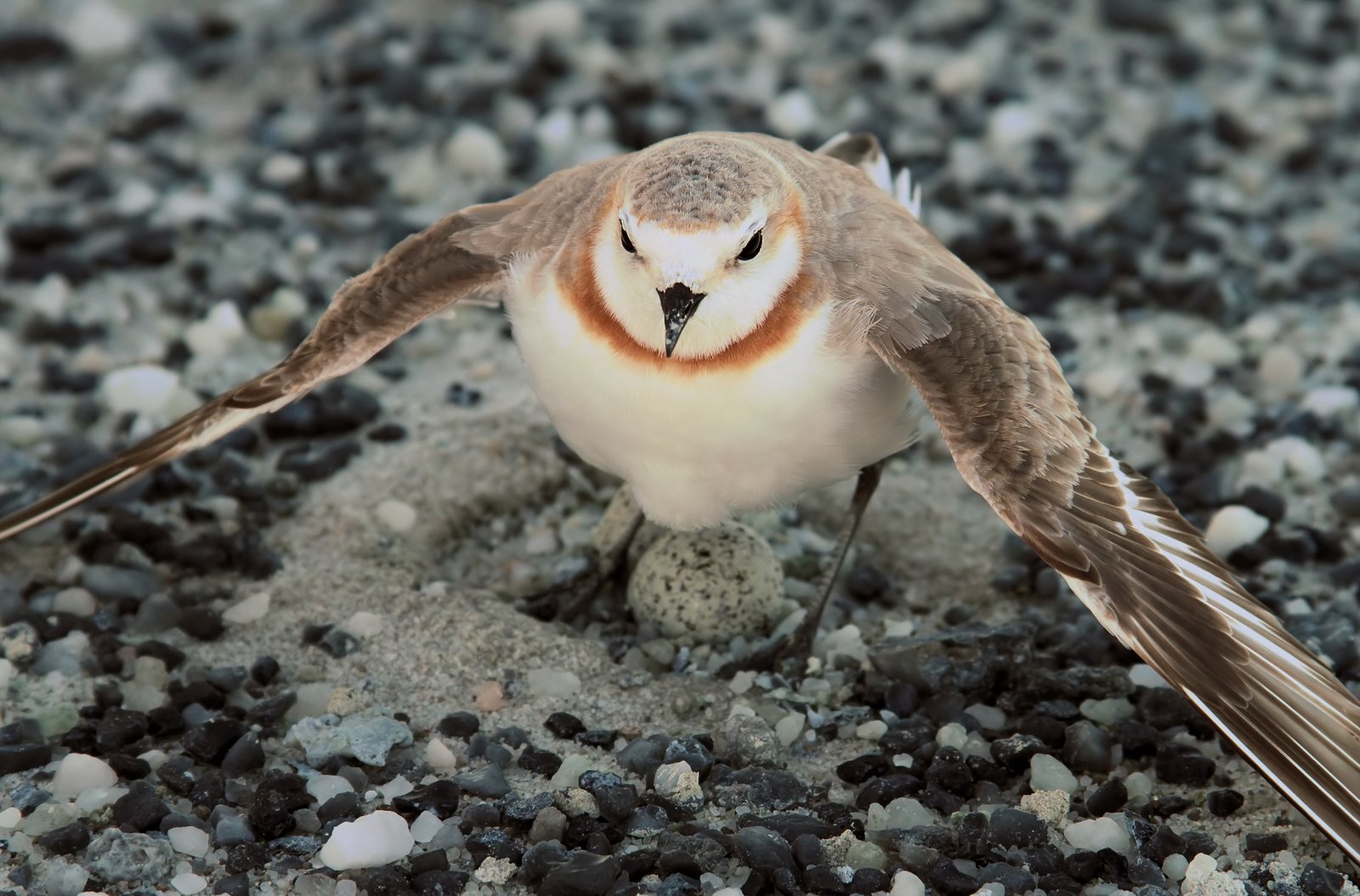
The Chestnut-Banded Plover is the smallest plover in the region, a pale, round-headed bird of salt pans, saltworks and brackish lagoons. A narrow chestnut breast band on otherwise sandy and white plumage makes it unmistakable. A large part of the world population lives in Namibia and Botswana.
Voice
A soft, short prrp or chuk and a fine thin tuu-it; on the whole a quiet species.
No recording with a suitable Creative Commons licence is available for this species yet.
Identification
14–15 cm. The upperparts are pale sandy grey, the underparts white. A narrow chestnut band crosses the breast and runs up the sides of the neck. The male has a white forehead bordered above by a black bar across the forecrown and black lores; the hindcrown is tinged rufous. In the female the head markings are grey or rufous rather than black and the breast band is narrower. The bill is short and black, the legs grey. Juveniles have only grey patches at the breast sides. In flight there is a narrow white wing bar.
Confusion species
The White-Fronted Plover Anarhynchus marginatus is larger, with a white collar, only faint breast patches and a preference for sandy beaches. Kittlitz's Plover Anarhynchus pecuarius is longer-legged and has ochre-buff underparts without a breast band. The Kentish Plover Anarhynchus alexandrinus is larger and has dark, not chestnut, patches at the breast sides. Juveniles may suggest juvenile White-Fronted Plovers, but are smaller and more compact.
Habitat
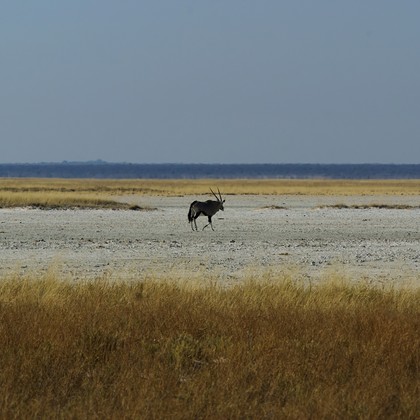
Salt pans, saltworks, brackish and saline lagoons and the bare margins of alkaline lakes. It feeds on wet salt crust or at the edge of shallow, very saline water, taking brine shrimps, fly larvae and other small invertebrates. It breeds on bare, dried-out surfaces, in a shallow scrape.
Where the bird is most at home, classified by the vegetation units of southern Africa.

Range and movements
Most numerous in Namibia, especially on the coast at Walvis Bay, Sandwich Harbour and Lüderitz and on Etosha Pan, and in Botswana on the Makgadikgadi Pans. In South Africa it is scattered on pans in the Northern Cape, Free State, North West and Gauteng and on the Western Cape coast (Velddrif, Berg River estuary); scarce in southern Angola and rare in southern Mozambique and Zimbabwe. Outside the region a separate population lives on the soda lakes of the Rift Valley in Kenya and Tanzania.
- Resident
- Summer visitor (c. Oct–Mar)
- Winter visitor (c. Apr–Sep)
- dark = core range, pale = thinly spread
How and when to look
The saltworks at Walvis Bay are the best site: tens to hundreds almost always feed among the salt pans. In South Africa the saltpans at Velddrif are a reliable site. Watch the salty white flats where other waders are absent; the birds run fast and keep low to the ground.
Conservation status
Not threatened. Most of the world population is concentrated at a handful of sites, so changes in saltworks management, drainage and disturbance can have large effects. Saltworks act as important substitute habitat.
Scientific name
Anarhynchus pallidus | (Strickland, 1853)
Strickland described the species in 1853 as Charadrius pallidus; because it was later moved to another genus, the author and year stand in brackets. The genus Anarhynchus was introduced in 1832 by Quoy & Gaimard. Anarhynchus is Greek, from ana- 'backward' and rhunkhos 'bill', after the sideways-bent bill of the wrybill, the type species of the genus. pallidus is Latin for 'pale' — for the very light, sandy upperparts. The specimen the first description was based on came from Damaraland, Namibia.