All species › Waders, gulls and terns › Plovers and lapwings › White-Fronted Plover
White-Fronted Plover | Anarhynchus marginatus
Vale strandplevier | Chorlitejo Frentiblanco
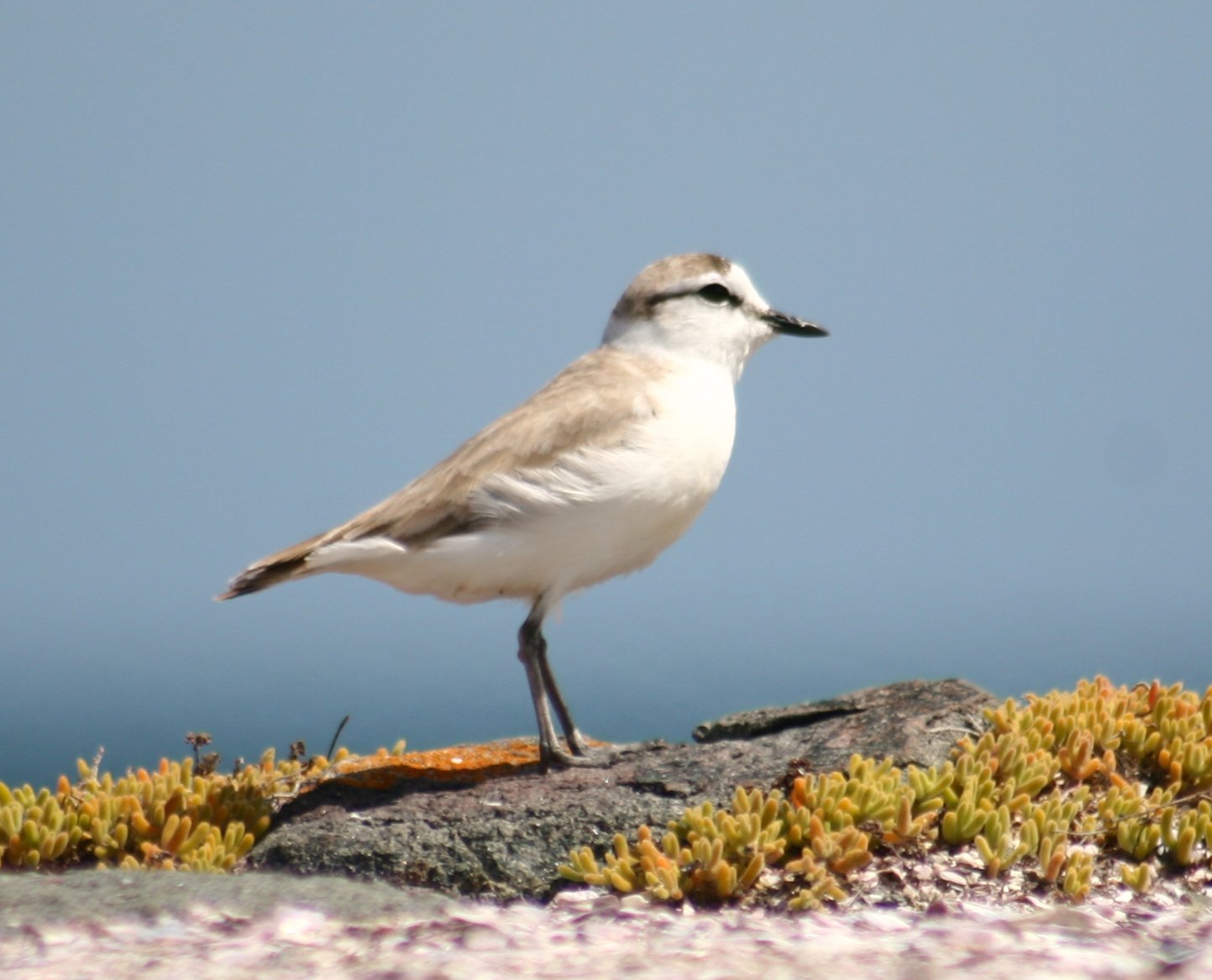
The White-Fronted Plover is the plover of the sandy beaches of southern Africa: a pale, compact bird that runs in short dashes along the tideline. Pairs hold a stretch of beach all year. In addition an inland population lives on the sandbanks of the large rivers and lakes.
Voice
A soft whistled wiit or twirrit, and a sharp tik in alarm; a soft rolling trill in display.
No recording with a suitable Creative Commons licence is available for this species yet.
Identification
17–18 cm. The upperparts are pale sandy brown, the underparts white, often with a faint cream or rusty wash on the breast. The forehead is white, bordered in the male by a black bar across the forecrown and a black eye-stripe; in the female these marks are browner and fainter. A white collar runs round the hindneck. The breast band is absent or reduced to small dark patches at the sides. The bill is black, the legs grey to greenish-grey. In flight there is a white wing bar and white tail sides.
Confusion species
The Kentish Plover Anarhynchus alexandrinus, a vagrant, has more distinct dark patches at the breast sides, blacker legs and in breeding plumage a rufous crown in the male. The Chestnut-Banded Plover Anarhynchus pallidus is smaller and has a chestnut breast band. Kittlitz's Plover Anarhynchus pecuarius has ochre-buff underparts and black-and-white head bands running to the nape. The Sanderling Calidris alba runs along the tideline in the same way, but lacks the white forehead and collar and has a longer, straight bill.
Habitat
Sandy and shelly beaches, especially where kelp and washed-up seaweed provide food, also small river mouths, lagoons and rocky shores with sand patches. Inland it uses sand and gravel bars in large rivers and the beaches of large lakes. The nest is a scrape in the sand above the tideline; when disturbed the sitting bird covers the eggs with sand.
Where the bird is most at home, classified by the vegetation units of southern Africa.


Range and movements
Along almost the entire coast of the region, from Angola via Namibia and South Africa to Mozambique, most numerous on the sandy beaches of Namibia and the Western and Eastern Cape. Inland along the Zambezi (including Kariba and the Chobe), the Luangwa, Lake Malawi and the Shire. Beyond the region along the coasts and large rivers of West and East Africa and on Madagascar.
- Resident
- Summer visitor (c. Oct–Mar)
- Winter visitor (c. Apr–Sep)
- Passage (Mar–Apr, Oct–Nov)
- dark = core range, pale = thinly spread
How and when to look
Walk a quiet beach in the early morning and watch the upper tideline: the birds vanish as soon as they stop running and are almost invisible against the sand. From August to January nests lie exposed on the beach; keep to the wet sand then and keep dogs on a lead.
Conservation status
Not threatened and widespread. Breeding success falls sharply in places because of recreation, dogs, beach vehicles and coastal development; it has disappeared from busy resorts. On the large rivers dams and altered flow regimes threaten the sandbanks.
Scientific name
Anarhynchus marginatus | (Vieillot, 1818)
Vieillot described the species in 1818 as Charadrius marginatus; because it was later moved to another genus, the author and year stand in brackets. The genus Anarhynchus was introduced in 1832 by Quoy & Gaimard. Anarhynchus is Greek, from ana- 'backward' and rhunkhos 'bill', after the sideways-bent bill of the wrybill, the type species of the genus. marginatus is Latin for 'bordered, edged', from margo, 'edge' — here in the sense 'of the edge', that is the seashore (Hockey et al. 2005). The specimen the first description was based on came from not stated.