All species › Waders, gulls and terns › Gulls and terns › Grey-Headed Gull
Grey-Headed Gull | Chroicocephalus cirrocephalus
Grijskopmeeuw | Gaviota Cabecigrís
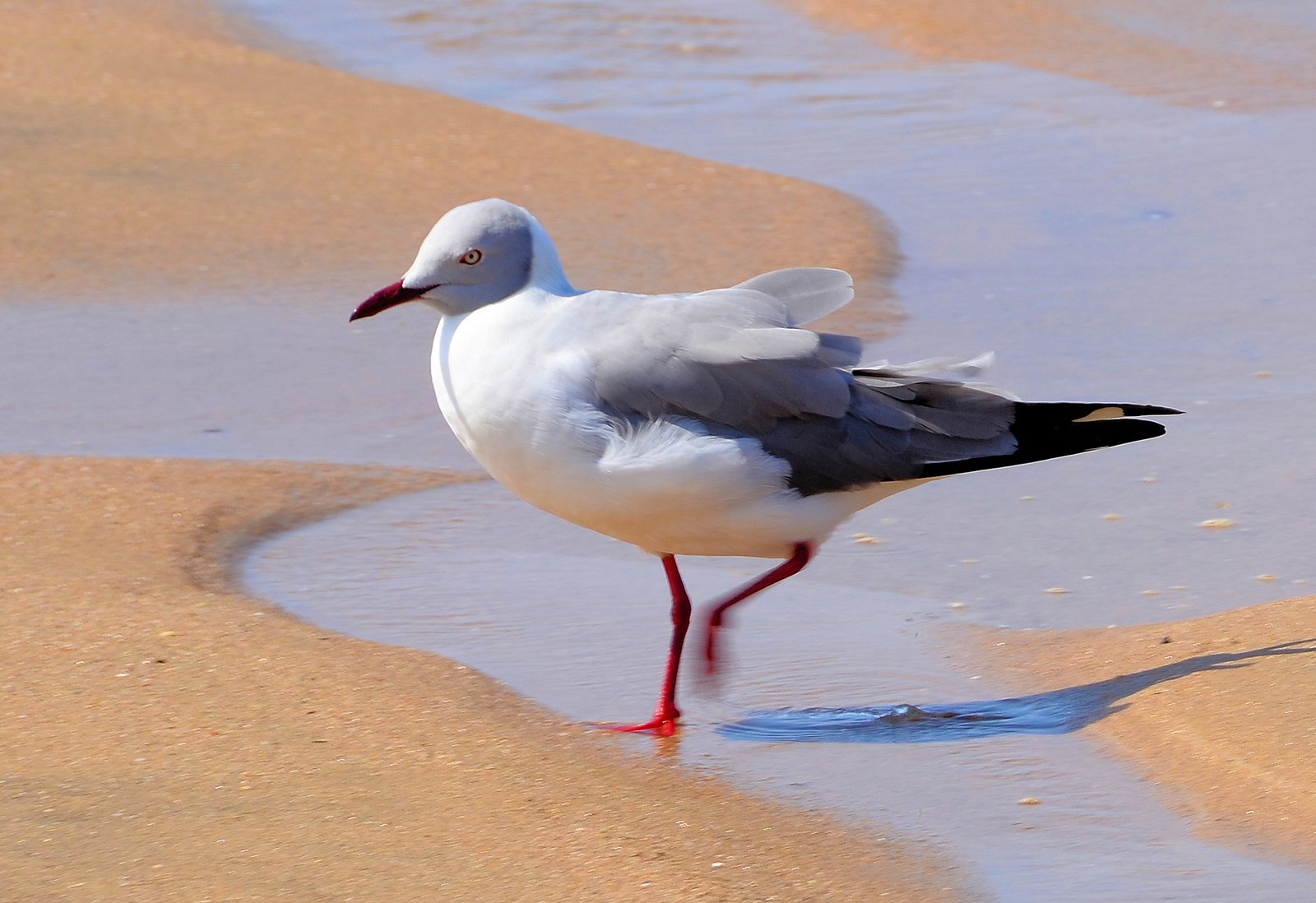
The Grey-Headed Gull is the small gull of the inland waters of southern Africa and of the east coast. In breeding plumage it is marked by a soft grey hood and pale eye; along the Western Cape coast it overlaps with the very similar Hartlaub's Gull.
Voice
A drawn-out, grating kaaarr and a hoarse kwerrk, deeper and harsher than in Hartlaub's Gull; a continuous cackling in colonies.
Recording: Fabrício Grigolin — CC BY-NC-SA 4.0 · shortened to the first 60 s, mono · xeno-canto
Identification
40–42 cm. Slightly larger and heavier than Hartlaub's Gull, with longer legs and a stouter bill. In breeding plumage it has a pale grey hood with a dark grey rear edge, a pale yellow to white iris with a red orbital ring, and a bright red bill and legs. In non-breeding plumage the hood fades to a grey wash or a dark patch behind the eye. The upperparts are mid-grey, a shade darker than in Hartlaub's Gull. The outer wing is black with two large white mirrors and a white wedge on the leading edge; the underwing is strikingly dark grey. Immatures have a brown carpal bar, a black tail band, an orange bill with a dark tip and a dark eye.
Confusion species
Hartlaub's Gull Chroicocephalus hartlaubii is smaller and slimmer, with a dark eye, a thin dark red bill and never a clear hood. Black-Headed Gull Chroicocephalus ridibundus is smaller, with a dark eye, a dark ear spot in non-breeding plumage and a white leading edge to the wing running to the wingtip, bordered only by a narrow black edge. Franklin's Gull Leucophaeus pipixcan is darker grey, with a black half-hood and a white band between the grey and the black of the wingtip.
Habitat
Large lakes, reservoirs, rivers, pans, sewage works and rubbish dumps, and on the coast estuaries, lagoons and harbours. It eats fish, insects, crustaceans and refuse, and hawks swarming insects over the water. It breeds in colonies on islets, in reedbeds and on floating vegetation in lakes and pans.
Where the bird is most at home, classified by the vegetation units of southern Africa.


Range and movements
Widespread in the east and centre of the region: on the South African highveld, in KwaZulu-Natal, along the east coast into Mozambique, in Zimbabwe, the Okavango and the Makgadikgadi Pans in Botswana, northern Namibia (Etosha) and the lakes and rivers of Zambia and Malawi; local in Angola. Also along the west coast of the Western Cape and Namibia, but scarcer there than Hartlaub's Gull. After wet spells flocks appear on temporary pans. Elsewhere in sub-Saharan Africa, especially the East African Rift and West Africa, and in South America.
- Resident
- Summer visitor (c. Oct–Mar)
- Winter visitor (c. Apr–Sep)
- Passage (Mar–Apr, Oct–Nov)
- dark = core range, pale = thinly spread
How and when to look
Easiest at the sewage works and reservoirs around Johannesburg and Pretoria, and in large numbers in the harbours of Durban and Maputo. On the Cape coast it is worth scanning flocks of Hartlaub's Gulls for a larger bird with a pale eye and a grey wash on the head.
Conservation status
Not threatened; the IUCN lists it under the older name Larus cirrocephalus. The range is large and the species benefits from reservoirs, sewage works and refuse. Colonies on pans are vulnerable to drought and disturbance, and avian influenza also affects this species.
Scientific name
Chroicocephalus cirrocephalus | (Vieillot, 1818)
Vieillot described the species in 1818 as Larus cirrocephalus; because it was later moved to another genus, the author and year stand in brackets. The genus Chroicocephalus was introduced in 1836 by Eyton. Chroicocephalus combines the Ancient Greek khrōikos 'coloured' with -kephalos '-headed'. cirrocephalus comes from Modern Latin cirrus, 'cloud' (Latin cirrus, 'curl'), and Greek -kephalos, '-headed': 'cloud-headed', for the grey head. The name is based on Azara's 'Gabiota cenicienta' (ashy gull). The specimen the first description was based on came from Brazil.