All species › Pelicans, herons and ibises › Herons and bitterns › Grey Heron
Grey Heron | Ardea cinerea
Blauwe reiger | Garza Real
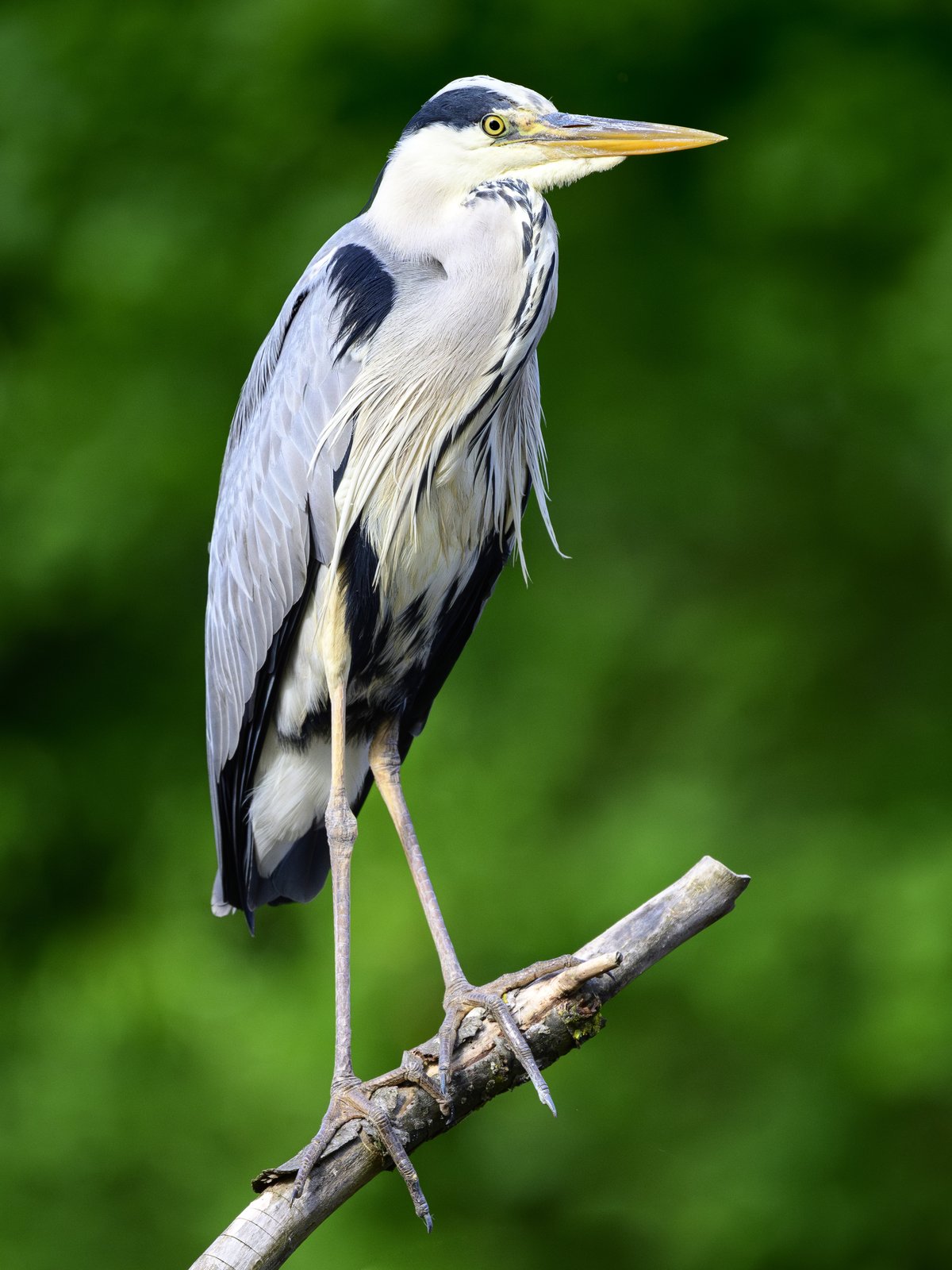
The Grey Heron is a large grey-and-white heron found almost everywhere in southern Africa where there is water with fish, from mountain streams to estuaries. Unlike the related Black-Headed Heron it is closely tied to water and hunts almost exclusively standing or wading slowly in the shallows.
Voice
A loud, hoarse fraank or kraank, mostly in flight; at the colony bill-clappering and various croaking and barking sounds.
Recording: David Darrell-Lambert — CC BY-NC-SA 4.0 · converted to mono · xeno-canto
Identification
About 100 cm. The head and neck are white, with a broad black stripe from above the eye to the nape that ends in thin black plumes; a line of black spots runs down the foreneck. The back and wings are pale grey, with a black patch at the bend of the wing. The bill is yellow, briefly orange-pink in the breeding season; the legs are yellowish brown. Juveniles are greyer on the head and neck, with a dark grey crown and a duller bill. In flight the flight feathers are black and the underwing uniform grey.
Confusion species
Black-Headed Heron Ardea melanocephala has a black crown and hindneck, dark legs and in flight a two-toned underwing with white coverts; it often feeds on dry land. Goliath Heron Ardea goliath and Purple Heron Ardea purpurea are rufous on the head and neck.
Habitat
The margins of rivers, lakes, dams, pans, vleis, fish ponds and estuaries, also rocky shores and lagoons. It stands motionless for long periods in shallow water or walks slowly, taking fish, frogs, crabs and at times rodents and young birds. It breeds colonially in tall trees, reedbeds or on rocks, often with other herons and cormorants.
Where the bird is most at home, classified by the vegetation units of southern Africa.


Range and movements
Common throughout almost the entire region wherever there is suitable water, from Angola and Zambia to the Western Cape, including the Lesotho highlands; absent only from the driest desert areas. Beyond the region in sub-Saharan Africa, Madagascar, Europe and Asia; some European breeders winter in North and West Africa.
- Resident
- Summer visitor (c. Oct–Mar)
- Winter visitor (c. Apr–Sep)
- Passage (Mar–Apr, Oct–Nov)
- dark = core range, pale = thinly spread
How and when to look
Found at almost every dam or river. Take care to separate it from Black-Headed Heron: check the head colour and, when the bird takes off, the underwing. Breeding colonies are most active in winter and early spring.
Conservation status
Not threatened; numerous in southern Africa and, if anything, increased with the building of dams and fish ponds. Sometimes persecuted at fish farms.
Scientific name
Ardea cinerea | Linnaeus, 1758
Linnaeus described the species in 1758 and placed it straight away in the genus where it still stands. He introduced the genus Ardea in that same work. Ardea is the Latin word for 'heron'. cinerea is Latin for 'ash-grey', from cinis 'ashes'. The specimen the first description was based on came from Sweden.