All species › Passerines › Wagtails and pipits › Grey Wagtail
Grey Wagtail | Motacilla cinerea
Grote gele kwikstaart | Lavandera Cascadeña
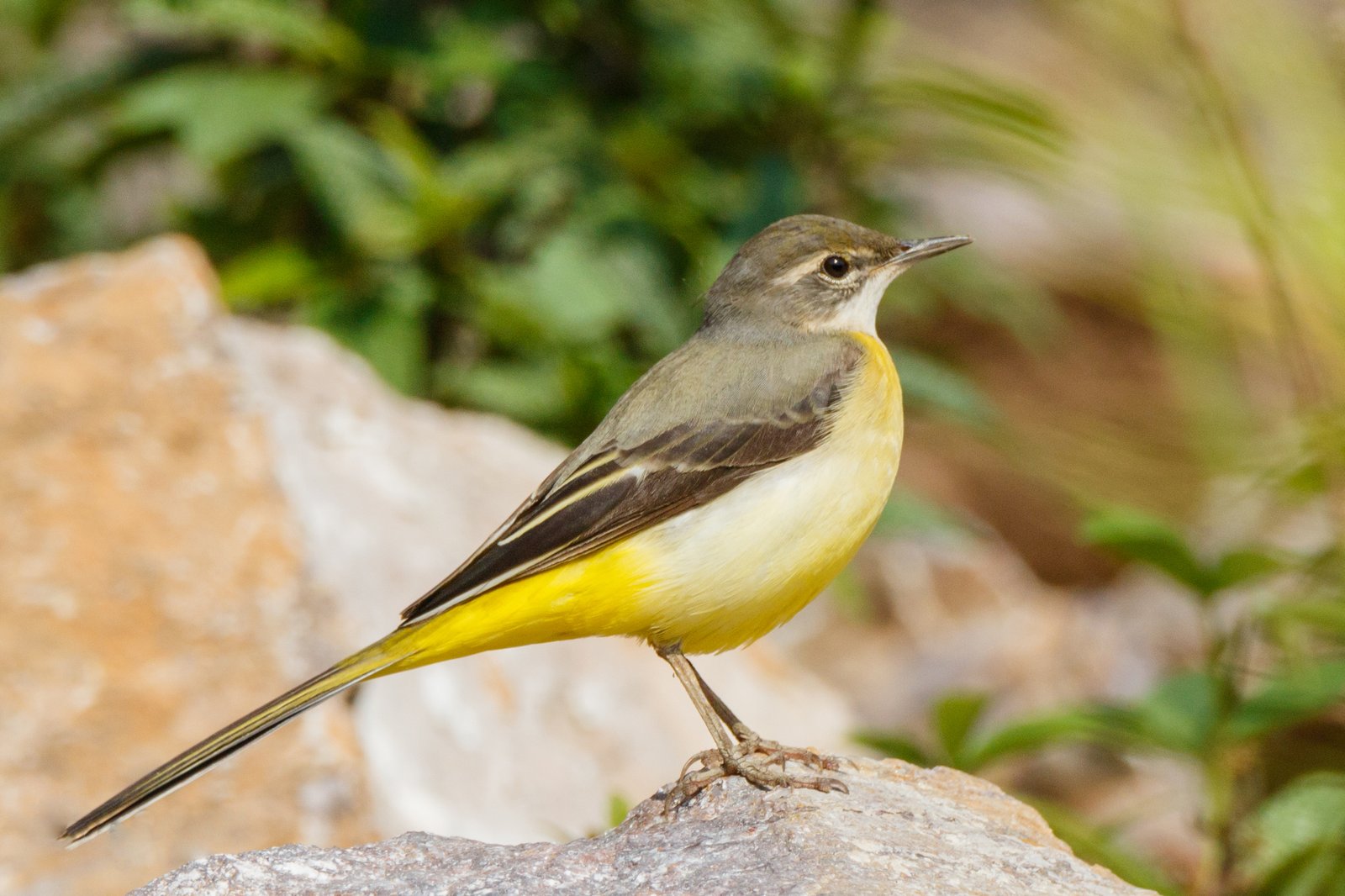
The Grey Wagtail is a scarce Palearctic migrant that winters in the north and east of the region along fast-flowing streams and rivers. The very long, incessantly wagging tail and the combination of grey back and yellow undertail make it recognisable even at a distance.
Voice
A sharp, metallic tsisit or chee-tseet, higher and harder than the call of Western Yellow Wagtail, often given in flight along the stream. Song is rarely heard in the wintering area.
Recording: Shaun Micklewright — CC BY-NC-SA 4.0 · shortened to the first 60 s, mono · xeno-canto
Identification
18 to 19 cm, with the longest tail of the yellow wagtails. The upperparts are slate-grey, the rump and uppertail coverts bright yellow-green. White supercilium and moustachial stripe. In winter plumage the underparts are pale yellow to whitish, with bright yellow undertail coverts; males acquire a black throat from February. The wings are blackish, showing a white wing bar in flight. The legs are flesh-coloured, not black.
Confusion species
Western Yellow Wagtail (Motacilla flava) has a green or olive-brown back, a shorter tail and black legs, and lives in flocks on grassland and shores, not along forest streams. Mountain Wagtail (Motacilla clara) has no yellow but a black breast band and a white wing panel. Cape Wagtail (Motacilla capensis) is browner, with a breast band and no yellow on rump and undertail.
Habitat
Rocky, fast-flowing streams and rivers, often in forest, mountain gorges and at waterfalls; also dam spillways, weirs and sewage works. Usually solitary and often faithful to a fixed wintering site.
Where the bird is most at home, classified by the vegetation units of southern Africa.


Range and movements
Winters in small numbers in Malawi, northern and eastern Zambia, the Eastern Highlands of Zimbabwe and central Mozambique. Rare but annual in South Africa, mainly in KwaZulu-Natal, Mpumalanga and the Eastern and Western Cape; a vagrant to Namibia and elsewhere in the west. Breeds in Europe, north-west Africa and much of Asia, and winters south to East Africa and southern and south-eastern Asia.
- Summer visitor (c. Oct–Mar)
- Passage (Mar–Apr, Oct–Nov)
- dark = core range, pale = thinly spread
How and when to look
Search at waterfalls and rapids in the Eastern Highlands, on the Nyika Plateau or on Mulanje. In South Africa wintering birds sometimes return to the same site for several years in a row. For any yellow wagtail along a stream, check leg colour and tail length.
Conservation status
Not threatened. Large range and stable population; the region lies at the southern edge of the wintering range.
Scientific name
Motacilla cinerea | Tunstall, 1771
Tunstall described the species in 1771 and placed it straight away in the genus where it still stands. The genus Motacilla was introduced in 1758 by Linnaeus. Motacilla was the Roman name for the wagtail; it is really a diminutive of motare 'to move about', but from medieval times -cilla was wrongly taken to mean 'tail'. cinerea is Latin for 'ash-grey', from cinis 'ashes', after the grey upperparts. The specimen the first description was based on came from Wycliffe, England.