All species › Turacos › Turacos › Guinea Turaco
Guinea Turaco | Tauraco persa
Groene toerako | Turaco de Guinea
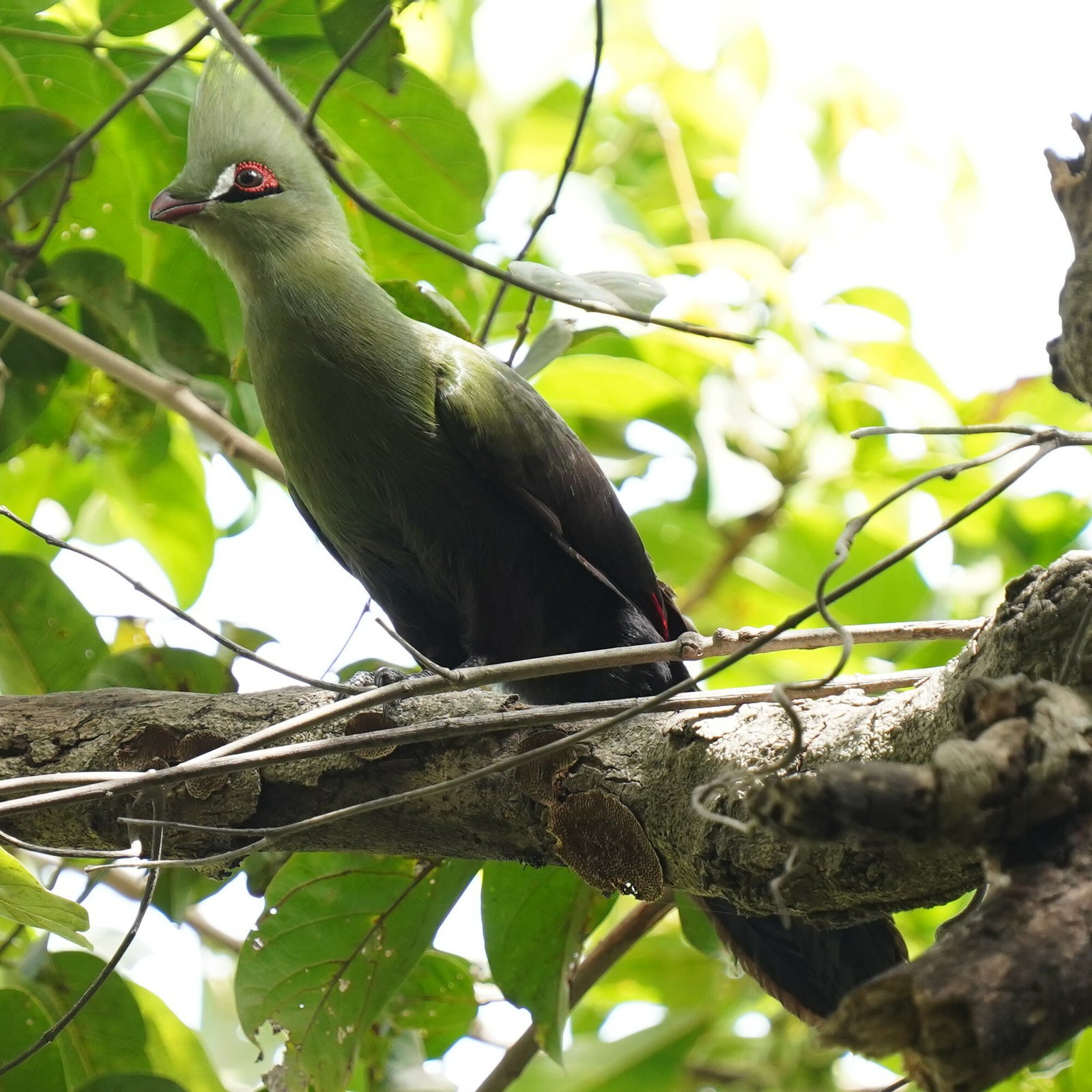
The Guinea Turaco is a West and Central African forest turaco that within the region reaches only northern Angola. It is a grass-green bird with a rounded green crest and, like its relatives, crimson flight feathers that become visible only in flight.
Voice
A deep, hoarse, fast kaw-kaw-kaw-kaw, accelerating and ending in a growling cackle; several birds often answer one another.
Recording: Marc Languy — CC BY-NC-SA 4.0 · converted to mono · xeno-canto
Identification
About 40 to 43 cm, with a long tail. Head, crest, neck and breast are grass-green; the crest is rounded and lacks the long white tips of Schalow's Turaco. In front of the eye is a small black spot with a white line above it, and a white line runs below the eye; eye-ring and bill are red. Back, wings and tail are glossy blue-violet. The primaries are crimson. Sexes alike. It moves nimbly through the dense canopy and glides short distances between trees.
Confusion species
Schalow's Turaco (Tauraco schalowi), which lives in the interior of Angola, has a much longer, pointed crest with clear white tips. Red-Crested Turaco (Tauraco erythrolophus) has a red crest and a white face. Great Blue Turaco (Corythaeola cristata) is much larger and blue.
Habitat
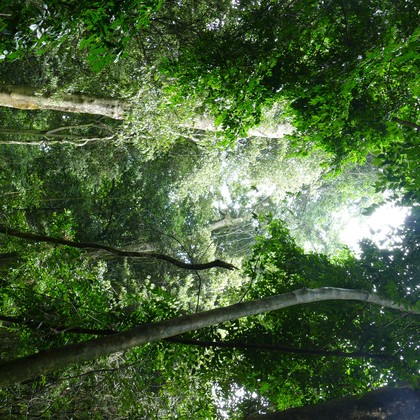
Lowland rainforest, gallery forest, secondary forest, forest edges and plantations with shade trees. It eats mainly fruit, also leaves and flowers.
Where the bird is most at home, classified by the vegetation units of southern Africa.

Range and movements
Within the region only in north-western Angola: Cabinda and Zaire and Uíge provinces, to about northern Cuanza Norte. Beyond the region from Senegal and Gambia along the West African forest belt to Ghana, and again from Nigeria and Cameroon to Gabon, Congo-Brazzaville and western DR Congo.
- Resident
- dark = core range, pale = thinly spread
How and when to look
In the region best looked for in the Mayombe forest of Cabinda and the forest remnants of Uíge. Listen for the hoarse chorus and watch for a green shape running along branches; the red wing appears as it crosses openings.
Conservation status
Not threatened and common over much of its range. Locally sensitive to deforestation and to the trade in live birds and feathers.
Scientific name
Tauraco persa | (Linnaeus, 1758)
Linnaeus described the species in 1758 as Cuculus Persa; because it was later moved to another genus, the author and year stand in brackets. The genus Tauraco was introduced in 1779 by Kluk. Tauraco is a Latinised form of 'touraco', a name that imitates the bird's call and was already in use among European travellers in West Africa in the eighteenth century. persa is Latin for 'Persian'; why Linnaeus gave this West African bird that name is unclear. The specimen the first description was based on came from Gold Coast (Ghana).