All species › Turacos › Turacos › Livingstone's Turaco
Livingstone's Turaco | Tauraco livingstonii
Livingstones toerako | Turaco de Livingstone
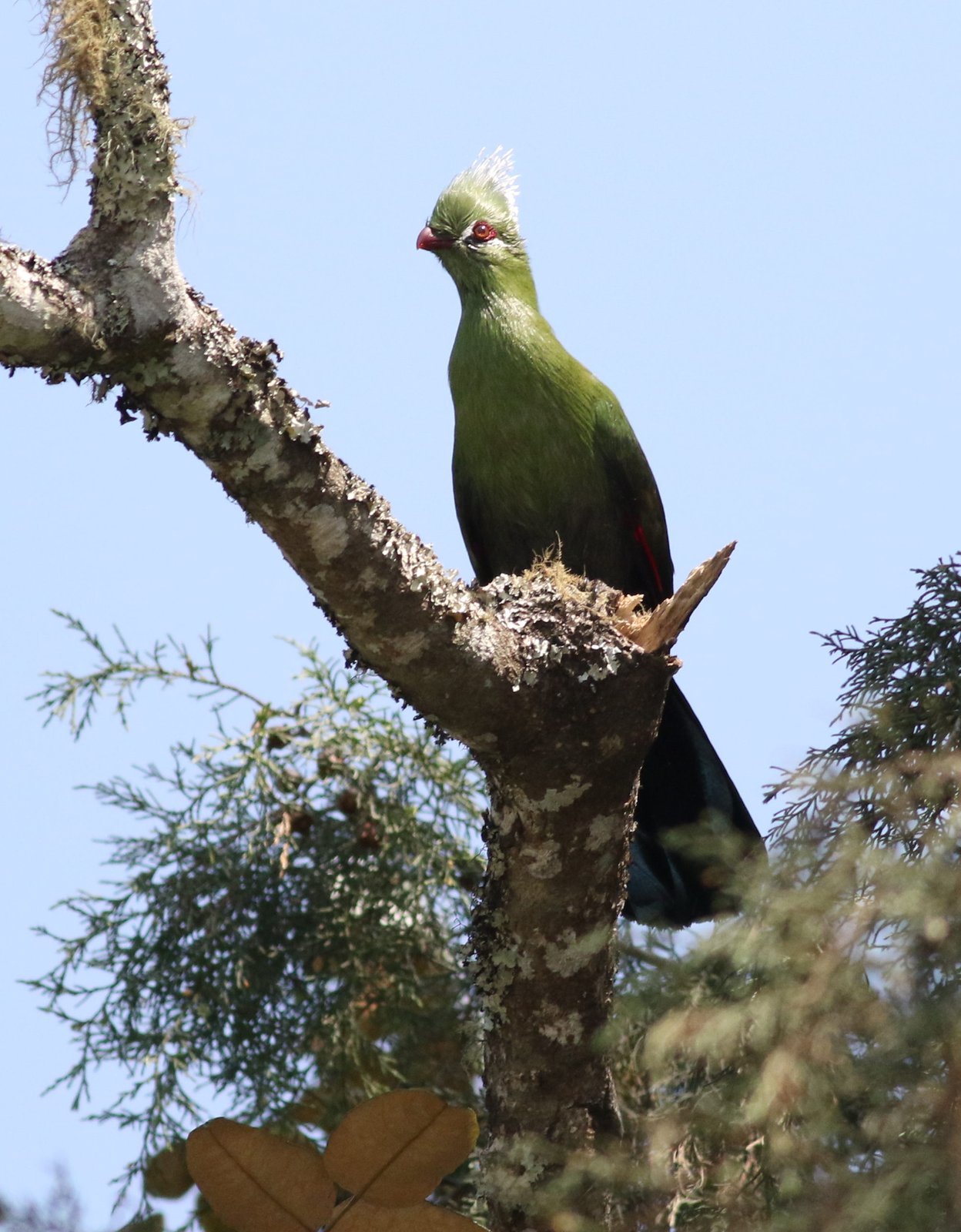
Livingstone's Turaco is the northern counterpart of the Knysna Turaco: a grass-green forest bird with a notably long, pointed, white-tipped crest and crimson flight feathers that show only in flight. It is tied to evergreen forest, from lowland riverine forest to montane forest in the eastern highlands.
Voice
A loud, hoarse, barking kow-kow-kow-kow-kow that swells and fades and carries far through the forest; neighbours often answer one another. Also a short growling krrrr when disturbed.
Recording: Rick Nuttall — CC BY-NC-SA 4.0 · shortened to the first 60 s, mono · xeno-canto
Identification
About 40–45 cm long, with a long tail. Head, neck and breast are bright grass green; the tall, tapering crest is green with a broad white fringe at the tip. White lines in front of and below the eye frame a red eye-ring, and the bill is orange-red. Back and wing coverts are blue-green to dark blue with a metallic sheen, and the tail is dark bluish violet. In flight the crimson primaries flash brightly. The sexes are alike; juveniles have a shorter crest and a duller bill. It runs and hops nimbly along branches and glides on short wingbeats from crown to crown.
Confusion species
The Knysna Turaco (Tauraco corythaix) is almost identical but has a shorter, more rounded crest with narrower white tips; the ranges do not overlap. Schalow's Turaco (Tauraco schalowi) of Zambia and Angola has an even longer, thin crest that droops backwards. The Purple-Crested Turaco (Gallirex porphyreolophus) shares the same forest but has a violet crest without white markings and green-and-purple plumage.
Habitat
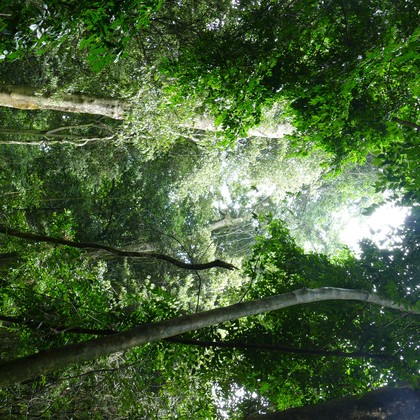
Evergreen riverine forest, lowland and montane forest, dense growth in ravines and on wooded mountain slopes, up to about 2000 m. It forages in the canopy on fruit, especially wild figs, and also on leaves, buds and flowers.
Where the bird is most at home, classified by the vegetation units of southern Africa.


Range and movements
Within the region in eastern Zimbabwe (the Eastern Highlands around Nyanga, Vumba and Chimanimani), in central and northern Mozambique and in much of Malawi, locally also along lowland rivers. Beyond the region in Tanzania and Burundi.
- Resident
- Summer visitor (c. Oct–Mar)
- Passage (Mar–Apr, Oct–Nov)
- dark = core range, pale = thinly spread
How and when to look
Heard far more often than seen. Follow the barking call at first light and search fruiting trees for a green shape running along a branch. Good sites are the Vumba and Bvumba area in Zimbabwe, the riverine forests of Gorongosa in Mozambique and the forests of Zomba and Mulanje in Malawi. The red in the wing is best seen when the bird glides across a clearing.
Conservation status
Not threatened and locally common in suitable forest. Clearance of riverine and montane forest for farming and firewood causes local declines; the species persists in wooded gardens and plantations with old trees.
Scientific name
Tauraco livingstonii | Gray, 1864
Gray described the species in 1864 as Turacus livingstonii; because it was later moved to another genus, the author and year stand in brackets. The genus Tauraco was introduced in 1779 by Kluk. Tauraco is a Latinised form of 'touraco', a name that imitates the bird's call and was already in use among European travellers in West Africa in the eighteenth century. livingstonii honours Charles Livingstone (1821–1873), brother of the explorer David Livingstone and a member of his Zambezi expedition. The specimen the first description was based on came from Manganja Highlands (Shire Highlands), Malawi.