All species › Turacos › Turacos › Knysna Turaco
Knysna Turaco | Tauraco corythaix
Knysnaturako | Turaco de Knysna
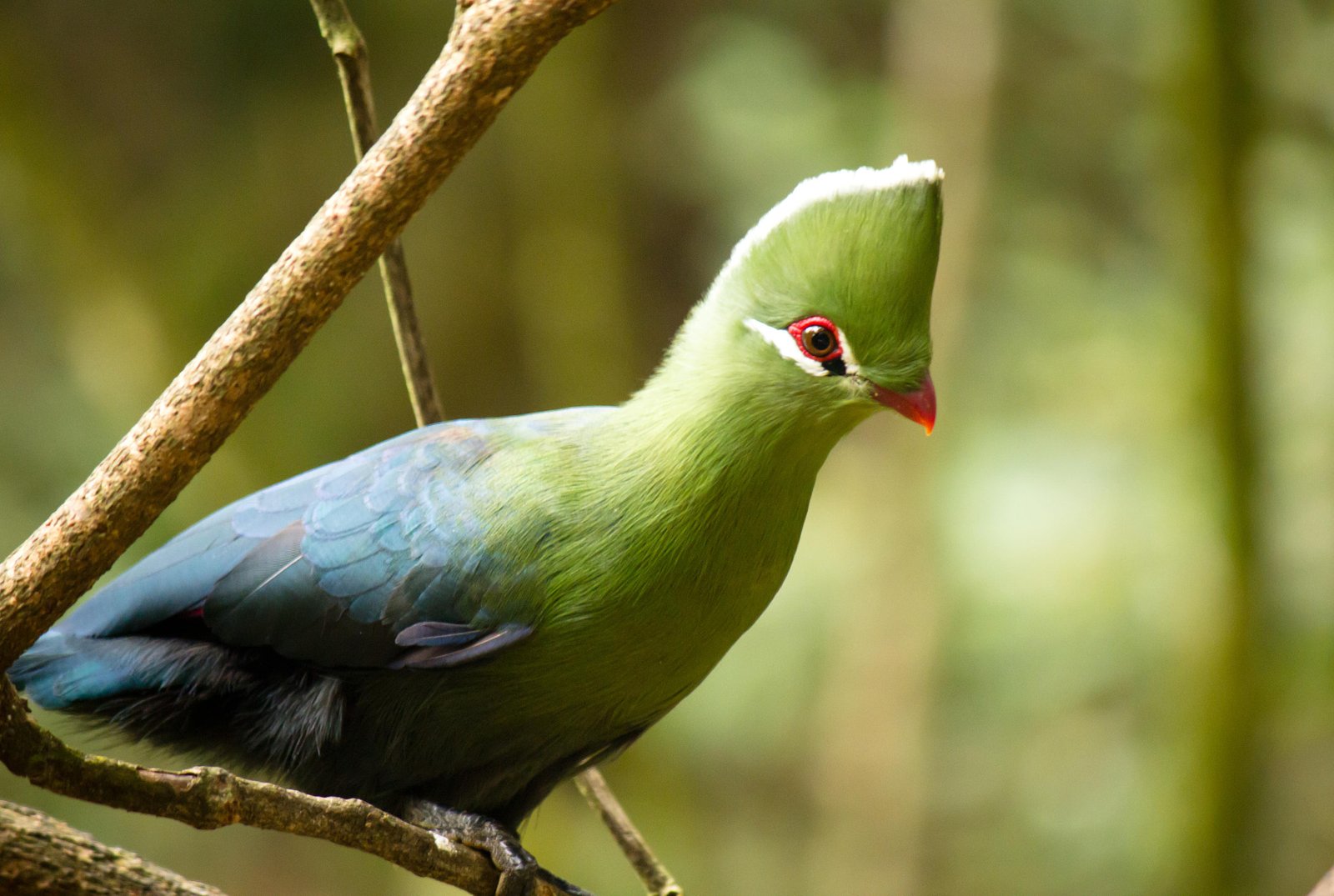
The Knysna Turaco is a grass-green forest bird with a white-tipped crest and a long tail, which shows its crimson flight feathers only in flight. That red comes from turacin, a copper-based pigment found only in turacos.
Voice
A loud, deep, barking kow-kow-kow-kow, accelerating and falling in pitch, carrying far through the forest. Neighbours take up the call, so it travels along the valley. Also a growling krrr between partners.
Recording: Walter Wallner — CC BY-NC-SA 4.0 · shortened to the first 60 s, mono · xeno-canto
Identification
About 40 to 42 cm long, nearly half of it tail. Head, neck and breast are grass-green, with a tall green crest tipped white, a white line below the eye and a short white line in front of it, a crimson eye-ring and a red bill. Back and wings are blue-green, the long tail blue-purple. The primaries are crimson and flash only when the wings are spread. Sexes alike. It moves through the canopy by running along branches and gliding from tree to tree.
Confusion species
Livingstone's Turaco (Tauraco livingstonii) of eastern Zimbabwe, Mozambique and Malawi has a longer, more pointed crest with a broader white tip; the ranges do not overlap. Purple-Crested Turaco (Gallirex porphyreolophus) shares the same eastern forests but has a glossy violet crest, no white facial markings, and green-and-purple rather than uniformly green plumage.
Habitat
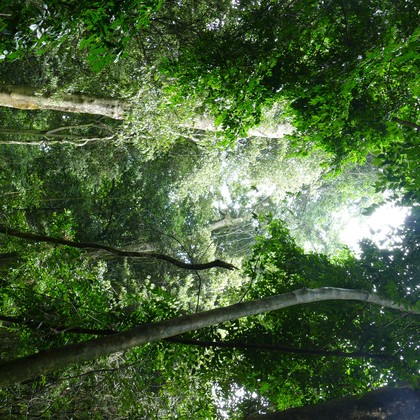
Evergreen Afromontane and coastal forest, dense riverine bush and well-wooded gardens at the forest edge. Forages high in the canopy on fruit, especially wild figs, and also on flower buds and leaves.
Where the bird is most at home, classified by the vegetation units of southern Africa.

Range and movements
Endemic to southern Africa. The species occupies the forest belt of the south and east coasts and the escarpment, from about Mossel Bay eastwards along the Garden Route and the Eastern Cape forests, on through KwaZulu-Natal and Eswatini and into the Mpumalanga and Limpopo escarpment. Further north, from Zimbabwe onwards, it is replaced by Livingstone's Turaco.
- Resident
- Summer visitor (c. Oct–Mar)
- Passage (Mar–Apr, Oct–Nov)
- dark = core range, pale = thinly spread
How and when to look
The bird is heard far more often than seen. Listen for the barking call at first light, then scan the canopy for a green shape running along a branch; the red in the wing shows only as it glides across a clearing or a forest road. Fruiting fig trees give the best chance. The forests around Knysna, Tsitsikamma and Nature's Valley lie in the core of the range.
Conservation status
Not threatened. The species depends on forest, but much of that forest lies within protected state forest and reserves. Fragmentation of small forest patches, and in the past hunting for the red flight feathers and crest plumes, play a local role. The bird also holds on in well-wooded suburbs and gardens beside forest.
Scientific name
Tauraco corythaix | (Wagler, 1827)
Wagler described the species in 1827 as Spelectos Corythaix; because it was later moved to another genus, the author and year stand in brackets. The genus Tauraco was introduced in 1779 by Kluk. Tauraco is a Latinised form of 'touraco', a name that imitates the bird's call and was already in use among European travellers in West Africa in the eighteenth century. corythaix comes from the Greek korythaix, 'helmet-shaking' (from korys/korythos, 'helmet', and aissein, 'to shake') — for the prominent, erectile crest on the head. The same root appears in Corythaeola, the genus name of the great blue turaco. The specimen the first description was based on came from Knysna, Cape Province.