All species › Passerines › Sunbirds › Johanna's Sunbird
Johanna's Sunbird | Cinnyris johannae
Groenkruinhoningzuiger | Suimanga de Johanna
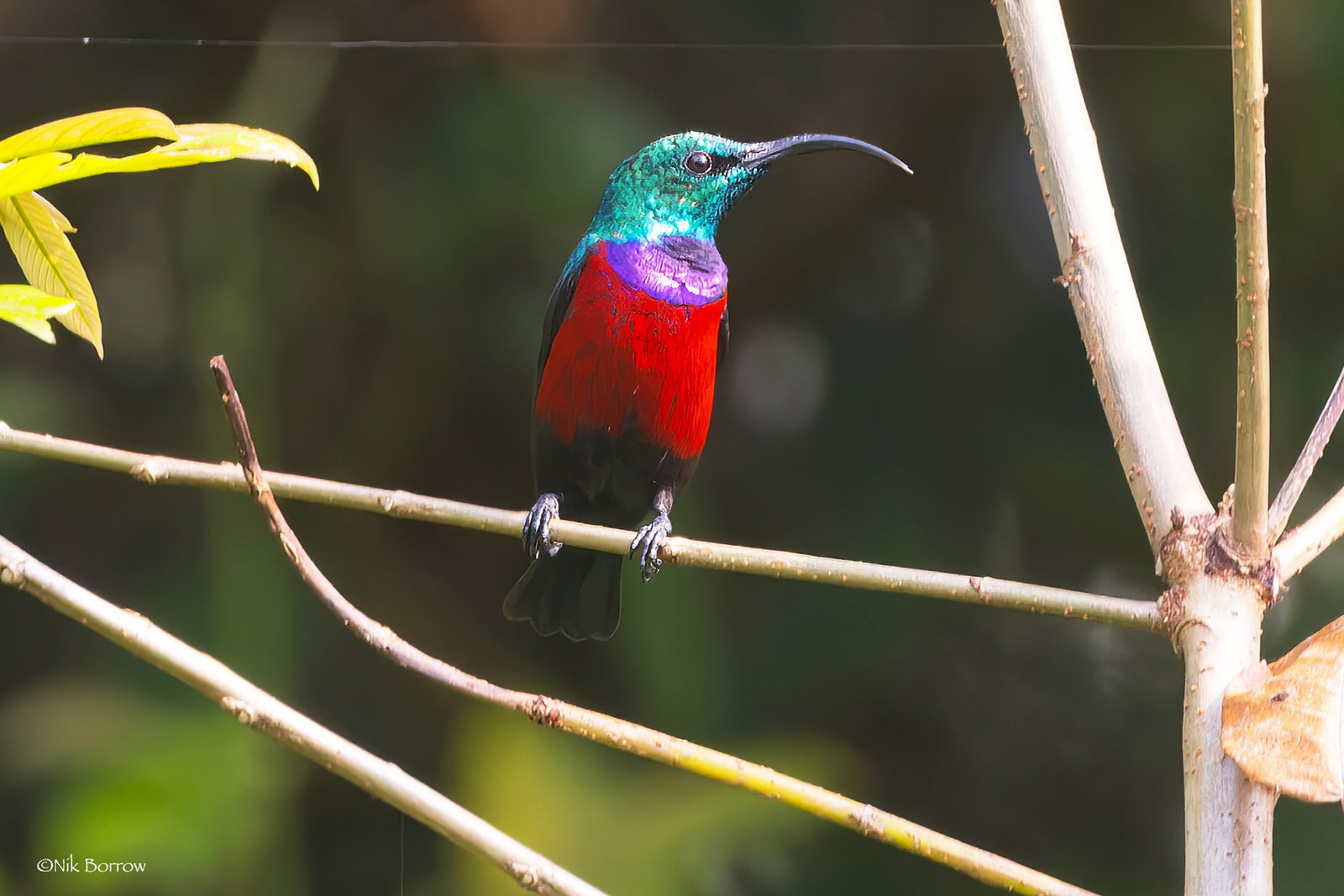
Johanna's Sunbird is a large, long-billed sunbird of the lowland rainforest of West and Central Africa that reaches the region only in extreme north-western Angola. The male has a metallic green head and throat above a scarlet breast; the female is strikingly streaked.
Click a thumbnail to switch the photo above.
Voice
A sharp, metallic tchik, often repeated. The song is a short, fast and high series of high notes, interspersed with scratchy notes.
Recording: Étienne Leroy — CC BY-NC-SA 4.0 · converted to mono · xeno-canto
Identification
13 to 14 cm, with a long, heavy, decurved bill. The male has a glossy metallic green crown, back and throat, then a narrow violet band and a bright scarlet breast that shades into dark maroon to blackish on the belly; the pectoral tufts are yellow. The female is olive-green above with a pale supercilium, and yellow below with heavy dark streaking across breast and belly, a pattern unusual among the sunbirds of this forest.
Confusion species
Superb Sunbird (Cinnyris superbus) is larger, with a violet-blue rather than green throat and deep maroon-red underparts; its female is unstreaked yellow with an orange undertail. Olive-Bellied Sunbird (Cinnyris chloropygius) is much smaller, with a short bill, a narrow red band and an olive-green belly. The heavily streaked female is the best key to the species.
Habitat
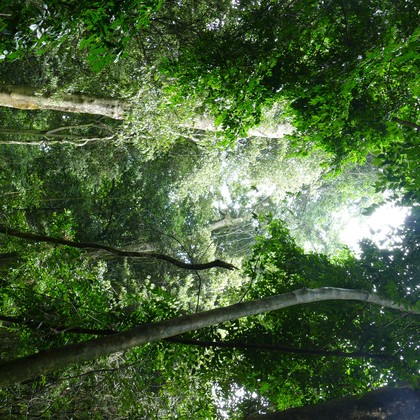
Edges and clearings of moist lowland forest, mature secondary forest, gallery forest and well-wooded plantations; it usually feeds in the middle and upper strata at flowering trees and creepers.
Where the bird is most at home, classified by the vegetation units of southern Africa.

Range and movements
Within the region only in extreme north-western Angola, in the Cabinda enclave and possibly in the forest belt of the northern interior; data are scarce. Beyond the region from Sierra Leone and Liberia along the Gulf of Guinea to Cameroon, Gabon, Congo and DR Congo.
How and when to look
A species of the Cabinda rainforest (Mayombe); without a visit to the enclave the chance of a record within the region is small. Watch flowering trees at forest edges; with a green-headed, red-breasted male check the throat colour, and with females look for the heavy streaking.
Conservation status
Not threatened. Fairly common across its large range; within the region vulnerable to logging and deforestation in northern Angola.
Scientific name
Cinnyris johannae | Verreaux & Verreaux, 1851
Verreaux & Verreaux described the species in 1851 and placed it straight away in the genus where it still stands. The genus Cinnyris was introduced in 1816 by Cuvier, GLCFD. Cinnyris derives from the Greek kinnuris, the name of a small bird mentioned by the lexicographer Hesychius that cannot be identified further. johannae honours Johanna Verreaux, wife of the French naturalist Édouard Verreaux, who described the species with his brother Jules. The specimen the first description was based on came from Gabon.