All species › Passerines › Sunbirds › Superb Sunbird
Superb Sunbird | Cinnyris superbus
Prachthoningzuiger | Suimanga Soberbio
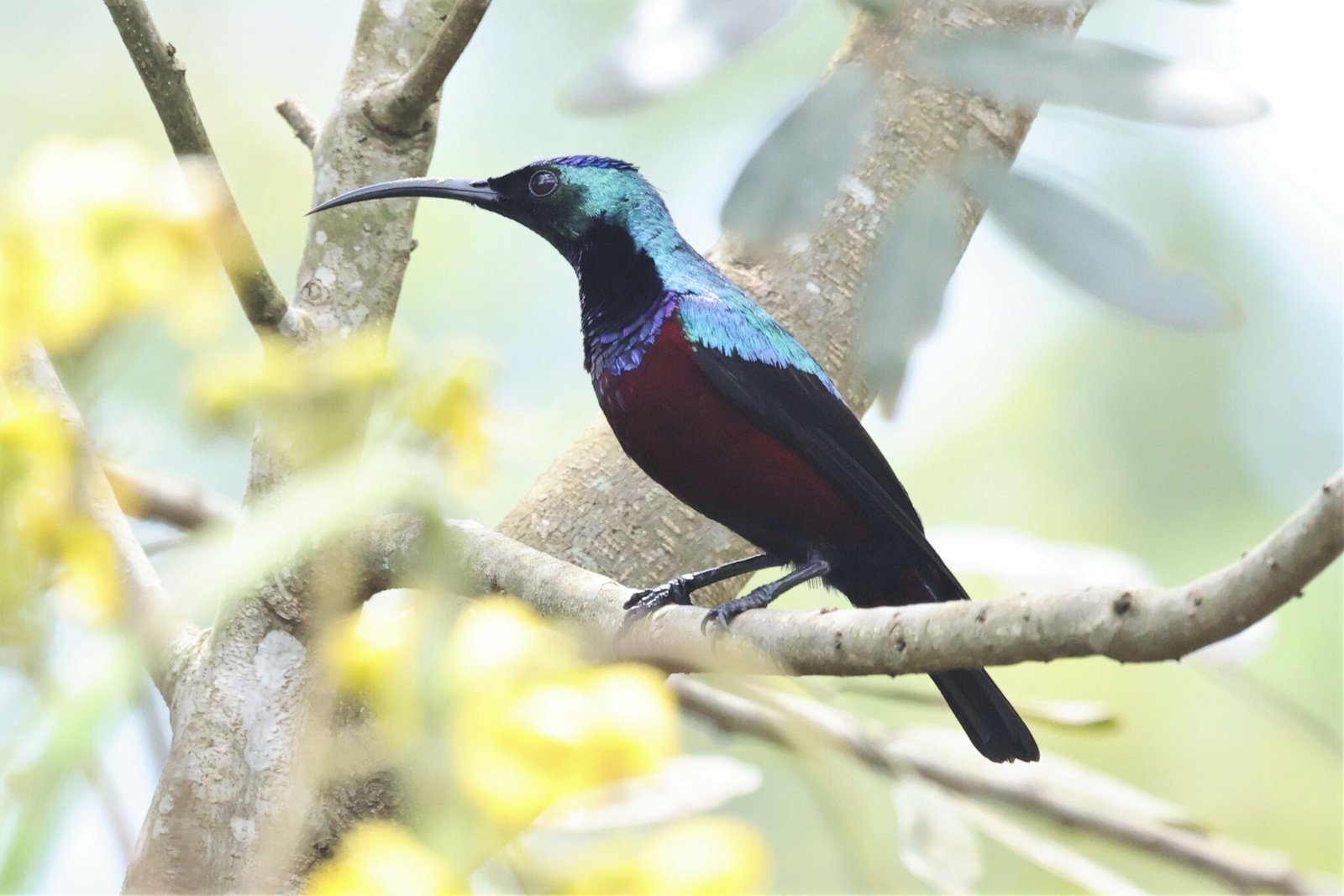
The Superb Sunbird is the largest and heaviest Cinnyris sunbird in the region, a bird of forest edges in northern Angola. The male has a glossy violet-blue throat and deep maroon-red breast and belly; the bill is strikingly long.
Voice
A sharp, loud tchip or tcheek. The song is a short, irregular series of high and scratchy notes, less fluent than in most relatives.
Recording: Étienne Leroy — CC BY-NC-SA 4.0 · converted to mono · xeno-canto
Identification
14 to 16 cm, with a very long, heavy, decurved bill; the male is clearly larger than the female. The male has a metallic green crown and back, a glossy violet-blue throat and upper breast and, below that, deep maroon to chestnut-red breast and belly; in poor light the whole underside looks black. The female is olive-green above with a pale supercilium, and yellow below without streaks, with orange to rufous undertail coverts.
Confusion species
Johanna's Sunbird (Cinnyris johannae) is smaller, with a green throat and a brighter scarlet breast; its female is heavily streaked. Copper Sunbird (Cinnyris cupreus) is smaller and glossed coppery with a black belly. The unstreaked yellow female with an orange undertail and a long bill is distinctive.
Habitat
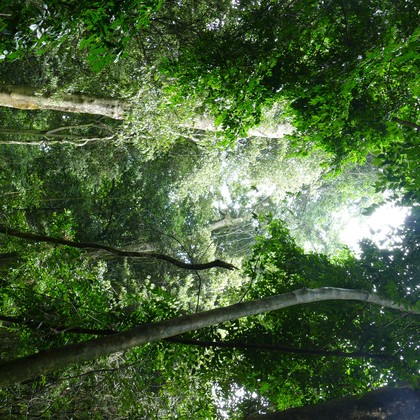
Edges and clearings of moist lowland forest, gallery forest, secondary forest, overgrown plantations and gardens near forest; it often feeds high in flowering trees, also at Erythrina and banana flowers.
Where the bird is most at home, classified by the vegetation units of southern Africa.

Range and movements
Within the region only in northern Angola: Cabinda and the forest belt of the northern provinces, south to about Cuanza Norte and east to the Lunda provinces. Beyond the region from Sierra Leone along the Gulf of Guinea to Cameroon, Gabon, Congo, DR Congo, Uganda, western Kenya and north-western Tanzania.
- Resident
- dark = core range, pale = thinly spread
How and when to look
Best in Cabinda and the forests of Uíge and Cuanza Norte, at flowering trees along forest edges and in old coffee plantations. Note the size and the extremely long bill: no other sunbird in that forest is as large and dark.
Conservation status
Not threatened. Fairly common across its large range; declining locally in northern Angola through forest loss.
Scientific name
Cinnyris superbus | (Shaw, 1809)
Shaw described the species in 1809 as Certhia superba; because it was later moved to another genus, the author and year stand in brackets. The genus Cinnyris was introduced in 1816 by Cuvier, GLCFD. Cinnyris derives from the Greek kinnuris, the name of a small bird mentioned by the lexicographer Hesychius that cannot be identified further. superbus is Latin for 'superb, splendid', for the brilliantly coloured male. The specimen the first description was based on came from Malembo, Cabinda, Angola.